

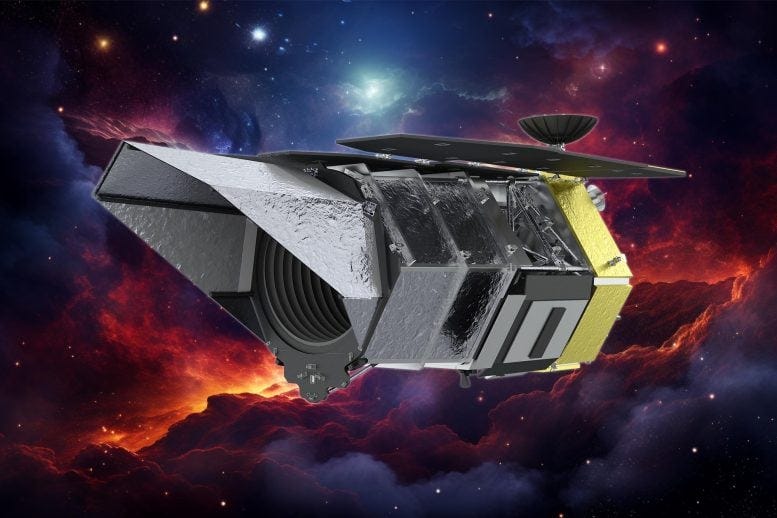
NASA’s Nancy Grace Roman Space Telescope
The era of stargazing is undergoing a radical transformation as humanity prepares to move past the traditional constraints of space-based astronomy. For decades, flagship observatories like the Hubble Space Telescope and the James Webb Space Telescope have operated like cosmic microscopes, peering deep into incredibly narrow fields of view to study isolated galaxies and singular deep-space anomalies.
A new generation of tech is about to flip this script entirely, prioritizing immense cosmic breadth without sacrificing resolution. By building instruments capable of mapping giant swathes of the sky in a single glance, astronomers are moving from studying individual cosmic specimens to charting the true macro-structure of the universe.
At the absolute forefront of this revolution is NASA’s Nancy Grace Roman Space Telescope, which has just been fully fueled with hundreds of gallons of hydrazine at the Kennedy Space Center in Florida ahead of its highly anticipated liftoff aboard a SpaceX Falcon Heavy rocket. Named after NASA’s first chief of astronomy, this state-of-the-art observatory matches Hubble’s giant primary mirror but integrates a staggering three-hundred-megapixel wide-field camera.
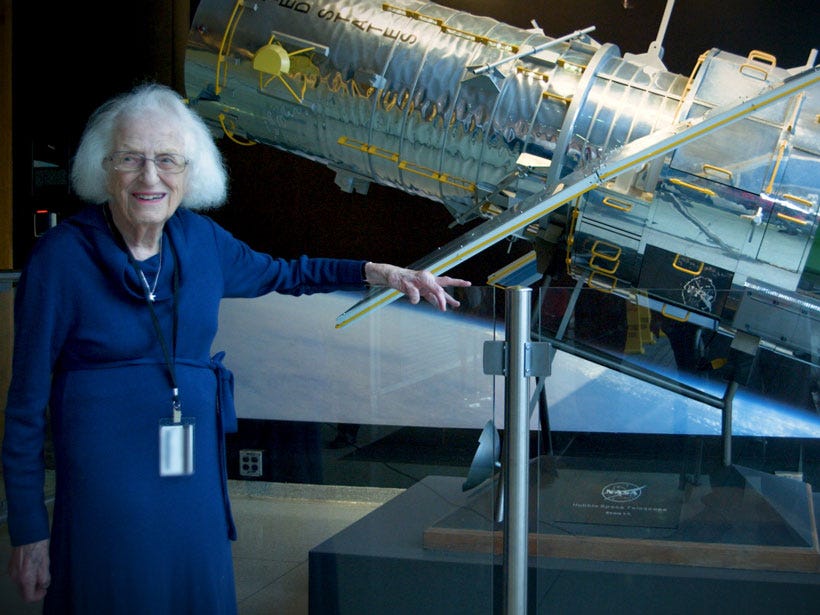
NASA’s first chief of astronomy Nancy Grace Roman (May 16, 1925 – December 25, 2018). She was the "Mother of Hubble" and made major discoveries in stellar research. Here pictured in front of a scale model of Hubble.
This engineering marvel grants the telescope a field of view one hundred times greater than Hubble’s, allowing it to capture massive panoramic vistas of the cosmos up to one thousand times faster. Over its initial five-year mission, it will stream a terabyte of data back to Earth every single day, effectively mapping dark matter distribution, tracking dark energy expansion, and cataloging thousands of hidden exoplanets.
While the Roman Space Telescope prepares to claim its orbital home a million miles away at the Sun-Earth Lagrange Point 2, international space agencies are drafting even more ambitious concepts for the decades to follow. The European Space Agency is actively advancing its own future fleet, while NASA has begun early conceptual work on the Habitable Worlds Observatory, a massive next-generation project slated for the late 2030s.
This future behemoth will be explicitly designed to use advanced ultra-precise mirrors to hunt for chemical signatures of life on dozens of Earth-like planets. Together with Roman’s wide-angle surveying capabilities, these upcoming machines will completely bridge the gap between finding distant worlds and determining if we are truly alone in the dark.
Ultimately, these next-gen telescopes represent a profound philosophical shift in how humanity archives the night sky. Instead of waiting years to stitch together hundreds of individual exposures to see a single neighboring galaxy, future astronomers will possess a real-time, three-dimensional map of billions of stars across the cosmic web.
The sheer influx of data will require advanced machine learning just to process the incoming imagery, turning space exploration into a collaborative effort between human curiosity and artificial intelligence. As these pristine lenses open their shutters in the coming years, they promise to reveal that the universe is far more connected, crowded, and dynamic than our narrow views have ever let us believe.
As cool as Hubble is, it was last serviced in 2009. The technology it operates on is ancient compared to what we have today.