

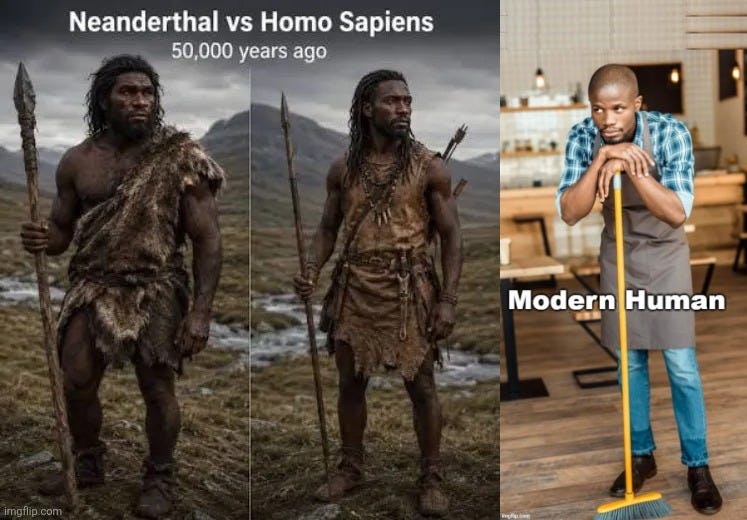
Human beings like to imagine themselves as the finished product of evolution, the polished endpoint of a long climb out of the trees and into cities of glass and steel. Yet the evidence suggests something far less flattering and far more interesting. We are still changing, sometimes in ways that look like refinement and sometimes in ways that look suspiciously like decline. The truth is messier than either pure progress or pure decay. We are evolving and, in certain respects, devolving at the same time, depending on which traits and which environments we examine.
For most of the history of life on Earth, natural selection was a brutal and efficient editor. Predators, parasites, starvation, and injury removed the majority of individuals before they could reproduce. In many wild mammal and bird populations, nine out of ten young never reach adulthood. That high death rate is not a tragedy in evolutionary terms; it is the mechanism that keeps gene pools sharp. Weak constitutions, poor immune responses, and clumsy bodies are quietly deleted from the lineage. Humans have largely stepped outside that filter.
Modern medicine, sanitation, agriculture, and the absence of large predators mean that the great majority of children in developed societies survive to reproductive age. Genes that once would have been lethal or severely disadvantageous now persist and spread. Myopia, diabetes risk alleles, immune disorders, and a host of other conditions that would have been heavily selected against in ancestral environments are far more common today. In that narrow but important sense, the protective shield of civilization has relaxed the purifying pressure that once kept our species lean.
Yet relaxed selection is not the same as no selection. Humans continue to compete intensely with one another for status, resources, and mates. Sexual selection, the preference of one sex for particular traits in the other, remains a powerful force. Across cultures, women show a consistent tendency to prefer taller men and men with more symmetrical, conventionally attractive faces. Height is partly heritable and correlated with health and developmental stability. Facial attractiveness often signals good genes and low pathogen load. One conspicuous trait that suffers under this preference is male pattern baldness.
Full heads of hair are generally rated more attractive, especially in younger men. The irony is that androgenetic alopecia is linked to higher sensitivity to dihydrotestosterone, a potent androgen. In ancestral environments, higher testosterone might have conferred advantages in muscle, dominance, or reproductive drive. By systematically favoring men who keep their hair, modern mate choice may be selecting, on average, for somewhat lower androgen activity. Whether that counts as an improvement or a subtle softening depends on the environment one imagines as ideal.
Intelligence presents another paradox. High cognitive ability is one of the strongest predictors of educational attainment, income, and long-term health, and it is substantially heritable. Yet in many social settings, especially during the years when people form pair bonds, very high intelligence can be perceived as socially awkward, intimidating, or simply unsexy. The result is a mild but persistent tendency for the most intellectually gifted individuals to have fewer children on average than those of more moderate ability.
At the same time, monetary success exerts a strong counter-pressure. In nearly every society that has been studied, higher income and status increase a man’s desirability as a long-term partner. Because intelligence and conscientiousness contribute to economic success, some of the genes associated with those traits continue to be favored indirectly through the marketplace of status.
Diet adds another layer of complication. For most of human history, the ability to store fat efficiently was a profound advantage. Periods of scarcity were common, and individuals who could lay down energy reserves when food was available were more likely to survive lean seasons and support offspring. That same metabolic machinery now operates in an environment of constant caloric abundance and ultra-processed food.
The result is widespread obesity, which reduces physical attractiveness, lowers fertility in both sexes, and increases the risk of a cascade of chronic diseases. A trait that was once adaptive has become costly in the novel environment we have created. Evolution does not anticipate future conditions; it only rewards what works in the present. When the present changes faster than genes can track, mismatches accumulate.
The history of ideas about human breeding is itself a cautionary tale. In the late nineteenth and early twentieth centuries, the rediscovery of Mendel’s laws of inheritance fueled a wave of enthusiasm for eugenics. Reformers and scientists alike believed that complex social behaviors, intelligence, and moral character could be attributed to single genes and improved by selective breeding or sterilization. Those beliefs were not only ethically catastrophic; they were scientifically naive.
Most behavioral and cognitive traits are highly polygenic, influenced by thousands of genetic variants of tiny effect, and deeply entangled with environment, culture, and chance. The crude genetic determinism of early eugenics collapsed under the weight of better data. Twin studies, adoption studies, and later genomic research showed that while heritability is real, the pathway from gene to complex trait is almost never simple.
Yet the underlying Mendelian reality remains. Humans are animals. Our genomes respond to selection pressures in the same way as those of dogs, cattle, or fruit flies. If a trait varies, is heritable, and affects reproductive success, it will change in frequency over generations. The fact that we find the idea of deliberately breeding humans morally repugnant does not alter the biology. Mate choice, differential fertility, migration, and differential survival still reshape allele frequencies every generation.
In some parts of the world, cultural practices intensify the process in unexpected directions. Consanguineous marriage, particularly between first cousins, remains common in parts of the Middle East, North Africa, and South Asia, reaching fifty percent of all unions in certain communities. Such patterns increase the expression of rare recessive disorders and slightly reduce average genetic diversity within those populations, another form of localized evolutionary change driven by culture rather than by predators or famine.
Taken together, the picture is neither comforting nor apocalyptic. We are not sliding into a dysgenic abyss, nor are we ascending toward some superior future form. Medical technology and social safety nets have reduced the death rate of the young and allowed a wider range of genotypes to reproduce. Sexual selection continues to favor certain physical and status markers while neglecting or even penalizing others.
Cultural practices such as cousin marriage and the economic premium placed on cognitive ability pull in different directions. Our bodies, shaped for scarcity, now navigate abundance and pay a metabolic price. The net effect is a species still very much in motion, subject to forces both ancient and novel.
The most honest conclusion is that humans are evolving in some traits and experiencing relaxed or reversed selection in others. The absence of the old filters of predation and untreated disease has changed the rules, but competition among ourselves for mates and resources has not disappeared. Evolution does not stop when the environment becomes safer; it simply changes the criteria by which it judges success.
Looking further ahead, the next thousand years are likely to be shaped less by famine and predators and more by the pressures we create ourselves. Assortative mating by education and income may slowly concentrate certain cognitive and personality traits, while medical technology continues to blunt the costs of once-harmful genes.
If space settlement becomes routine, small founder populations living under different gravity, radiation, and social conditions could begin to diverge in subtle ways. A million years is a different scale entirely. Over that span even modest differences in reproductive success can compound into major change, and isolation between planetary populations could produce genuine speciation.
Bodies might grow taller or more gracile in low-gravity worlds, immune systems could shift under novel pathogens, and brains might adapt to environments saturated with information and artificial minds. Or, if technology ever grants us full control over our own genomes, the very notion of passive evolution could give way to deliberate design. In either case we remain a work in progress, shaped by the choices we make, the partners we prefer, the foods we eat, and the technologies that keep more of us alive long enough to pass on our genes, for better and for worse.
I'm not even that old and it's startling to see the amount of allergies/autoimmune diseases in kids these days when such things were unheard-of when I grew up. The same goes for physical fitness/durability, though culture and lifestyle undoubtedly does play a role with the latter example.