

We humans are incredibly proud of our brains. Our oversized cerebral cortexes have allowed us to build skyscrapers, split the atom, and write symphonies. But if you look at the grand timeline of Earth, we are the new kids on the block. Are we guaranteed to hold onto the cosmic crown of smartest creature forever? Or is there an evolutionary underdog waiting in the wings to outsmart us?
To figure out if another animal could eventually take our title, we first have to understand what intelligence actually is—and why it is one of the riskiest, most expensive gambles in the history of life.
What is Intelligence, Anyway?
Scientists used to define intelligence by how “human-like” an animal could act. If a creature couldn’t count or use a fork, we wrote it off. Today, our understanding is much broader and more elegant.
In simple terms, intelligence is the ability to adapt to change, solve novel problems, and learn from experience. It is not just about memorising tricks; it is about flexibility. A truly intelligent animal doesn’t just rely on hardwired instincts. When the environment changes or a new threat appears, an intelligent animal figures out a workaround.
The Heavy Toll of Having a Big Brain
If being smart is so great, why isn’t every creature on Earth a genius? Why didn’t evolution give us super-smart cheetahs or hyper-intelligent squirrels?
Because brains are absolute energy vampires.
Your brain makes up about 2% of your body weight, but it gobbles up roughly 20% of your daily calories. From an evolutionary standpoint, a massive brain is a massive liability. If you are a wild animal, every calorie matters. While a lion invests its energy into raw power, speed, and muscle, a high-intelligence creature invests its energy into grey matter. If that investment doesn’t pay off immediately in finding more food, the animal starves.
Furthermore, intelligence requires curiosity, which can be downright deadly. A curious animal explores new territory, touches unknown things, and investigates strange noises. As the old saying goes, curiosity killed the cat—and it has killed plenty of other animals too. Evolution usually prefers creatures that play it safe, rely on speed or camouflage, and don’t ask too many questions.
The Changing Minds of Our Best Friends
Sometimes, animals don’t even have to evolve intelligence on their own; they adapt to ours. Take dogs.
Through thousands of years of a symbiotic, cooperative relationship with humans, dog intelligence has fundamentally shifted. While their wild wolf ancestors are arguably better at independent physics-based problem solving (like figuring out how to pull a piece of meat out of a complex trap), dogs have evolved an unparalleled social intelligence.
Dogs are master mind-readers. They are one of the few animals on Earth that inherently understand what it means when a human points at something. They have traded raw, independent survival intellect for the ability to communicate with, charm, and rely on another species.
Pig Cunning and Tactical Deception
But what happens when an animal combines domestic adaptability with raw, independent brainpower? You get the pig. Widely considered by biologists to be significantly smarter than dogs, pigs possess a level of social sneakiness known historically as “pig cunning.”
Pigs are masters of tactical deception. In studies where pigs were paired up to find hidden food, researchers discovered that if one pig figured out where the food was, a dominant bully pig would simply follow them and steal it.
The underdog pig quickly learned to cheat the system. It would intentionally lead the bully pig in the completely opposite direction. The smart pig would wait for the bully to get distracted looking in the wrong spot, and then bolt back to the real food stash to eat in peace. This requires a cognitive ability called “Theory of Mind”—the understanding that another creature has different thoughts and information than you do.
Genius in the Wild: Mind-Blowing Animal Stories
When we look past our farms and pets and into the wild, we find jaw-dropping examples of cognitive brilliance that rival our own.
The Dolphins Who Played Doctor and Strategist
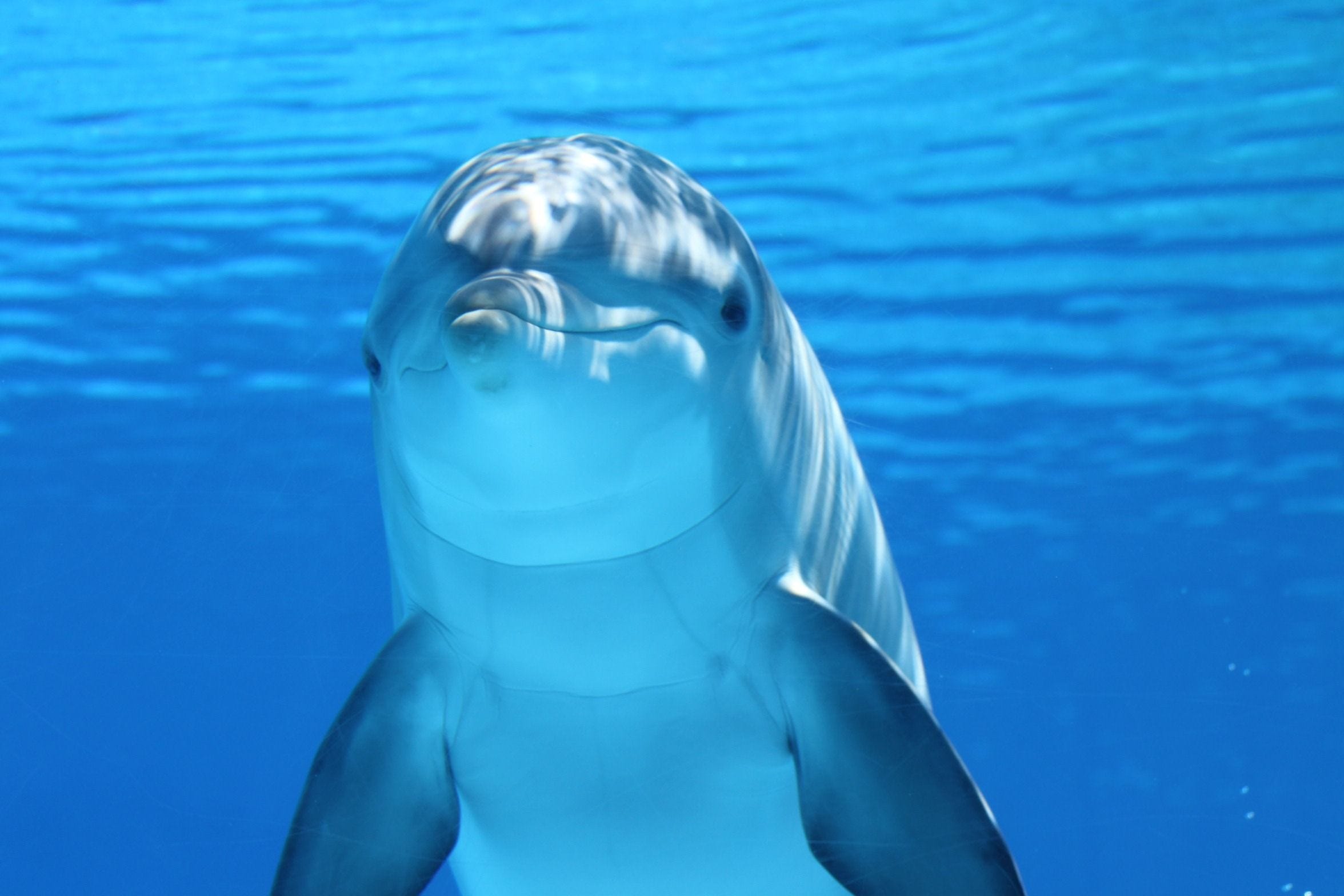
In Bunbury, Western Australia, a famous wild dolphin named Scar became a legend. After suffering from a severe infection, local researchers managed to catch him, administer a dose of antibiotics, and release him. Scar swam away rapidly, seemingly eager to escape. However, weeks later, Scar returned to the bay. He wasn’t alone. He had brought a completely different, visibly sick dolphin with him, presenting the ailing companion to the researchers as if to say, “Hey, do that magic healing thing for my mate.”
Dolphins also showcase mind-boggling collective intelligence. In captivity, researchers have given pairs of dolphins the command to “create a new trick together.” The dolphins will dive underwater, emit a burst of clicks and whistles (seemingly discussing the plan), and then burst through the surface to perform a perfectly synchronised, completely original acrobatic stunt they had never been taught.
Out in the open ocean, their larger cousins, Orcas, turn this communication into cold, calculating military strategy. To hunt seals resting safely on top of floating Antarctic ice floes, a pod of orcas will swim side-by-side in perfect formation toward the ice at high speed. At the very last second, they dive underneath it in unison, executing a coordinated tail-flip. This creates a massive, targeted hydrodynamic wave that washes over the ice, knocking the helpless seal directly into the water where the rest of the pod is waiting.
The Mathematical Parrot
Birds are often dismissed as “birdbrains”, but Alex, an African Grey parrot studied by scientist Irene Pepperberg, shattered those stereotypes. Alex didn’t just mimic words; he understood concepts. He could look at a tray of different objects and correctly identify how many red squares or green balls there were. He understood the concept of “bigger” and “smaller”, and famously, he is the only non-human animal to have ever asked an existential question. Looking in a mirror, he asked, “What colour?” (He was told he was grey, and he learned the word).
Corvids Outsmarting Our Kids
Crows and ravens (corvids) are the undisputed physics champions of the avian world. In various studies, crows have been presented with a deep tube of water with a floating treat just out of reach. To get the treat, the crows figured out they needed to drop heavy stones into the tube to raise the water level. When researchers ran the same test on human children, crows routinely solved the puzzle faster than four-year-old humans, who often just stared at the tube in frustration.
But New Caledonian crows take things a step further: they actually manufacture tools from scratch. In the wild, they will take a straight, stiff twig, strip away the extra leaves, and deliberately bend the end into a perfect hook to fish plump grubs out of deep tree holes. They aren’t just using what they find; they have a blueprint in their minds of a tool that doesn’t yet exist in nature.
Engineering Giants and Pragmatic Primates
We see this same engineering mindset in elephants. At the Smithsonian National Zoo, a young Asian elephant named Kandula wanted some fruit that researchers had hung intentionally out of his reach. Instead of giving up, Kandula looked around the yard, found a heavy plastic square block, and rolled it over with his trunk. He positioned it directly under the fruit, stood on it with his front legs to give himself a boost, and grabbed the treat. He didn’t just use a tool; he understood the abstract concept of a step-ladder.
Our closest relatives, the primates, constantly surprise us with this same rational thinking. In one research facility, a chimpanzee was given a plastic ball and told by his keeper to “wet the ball” using a nearby sink. The sink happened to be turned off that day. Instead of giving up, the chimpanzee walked over to the window, looked out at the pouring rain, threw the ball out into the courtyard, and waited. When challenged by the researcher, the chimp pointed out the window at the ball, showing that it was now perfectly wet. He bypassed the broken tool and used nature instead.
The Alien Mind of the Octopus
Perhaps the most bizarre intelligence on Earth belongs to the octopus. Mammals, birds, and elephants share a relatively recent common ancestor, meaning our brains are built from a similar blueprint. The octopus, however, is an invertebrate. Its evolutionary line split from ours over 500 million years ago when the smartest thing on Earth was a flatworm.
Yet, octopi have evolved massive brains, capable of navigating complex mazes, opening child-proof jars, and using tools (like carrying coconut shells around to use as portable armor). What makes them truly alien is that their intelligence is decentralised. Two-thirds of an octopus’s neurons are actually in its arms. Each arm can literally think, taste, and solve problems on its own, completely independent of the central brain. It is proof that nature found a totally separate path to creating a genius.
The Future: Will We Be Dethroned?
So, will humans always be the smartest animals on Earth?
If we look tens of millions of years into the future, the answer is: not necessarily. Evolution never stops. If human activity or a natural disaster changes the planet drastically, the evolutionary pressures will shift.
If humans were to disappear, who would take over?
Chimpanzees and bonobos are already entering their own basic “Stone Age,” using tools and passing traditions down through generations. Given a few million years of isolation, their brains could continue to expand.
Crows and ravens possess the ideal mix of problem-solving skills and social structure, though their lack of hands limits their ability to build complex machinery.
Pigs have the social intellect and adaptability, but like crows, their physical anatomy (hooves) makes it difficult to manipulate the physical world into advanced technology.
Octopi have the raw brainpower, but they are held back by short lifespans (usually only 1 to 5 years) and the fact that they are solitary, meaning they cannot pass knowledge down to their children. If an octopus species ever evolved a longer lifespan and social habits, they could build an underwater civilization.
For now, humans remain the undisputed heavyweight champions of intellect. But the animal kingdom reminds us every day that we do not have a monopoly on thought. Intelligence is not a straight line leading to humans; it is a massive, beautiful bush branching out in wild directions. We just happen to be the branch holding the pen today.