

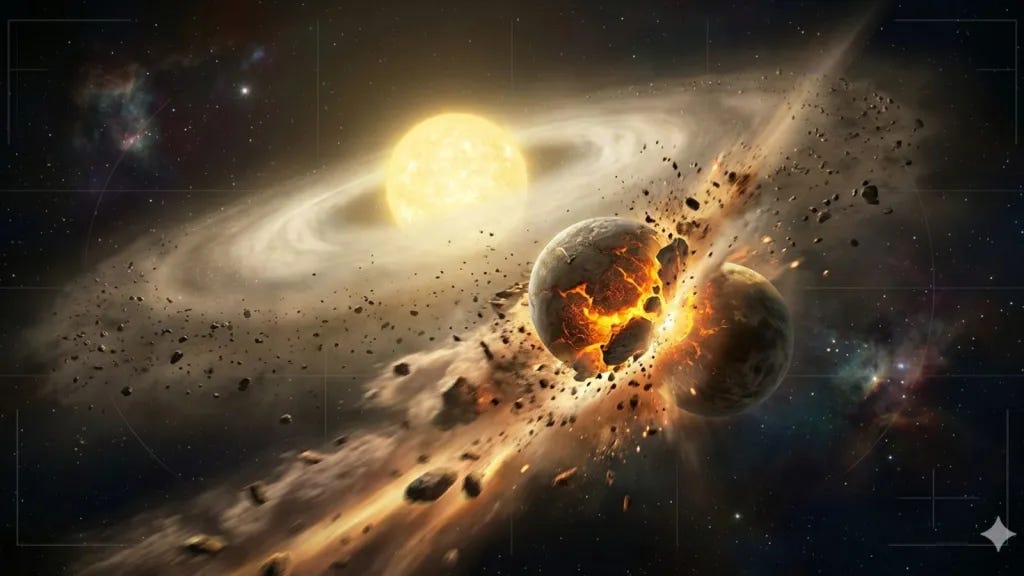
Astronomers are witnessing the chaotic birth pangs of distant planetary systems, revealing a violent reality that mirrors the early history of our own solar system. Recent observations from the James Webb Space Telescope have provided unprecedented insights into tge dusty disks surrounding young stars. These studies suggest that the vast plumes of dust we observe are not merely leftovers from stellar formation, but the catastrophic debris of giant collisions between moon- or Mars-sized protoplanets.
For decades, the standard model of planetary formation painted a relatively gradual picture. Dust grains within a circumstellar disk collide and stick together, slowly building up into pebbles, planetesimals, and eventually full-sized planets. However, the sharp infrared eyes of the Webb telescope are revealing that the final stages of this process are defined by extreme violence. By analyzing the thermal emissions and precise chemical compositions of dusty disks around nearby young stars, scientists have detected sudden, massive spikes in specific types of silicates and extreme variability that can only be explained by high-velocity impacts.
These giant impacts occur during a critical epoch of planetary infancy known as the oligarchic growth phase. During this time, dozens of protoplanets roughly the size of our Moon or Mars vie for gravitational dominance within a crowded orbital highway. When their paths inevitably cross, the resulting collisions are energetic enough to completely pulverize the outer layers of the colliding bodies. The Webb telescope has captured the immediate aftermath of these smashups, detecting vast clouds of microscopic, warm dust particles that spread out across space like smoke from a cosmic wreckage.
The implications of these findings extend far beyond the distant stars currently under Webb’s gaze. They provide a direct window into the ancient history of our own cosmic backyard. Scientists believe that Earth’s own Moon was formed through a remarkably similar event when a Mars-sized protoplanet named Theia collided with the proto-Earth billions of years ago. By observing these same types of collisions happening in real time across the galaxy, the Webb telescope is validating the idea that such cataclysms are a universal rite of passage for terrestrial planets.
Ultimately, the dust clouds cataloged by the James Webb Space Telescope show that building a habitable world is a destructive business. The serene, orderly planetary systems we observe today are the survivors of an era characterized by planetary cannibalism. As Webb continues to peer into these dusty stellar nurseries, it reminds us that the solid ground we walk upon was forged in the remnants of an ancient time when worlds collided.