

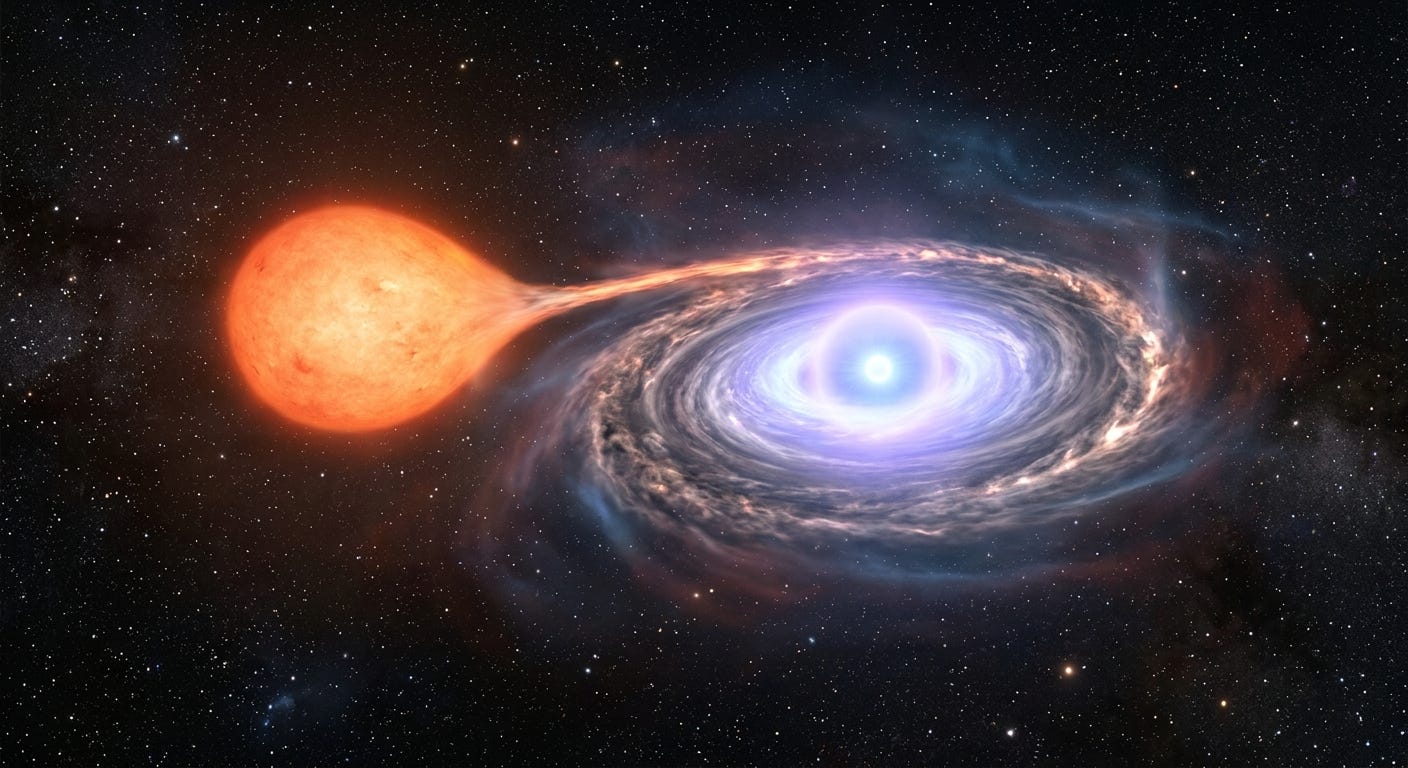
Space news cycles follow a predictable formula. Astronomers discover a new thing, the media panics, and headlines scream about cosmic death rays or mysterious objects defying the laws of physics. The recent announcement of hypersoft X-ray sources followed the script perfectly. Everyone learned that a bunch of strange, ultra-low-energy X-ray glowing things were found lurking in neighboring galaxies, and that they might hold the key to exploding stars. That is all well and good, but the standard reporting entirely missed the funniest, weirdest, and most deeply human angles of this cosmic detective story. While the public was treated to glossy artist impressions and clean press releases, the gritty reality of the discovery tells a much more hilarious tale of intergalactic hide-and-seek, decomposing robotic eyes, and stars that seem to suffer from extreme stage fright.
The Galactic Fog Paradox
To find these objects, astronomers had to look across millions of light-years of empty space to peer into other galaxies like Andromeda and the Pinwheel. Meanwhile, their census of hypersoft sources inside our very own Milky Way remains a resounding zero. This is the cosmic equivalent of standing on your front porch, using a high-powered telescope to successfully read a restaurant menu in the next town over, but being completely unable to find your own shoes because your house is on fire and filled with smoke. The flat disc of the Milky Way is packed with a thick, suffocating sludge of interstellar hydrogen and helium gas. This galactic smog acts like an impenetrable blackout curtain for extreme ultraviolet light and low-energy X-rays. Because we are trapped inside the house, our local view is entirely obscured. It turns out that if you want to see a hypersoft source, your best bet is to look at a completely different galaxy that is tilted nicely out of the line of fire, allowing you to bypass the cosmic fog of our own neighborhood. We can map the universe, but we cannot see our own cosmic backyard.
The Race Against Space Telescope Degradation
The media framed this discovery as a triumph of cutting-edge modern science, leaving the casual reader with the impression that astronomers just booted up a brand-new super-telescope to snap these pictures. In reality, this was a desperate archaeological salvage mission using a twenty-five-year-old piece of space hardware that is slowly falling apart. The researchers found the hypersoft sources by combing through decades of old archival data from NASA’s Chandra X-ray Observatory. This was an urgent race against time because Chandra’s primary low-energy sensor has been suffering from severe, irreversible degradation after spending a quarter-century getting bombarded by space radiation. The detector is losing its ability to see soft X-ray photons with every passing year. If the researchers had procrastinated for another decade, the aging telescope’s eyes would have grown too dim to perceive the low-energy signatures at all. The definitive proof of a brand-new cosmic class was essentially found by digging through the digital equivalent of a dusty old hard drive before the machine totally gave up the ghost.
The Blinking Nature of Extreme Cosmic Cooling
When journalists describe these objects, they tend to use static terms like binary systems or steady white dwarfs pulling matter from companion stars. They gloss over the fact that these things are absolute chaotic nightmare objects that keep disappearing on purpose. Some hypersoft sources appear to pull a literal magic trick, blinking out of existence before suddenly popping back into view later. They are not actually moving or exploding. Instead, they are experiencing extreme thermal fluctuations. The physics of these systems dictates that a tiny drop in temperature stretches out the wavelengths of light they emit. By cooling down just a tiny fraction, a hypersoft source shifts its entire radiation output cleanly out of the X-ray band and drops down into the completely invisible extreme ultraviolet spectrum. To an X-ray telescope, the object effectively vanishes into thin air, leaving astronomers staring at a blank patch of sky until the star heats up again and decides to rejoin the party.
Challenging the Rare Oddity Assumption
The human brain loves an anomaly, and news outlets immediately treated the initial catalog of eighty-four objects as a rare boutique collection of cosmic weirdos. The data actually implies something far more unsettling for astrophysicists: these things are probably everywhere. The researchers emphasized that hypersoft sources represent a massive, significant fraction of the entire X-ray population in normal galaxies. They only looked rare because humanity possessed a massive, multi-decade blind spot in our telescope technology and data analysis techniques. We have spent the entire history of modern astronomy heavily undercounting the number of luminous, hyper-energetic binary star systems in the universe simply because they were wearing the perfect camouflage. Now that the blind spot has been eradicated, astronomers are starting to realize that the universe is absolutely crawling with hypersoft systems. Far from being exotic anomalies, these weird, blinking, gas-shrouded objects might just be one of the most common stellar configurations in the cosmos, proving once again that the universe is weirder than we are capable of detecting.