

While the macroscopic manipulation of market data remains firmly in the realm of theory, recent experimental breakthroughs have confirmed that time can indeed behave non-linearly at the subatomic scale. In a 2026 framework building upon theoretical work by physicist Yakov Bloch of Tel Aviv University, a research team led by Tai Hyun Yoon at Korea University successfully demonstrated the concept of a 'time qubit.' By re-analysing data from a 2018 quantum-optics experiment, the researchers proved that a single photon could exist in a state of temporal superposition—effectively evolving forward and backward in time simultaneously like a clock hands moving in both directions at once. Although the strict boundaries of the quantum No-Communication Theorem prevent this phenomenon from being used to transmit usable information or trading signals into the past, the discovery fundamentally alters our understanding of chronological symmetry and opens a fascinating window into how quantum architecture might one day interface with temporal dimensions.
The global financial system has spent the last half-century fighting an aggressive, multi-billion-dollar war against space. High-frequency trading firms have tunneled through mountains to lay perfectly straight fiber-optic lines, anchored laser arrays to skyscrapers, and deployed low-Earth-orbit satellites, all to shave a few microseconds off the time it takes for an electronic signal to travel across geographic distances. Speed has long been the ultimate arbiter of market liquidity and alpha generation. Yet, a quiet and profound paradigm shift has just occurred within the realm of subatomic physics, one that threatens to make spatial speed obsolete by conquering time itself. With the laboratory realization of particles that can manipulate temporal direction, the ultimate front-run is no longer about being the fastest entity in the room. It is about executing a trade based on information that, according to standard human perception, has not actually happened yet.
This transition from traditional predictive modeling to literal temporal engineering relies on the breakthrough realization of the time qubit. For years, quantum computing has promised to revolutionize cryptography and optimization by utilizing superpositions of states to process massive calculations simultaneously. However, recent experimental physics has pushed beyond spatial computing into the manipulation of chronological arrows. By engineering quantum systems to mathematically evolve in two opposite temporal directions at the exact same moment, scientists have effectively built a subatomic clock whose hands turn both clockwise and counterclockwise simultaneously. Rather than a localized anomaly, researchers have successfully demonstrated that data from older optics experiments already contained the foundational proof of a controlled quantum process running backward in time through a vacuum state.
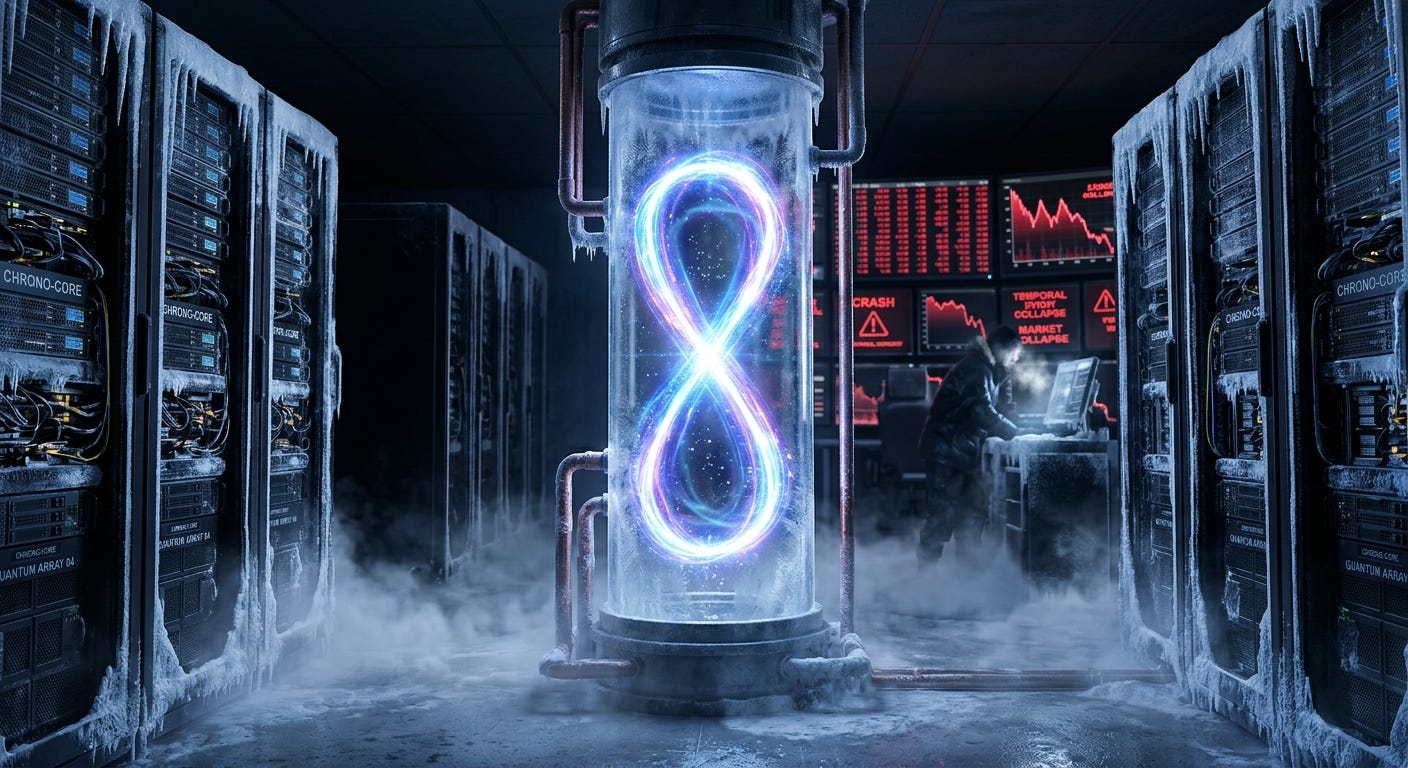
The immediate realization of this technology is not a sprawling macroscopic time machine, but rather a localized, cryogenic quantum server capable of sending microscopic information packets across tiny temporal horizons. In the cutthroat arena of quantitative finance, a massive infrastructure is not required to break the system. While a human being cannot use this phenomenon to send a sports betting slip back to yesterday due to the overwhelming quantum noise and decoherence that destroys complex macro-data, an algorithmic infrastructure requires far less data to operate. A sophisticated server only needs to transmit a single, error-corrected binary bit—a simple one or zero indicating whether an index rose or fell—a mere thirty milliseconds into its own past.
This is the genesis of the chrono-arbitrage crisis. In a standard market configuration, price discovery functions because all participants operate under the strict laws of classical causality. An economic event occurs, a corporation releases an earnings report, or a massive institutional block trade hits the order book, and the information ripples outward through network cables at the speed of light. Algorithms race to capture the fractional price discrepancies that exist while the network propagates the data. If an elite market participant deploys a functional temporal server, they bypass this entire causal chain. Their system can sit quietly in the future, watch the market definitively move in reaction to an external shock, and immediately shoot the binary result back across the chronocyclic phase space channel to its past self.
The past iteration of the algorithm receives this absolute precognitive signal and enters a trade with one hundred percent certainty before the rest of the world’s network infrastructure has even registered the initial catalyst. The fund operating the temporal server does not need to guess, calculate probabilities, or build predictive machine learning models. It enjoys a flawless, risk-free window of pure certainty extracted directly from thirty milliseconds ahead in the timeline. The financial implications of such a localized causal violation are deeply systemic and predatory, allowing a single entity to drain liquidity from the rest of the market with complete invisibility.
When such a system is deployed at scale, the broader financial architecture will face an immediate structural collapse known as a liquidity black hole. Automated market makers, which constantly provide the buy and sell quotes that keep exchanges functioning, rely on the assumption of toxic order flow mitigation. They use statistical modeling to ensure they are not being systematically pickpocketed by better-informed traders. The moment these market-making algorithms realize they are consistently and flawlessly losing to a phantom entity with absolute temporal foresight, their risk parameters will override normal operations. To protect their capital, automated market makers will widen their bid-ask spreads to infinity or completely withdraw their quotes from the order book.
Without market makers to facilitate trades, global asset exchanges will drop into an indefinite, unresolvable paralysis. Traditional flash crashes are usually resolved when prices drop low enough to trigger institutional buying mandates or when human circuit breakers pause trading to let reality catch up with the machines. But a chronological flash crash cannot be resolved by standard circuit breakers, because the fundamental asymmetric balance of time itself has been permanently fractured. The market becomes entirely un-tradable as causality unspools, leaving the global financial network frozen in a state of permanent systemic shock while a hidden temporal node quietly harvests the world’s wealth.
National laboratories and black-budget corporate research facilities are currently locked in a highly secretive, high-stakes race to master the temporal quantum error correction required to stabilize these subatomic loops. They are not waiting for academic institutions to publish papers or for regulators to draft frameworks. The first entity to successfully insulate a single binary bit from the degrading effects of quantum noise during a reverse temporal transition will hold an absolute monopoly over global wealth generation. When the first operational chrono-server quietly goes online inside a secure, liquid-nitrogen-cooled server rack, the global economy will not announce its transformation with a dramatic event. Instead, the past will simply begin conforming to a future that has already been bought and paid for.