

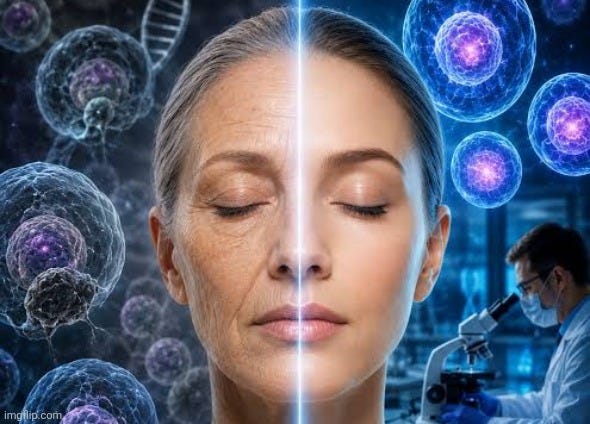
For generations, the medical community viewed aging as a slow, inevitable accumulation of physical wear and tear. Our bodies were like old cars, destined to rust out over time. However, a groundbreaking field of genetic research is entirely upending this narrative. Leading scientists now suggest that our cells do not actually lose the blueprint for youth; they simply misplace the instructions on how to read it. By introducing a precise combination of genes directly into living tissue, researchers are successfully hitting a biological reset button.
The story behind this breakthrough dates back to 2006, when Japanese scientist Shinya Yamanaka discovered a cocktail of four genes—collectively known as the Yamanaka factors—capable of rewinding mature, adult cells all the way back to an embryonic-like state. While the discovery earned a Nobel Prize, applying it to living animals proved hazardous. Forcing adult cells entirely back to their embryonic roots strips away their identity, turning a functional eye or kidney cell into a blank slate. Even worse, one of the four factors, a notorious oncogene called c-Myc, reliably triggered aggressive tumor growth in animal models.
To bypass these dangers, a research team at Harvard Medical School, co-led by geneticist David Sinclair, pursued a simpler approach. They decided to completely exclude the cancer-causing fourth factor, delivering only the remaining three genes: Oct4, Sox2, and Klf4, abbreviated as OSK. By doing so, they achieved what they call partial epigenetic reprogramming. The treated cells do not lose their fundamental identity, but they do shed the molecular clutter of old age, rewinding their biological clocks by an estimated 75%.
The most striking early proof of this concept occurred when researchers injected the OSK gene therapy into the eyes of old, blind mice suffering from glaucoma or age-related nerve degradation. Historically, once mammalian optic nerves are damaged, they never grow back. Yet, under the influence of these three factors, the damaged retinal cells regrew axons and the blind mice successfully regained their sight. Moving further up the evolutionary tree, subsequent animal testing in non-human primates yielded similar success, safely restoring significant optic nerve function in monkeys following an eye stroke.
While David Sinclair has faced valid public skepticism for past promotion of overhyped longevity compounds like NMN and resveratrol, which failed to live up to their initial promises in human clinical outcomes, the data backing this gene therapy study is showing concrete results. The transition from animal models to humans has officially crossed the threshold. Human clinical trials are actively evaluating the safety and tolerability of the OSK gene therapy, known as ER-100, specifically in patients experiencing vision loss from glaucoma. To ensure strict safety, the therapy utilizes a temporary genetic switch. The genes are delivered via a harmless viral shell, but they remain completely dormant until the patient takes a low dose of the antibiotic doxycycline. If any side effects emerge, stopping the antibiotic immediately turns the rejuvenation process off.
If these human eye trials continue to progress safely, the systemic implications are staggering. Because the three-factor cocktail targets the underlying epigenetic clock shared by all tissues, researchers intend to replicate this success across other vital organs. The next logical targets on the horizon include the brain, spinal cord, heart, and kidneys—organs where cellular damage has long been considered permanent. Ultimately, the overarching goal of this research branch is total body rejuvenation.
Describing the underlying mechanics of this breakthrough, David Sinclair frequently points to an information-based theory of aging. He explains that there is a backup copy of youthful epigenetic information hidden within every one of our cells. We do not fully know where the backup copy is, but we know it is there because we can reverse the aging of cells and animals so rapidly. He notes that it only takes three genes to reset the entire age of an animal. The elegance of epigenetic reprogramming is that it does not add anything new; it simply clears the clutter, allowing the cell to remember its original, youthful song.
Other experts in the longevity field mirror this profound shift in how we conceptualize human health, viewing it less as a mechanical problem and more as a matter of cellular memory. Commenting on the transition from traditional medicine to reprogramming therapies, medical researchers note that we are moving from an era of prosthetics to an era of resonance. We are no longer just mechanics of the body; we are curators of its memory. Healing is not about fixing what is broken, but about reminding the body of its own capacity for perfection.
Looking ahead, Sinclair believes that the successful execution of this gene therapy in human subjects will mark a watershed moment for the scientific community. He envisions that once the world definitively knows that human age reversal works, the global response will match the historic launch of revolutionary digital technologies. He describes it as a ChatGPT moment for biology and aging, because it proves we have finally learned how to safely rewrite the software of life.