

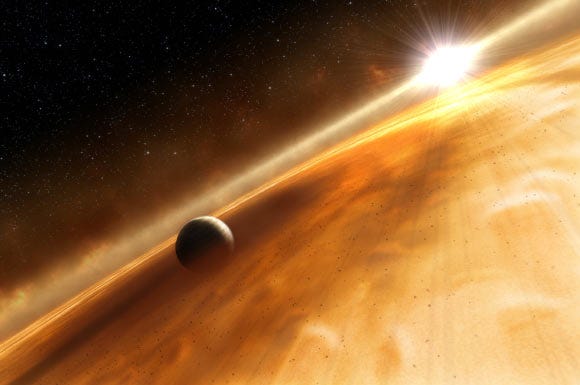
In the quiet reaches of the constellation Corvus, about a thousand light-years from Earth, a perfectly respectable hot Jupiter named TOI-2535 b decided it had had enough of the spotlight. For seven years it had dutifully marched across the face of its modest orange star every 8.2 days, dimming the starlight just enough for NASA’s TESS telescope to notice and for astronomers to cheer. Then, without so much as a farewell postcard, the transits stopped. One day the planet was there, crossing the stellar disk like a reliable transit bus. The next, it was gone from view, leaving a collection of puzzled scientists staring at blank light curves and muttering about gravitational hooliganism.
The truth, of course, is more ordinary and slightly more ridiculous. TOI-2535 b did not explode, evaporate, or get eaten by its star. It simply tilted. An unseen neighbor, probably at least as hefty as Saturn and locked in a mean-motion resonance with our disappearing act, has been giving the hot Jupiter a long, slow shove. Over the years the orbit precessed, the impact parameter drifted outward at a brisk 0.16 per year, and the transit chord slid from the middle of the star toward the edge, then off into the cosmic equivalent of the wings. By early 2026 the planet was still looping around its star on schedule, just no longer lined up with Earth. From our vantage point it had pulled off the celestial version of stepping just far enough to the side that the camera could no longer see it.
Astronomers watching the data must have felt a mix of excitement and mild betrayal. The timing variations were already theatrical enough, swinging by as much as six hours early or late, as if the planet kept checking its watch and deciding the audience could wait. Then the transit durations shrank, the dips grew shallower, and finally the show closed without an encore. It is the first time anyone has watched a planet around a single star stop transiting while the telescopes were still looking. Somewhere in the system a second giant is quietly taking credit for the best orbital magic trick in recent memory.
The planet will eventually swing back into view, probably in a few decades, when the precession brings the alignment around again. Until then, TOI-2535 b remains out there, orbiting contentedly, free from the pressure of performing for distant observers. One can almost imagine it leaning over to its invisible companion and whispering, “Finally. I was getting tired of all that crossing back and forth.”