

For nearly half a century, our understanding of the cosmos has undergone a radical transformation, moving from speculative theories to high-precision observational science. Looking at the universe today, we no longer see a static backdrop of distant stars, but a dynamic, expanding fabric teeming with alien worlds, invisible forces, and ripples in spacetime itself. This modern boom in astronomy has been driven by an unprecedented synergy between ground-based engineering and space-based observatories. Together, these technological leaps have shattered long-held assumptions and unveiled a universe far more complex, violent, and fascinating than previous generations of scientists ever dared to imagine.
The story of this modern revolution begins with the exoplanet revolution. For centuries, humanity wondered if other stars harbored planets like our own, yet no proof existed until the early nineties. The breakthrough arrived with the detection of planets orbiting a distant pulsar, followed closely by the discovery of a giant gas planet orbiting a sun-like star known as Fifty-One Pegasi b. What began as a trickle turned into a flood with the launch of dedicated planet-hunting missions like the Kepler Space Telescope. Kepler revealed that planets are not rare anomalies but cosmic constants, outnumbering the stars in our galaxy. Today, we know of thousands of alien worlds, ranging from scorching hot Jupiters to rocky super-Earths, fundamentally changing our understanding of planetary formation and our place in the cosmic hierarchy.
As our view of planets was expanding, our understanding of the universe on its grandest scale was simultaneously turned upside down by the discovery of dark energy. In the late nineties, two independent teams of astronomers utilized distant exploding stars, known as Type One-A supernovae, to measure how fast the universe was expanding. They expected to find that gravity was slowing the expansion down over time. Instead, the data revealed something shocking: the expansion of the universe is actually speeding up. This cosmic acceleration implied the existence of a mysterious, repulsive pressure stretching the fabric of space itself. Dubbed dark energy, this unknown force makes up roughly seventy percent of the universe, meaning the ultimate fate of the cosmos is governed by a component we still do not fully understand.
No single instrument has done more to bring these distant cosmic truths into the public consciousness than the Hubble Space Telescope. Launched in 1990, Hubble overcame a famously flawed mirror to become the most productive scientific tool in human history. By peering deeply into seemingly empty patches of sky for days at a time, Hubble captured the Deep Field images, revealing thousands of infant galaxies stretching back to the dawn of time. Hubble precisely pinned down the age of the universe to thirteen point eight billion years, charted the distribution of mysterious dark matter, and provided the first atmospheric measurements of worlds orbiting other stars. Beyond its raw data, Hubble transformed science communication, turning the cold data of space into breathtaking visual masterpieces that inspired a generation.
While telescopes like Hubble captured the light of the universe, an entirely new sense was gifted to astronomy through the detection of gravitational waves. Predicted by Albert Einstein a century prior, these literal ripples in the fabric of spacetime were directly observed for the first time in 2015 by the Laser Interferometer Gravitational-Wave Observatory. Caused by the violent collision of two black holes over a billion light-years away, the event compressed and stretched the physical dimensions of our planet by a fraction of the width of an atom. This monumental achievement birthed the era of multi-messenger astronomy, allowing scientists to not just see the universe through light, but to listen to the cosmic cataclysms that shape it, including the heavy metal-producing collisions of neutron stars.
The invisible also became visible in the realm of supermassive black holes. For decades, these gravitational monsters were inferred only by their effects on surrounding matter. This changed dramatically when the Event Horizon Telescope, a global network of synchronized radio dishes acting as an Earth-sized virtual mirror, captured the first direct image of a black hole silhouette. By peering into the heart of the galaxy Messier Eighty-Seven, and later our own Milky Way, scientists captured the glowing orange ring of superheated gas bending around the point of no return. This feat provided definitive visual proof of extreme gravity at work, confirming the wildest predictions of general relativity.
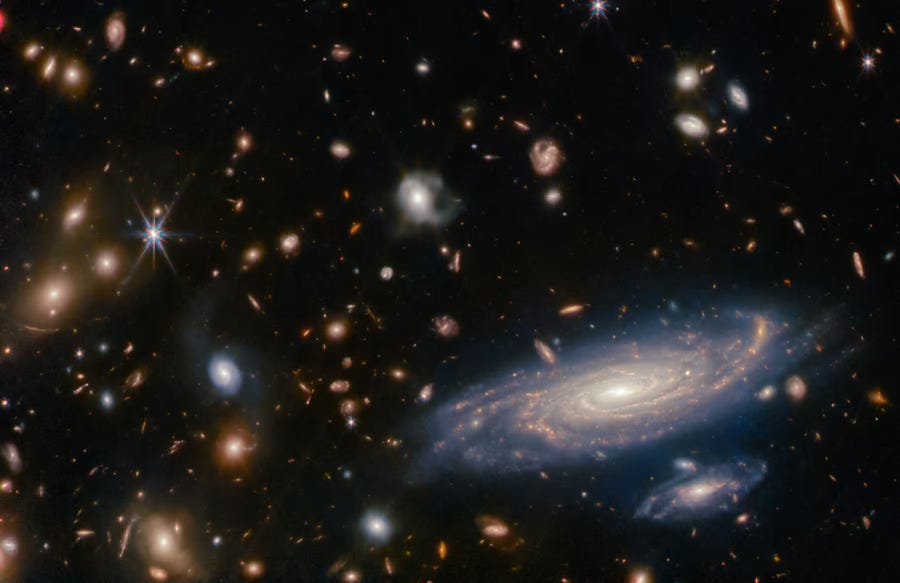
Building upon these triumphs, the James Webb Space Telescope has pushed the boundaries of human vision even further into the infrared spectrum. Since its deployment, this engineering marvel has peeled back the cosmic curtains of dust to witness the birth of the very first stars and galaxies. Its massive gold-coated mirror has detected complex carbon molecules in the atmospheres of distant exoplanets and found mature galaxies existing much earlier in cosmic history than standard models predicted. By looking at the universe in pristine infrared detail, Webb is actively rewriting textbooks, forcing astrophysicists to rethink how rapidly structures grew in the turbulent infancy of the cosmos.
The golden age of astronomy shows no signs of slowing down as we look toward wide-field cosmic surveying. The imminent arrival of the Nancy Grace Roman Space Telescope represents the next logical leap in our quest to map the dark universe. While Webb boasts unmatched depth and magnification, Roman will possess a field of view one hundred times greater than Hubble. This capability will allow it to capture sweeping, panoramic views of the sky with space-telescope resolution, effectively taking giant cosmic inventory. By tracking the distribution of millions of galaxies and discovering thousands of new exoplanets through gravitational microlensing, Roman will provide the statistical power needed to decode the true nature of dark energy and dark matter, ensuring that our journey into the cosmic dark remains as thrilling as ever.
As much as we love Hubble, it's a dinosaur by today's technological standards. Discoveries coming via the Roman Telescope should be very, very exciting!