

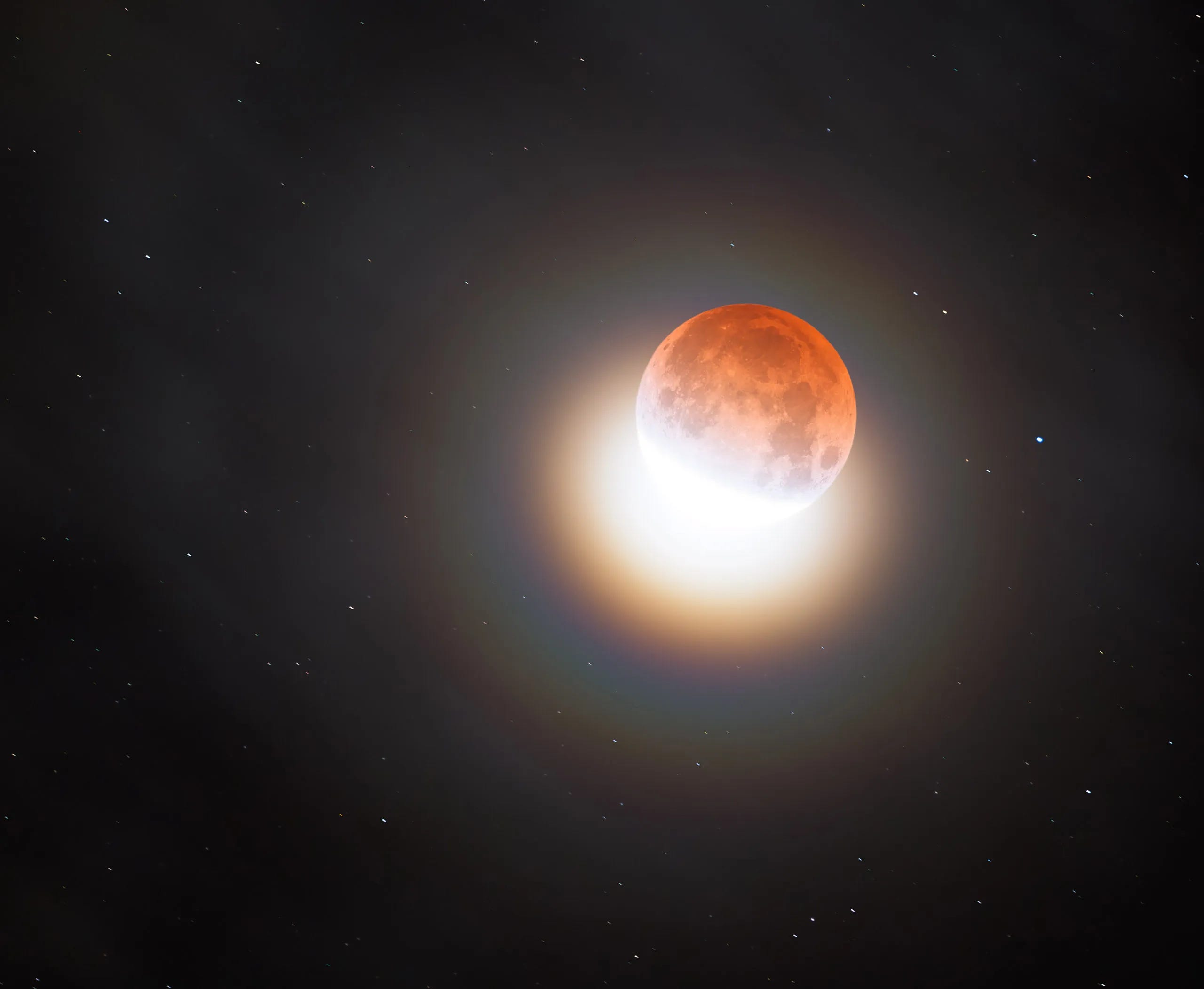
Get ready to look up, because the night sky is about to put on its most dramatic show of the season. On the night of August 27–28, 2026, our celestial companion will slide deep into Earth’s shadow for a spectacular deep partial lunar eclipse.
This isn’t just any regular partial eclipse. At its peak, Earth’s dark central shadow, known as the umbra, will swallow a staggering 96.2% of the moon’s surface. It is the deepest pass through our planet’s shadow that we will witness for more than two years.
A Galactic Projection Screen
While it is technically classified as a “partial” eclipse, it will look and feel almost exactly like a total “Blood Moon”. As the moon moves into the alignment, it won’t just vanish into the dark. Instead, it will transform into a glowing, coppery crimson jewel.
How does this happen? Think of it as a planet-sized light trick. Earth blocks the direct sunlight, but our atmosphere acts like a lens, filtering and bending the light. It scatters away short blue wavelengths but allows the long red wavelengths to pass through.
When you look up at the peak, you are literally seeing the glow of every single sunrise and sunset happening around the globe at that exact moment, projected onto the lunar surface.
Who Gets a Front-Row Seat?
Timing and location are everything for this cosmic alignment. Over 1 billion people in North America, Central America, and South America will have prime, front-row seats to the entire event.
For viewers on the East Coast of North America, the peak occurs just after midnight on Friday, August 28, while West Coast skywatchers will see the eclipse begin earlier in the evening on Thursday, August 27.
Meanwhile, stargazers across Western Europe and Africa will catch the show during the early dawn hours of August 28, watching the heavily shadowed moon sink toward the western horizon just before sunrise.
No Gear? No Problem!
The absolute best thing about a lunar eclipse is that it requires zero special equipment. Unlike a solar eclipse, you don’t need any protective glasses; it is completely safe to view with the naked eye.
All you need to do is step outside, find a spot away from bright streetlights, and let your eyes adjust to the dark. However, if you happen to have a pair of binoculars or a small backyard telescope, grab them! They will reveal incredible, moody details across the cratered lunar terrain as the shadow creeps forward.
Because the next complete total lunar eclipse won’t grace our skies until New Year’s Eve in 2028, this near-total blackout is an event you won’t want to miss. Set an alarm, grab a warm jacket, and prepare to watch the cosmos do what it does best: leave us completely starstruck.