

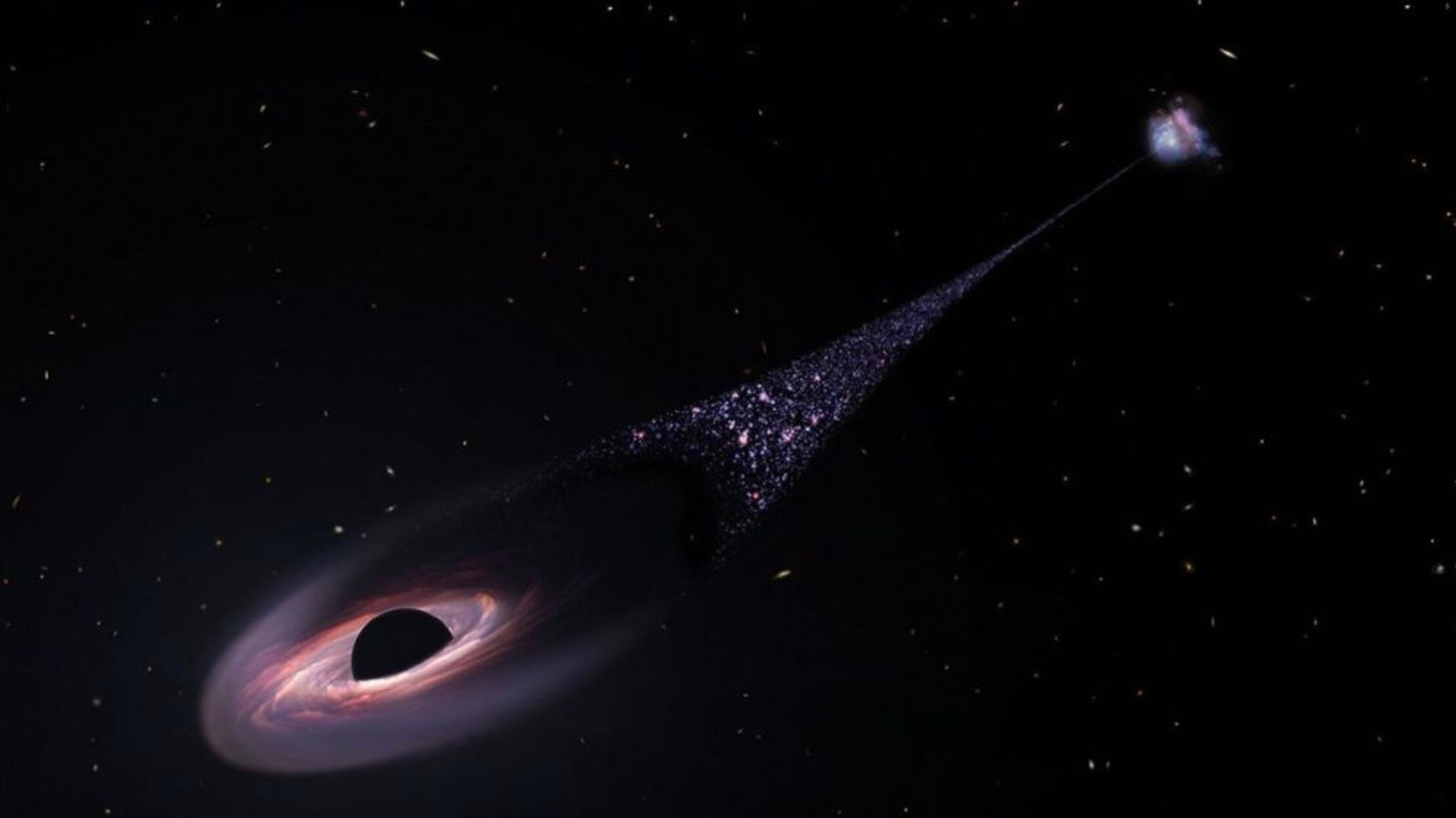
In the lexicon of deep space, black holes are typically viewed as anchoring forces—gravitational anchors holding entire galaxies together from their dark, central hearts. However, an accidental discovery by astronomers has upended this static view, revealing a runaway supermassive black hole weighing an estimated 20 million times the mass of the Sun.
Barreling through intergalactic space at an astonishing 3.5 million miles per hour (5.6 million km/h), this invisible titan is moving so fast that if it were in our solar system, it could travel from the Earth to the Moon in a mere 14 minutes. Yet, what makes this rogue monster truly spectacular is not just its speed, but what it leaves behind: an unprecedented 200,000-light-year-long trail of newborn stars, twice the physical diameter of our own Milky Way galaxy.
An Accidental Discovery in the Dark
The rogue entity was originally spotted by a research team led by Pieter van Dokkum of Yale University while reviewing archival data from NASA’s Hubble Space Telescope. Initially looking for globular star clusters in a nearby dwarf galaxy known as RCP 28—located roughly 7.5 billion light-years from Earth—van Dokkum noticed a razor-thin, bright streak of light.
At first, some researchers dismissed the anomaly as a potential cosmic ray artifact or an astrophysical jet. However, follow-up observations at the W. M. Keck Observatory in Hawaii confirmed the line was very real. While traditional astrophysical jets grow fainter the further they travel from their host galaxy, this particular linear streak grew progressively stronger and hotter at its furthest tip—the exact signature of a shockwave generated by a moving heavyweight object.
Trial of Creation: Moving from Destruction to Star Birth
Unlike a typical black hole that devours anything in its immediate path like a cosmic Pac-Man, this runaway behemoth is moving too fast to feed. Instead, it functions like a giant supersonic snowplough.
As the black hole tears through the thin, diffuse gas clouds surrounding its former host galaxy, it triggers a supersonic bow shock. This shockwave violently compresses the ambient hydrogen gas. As the compressed gas cools in the wake of the black hole’s passing, it collapses under its own gravity, igniting an explosive wave of star formation. The result is a luminous “contrail” of brilliant, hot blue stars marking the trajectory of a cosmic runaway.
Cosmic Billiards: How Do You Launch a Black Hole?
How does an object 20 million times heavier than our Sun get violently kicked out of its home galaxy? Astronomers point to a chaotic, multi-million-year game of intergalactic billiards.
According to theoretical models, the exit sequence likely unfolded in phases:
The First Merger: Roughly 50 million years ago, two large galaxies collided, causing their respective central supermassive black holes to sink to the core and lock into a tight orbital binary partnership.
The Intruder: Before the initial pair could cleanly merge, a third galaxy entered the fray, bringing its own supermassive black hole into the central core.
The Slingshot: The chaotic three-way gravitational dance became inherently unstable. In the ensuing tussle, the third black hole stole momentum from the binary pair, resulting in a dramatic gravitational slingshot that hurled one of the black holes out of the galaxy completely.
While one black hole was kicked away in one direction, the remaining binary pair was shot in the opposite direction due to recoil momentum, a phenomenon supported by faint secondary structures seen on the opposite side of the host dwarf galaxy.
A New Chapter for Space Observations
For decades, the concept of ejected supermassive black holes remained purely theoretical. Powerful deep-space confirmation by instruments like the James Webb Space Telescope (JWST) has validated the math behind these cosmic ejections.
With the deployment of wide-field survey equipment, such as NASA’s upcoming Nancy Grace Roman Space Telescope, astronomers expect to employ machine learning algorithms to scan the skies for more of these telltale star streaks. Rather than being isolated anomalies, rogue black holes may play a major, hidden role in how gas is distributed and how new stars are seeded throughout the structural web of our universe.