

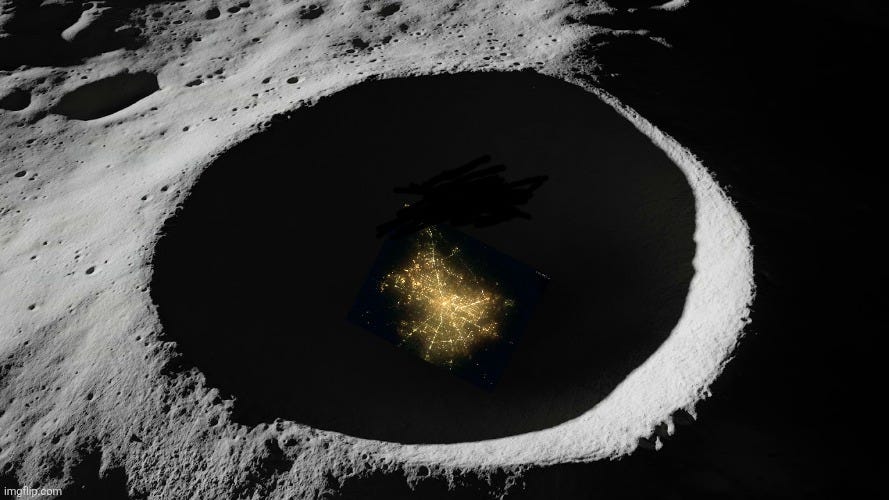
The strategic value of Shackleton crater at the lunar south pole has long been recognized by every serious spacefaring power. Its rim receives near-continuous sunlight for solar power while its permanently shadowed interior preserves water ice that could supply drinking water, breathable oxygen, and rocket propellant. In the coming decade this single geological feature is likely to become the most contested real estate beyond Earth. China’s public roadmap through the Chang’e series and the International Lunar Research Station places crewed operations and a research base in the 2030s. Yet the possibility exists that Beijing is preparing a compressed, less transparent path intended to place hardware and eventually personnel inside the crater ahead of the United States, then consolidate de facto control over the ice through an expansive operational buffer.
China has already developed a specialized hopping probe as part of the Chang’e-7 mission, designed to leap from the rim of Shackleton crater into its permanently shadowed interior and map the distribution of water ice with unprecedented precision. The spacecraft stack, including the hopper, was rolled out to the launch pad at Wenchang in mid-August 2026, but the attempt was aborted on 23 August just hours before liftoff when Chinese authorities announced that the mission did not meet launch conditions and could not proceed in the remaining 2026 window, citing the principles of absolute reliability and safety; weather associated with Tropical Storm Narra near the site was widely linked to the scrub. With the narrow lighting and orbital requirements for a south-polar landing, the next viable opportunity does not open until 2027, and partner statements now point specifically to early 2027 for the rescheduled attempt.
This will be followed by Chang’e-8 technology demonstrations and later ILRS construction. A secret acceleration would not require inventing entirely new vehicles; it would require compressing existing ones. The Long March 10 heavy-lift rocket, already under development for crewed missions, could fly uncrewed cargo or precursor landers earlier than announced. Robotic systems already in the pipeline—precision landers, hopping probes capable of traversing steep crater walls, nuclear reactors for continuous power in darkness—could be advanced through parallel, less publicized industrial lines. Chinese space activities benefit from a degree of opacity unavailable to open societies. Launch campaigns can be announced late, telemetry selectively released, and dual-use technologies developed under civilian and military programs simultaneously. A sequence of successful robotic landings inside or on the rim of Shackleton, followed by rapid delivery of power systems, habitats, and excavation equipment, could establish a continuous presence before American crews arrive under Artemis.
The primary motivation is straightforward resource monopoly. Water ice in sufficient concentration is the single most valuable commodity on the Moon. Exclusive or privileged access would allow China to produce propellant on site, reducing the mass that must be lifted from Earth and enabling longer-duration missions. Oxygen extracted from ice or regolith supports life support. The crater floor itself offers natural radiation shielding once habitats are buried or built against the walls. Controlling the ice also confers leverage over any later international partners or competitors who might wish to operate nearby. In geopolitical terms, a Chinese base operating inside Shackleton while declaring a wide safety or exclusion zone would mirror terrestrial strategies of creating facts on the ground that later negotiations must accommodate. Prestige matters as well: the first sustained human presence at the most scientifically and economically interesting lunar site would reinforce narratives of Chinese technological leadership and national rejuvenation.
Cultural and political structures make sustained deception more feasible than in democratic systems. Centralized decision-making under the Chinese Communist Party allows long-horizon planning without the electoral cycles, congressional oversight, or investigative journalism that force public disclosure in the United States. Information can be compartmentalized; state media can emphasize peaceful scientific goals while operational details remain classified. Historical strategic culture, including classic texts that treat deception as a legitimate instrument of statecraft, provides an intellectual framework for opacity when vital interests are at stake. Domestic political costs for failure or exposure are managed differently; the leadership faces fewer immediate electoral penalties for ambitious or risky programs. These differences do not guarantee success, but they reduce the friction that open societies encounter when attempting to conceal major technological advances.
China already plans a hopping probe as part of Chang’e-7 precisely to explore the interior of permanently shadowed craters. That vehicle is designed to leap across difficult terrain, map ice deposits, and test mobility in extreme cold and darkness. Such a precursor mission could quietly identify the richest ice concentrations and optimal sites for later landers. Once surface assets are in place, a nuclear reactor delivered by subsequent cargo flights would provide the continuous power needed for heating, electrolysis, and construction inside the crater, while solar arrays on the sunlit rim supply supplemental energy via cable. Habitats could be emplaced on the floor or lower slopes where the ice is accessible and the surrounding topography offers shielding.
The precedent of aggressive territorial consolidation is visible in the South China Sea. Over the past two decades China transformed low-tide elevations and reefs into militarized artificial islands complete with runways, radar, and missile systems, despite an international arbitral ruling that rejected expansive sovereignty claims. The method was incremental: dredging, construction, then assertion of administrative control and exclusion of others through coast-guard and militia presence. On the Moon the Outer Space Treaty formally prohibits national appropriation. Yet the same treaty’s provisions on harmful interference and the practical reality of safety zones around active bases create room for expansive interpretations. A first-arriving power could declare a multi-kilometer buffer justified by plume contamination risks, radio interference, or astronaut safety, effectively fencing off the ice. Enforcement would rest on continuous presence and the political cost other nations would pay for challenging it. Withdrawal from the treaty itself remains legally possible after one year’s notice, though the diplomatic price would be high; more likely is a strategy of remaining formally inside the treaty while practicing de facto control.
Exclusive access to Shackleton’s ice would confer lasting operational advantages. Propellant production at the pole shortens the logistics chain for any subsequent lunar or even Mars architecture. Scientific instruments could monopolize the unique thermal and illumination conditions of the crater. Later arrivals would face the choice of accepting Chinese operational rules or accepting higher costs and greater risk by operating farther from the resource. In a competition framed as zero-sum by some strategists in Beijing, that first-mover position is worth considerable investment and risk.
None of this is inevitable. American and allied sensors track major launches; a sudden surge in Chinese heavy-lift activity would be noticed. Engineering challenges inside the crater—extreme cold, limited solar power without cable links, difficult access—are real. International reaction, including from countries that have signed both Artemis Accords and ILRS agreements, could isolate an overtly exclusionary posture. Yet the combination of resource value, centralized decision-making, demonstrated capacity for incremental territorial assertion, and existing robotic plans for crater exploration makes the scenario of a quietly accelerated Chinese effort to occupy Shackleton’s interior a serious strategic possibility rather than pure speculation. The coming years of robotic activity will reveal whether Beijing intends to race for the ice or continue along its publicly stated, more measured schedule.