

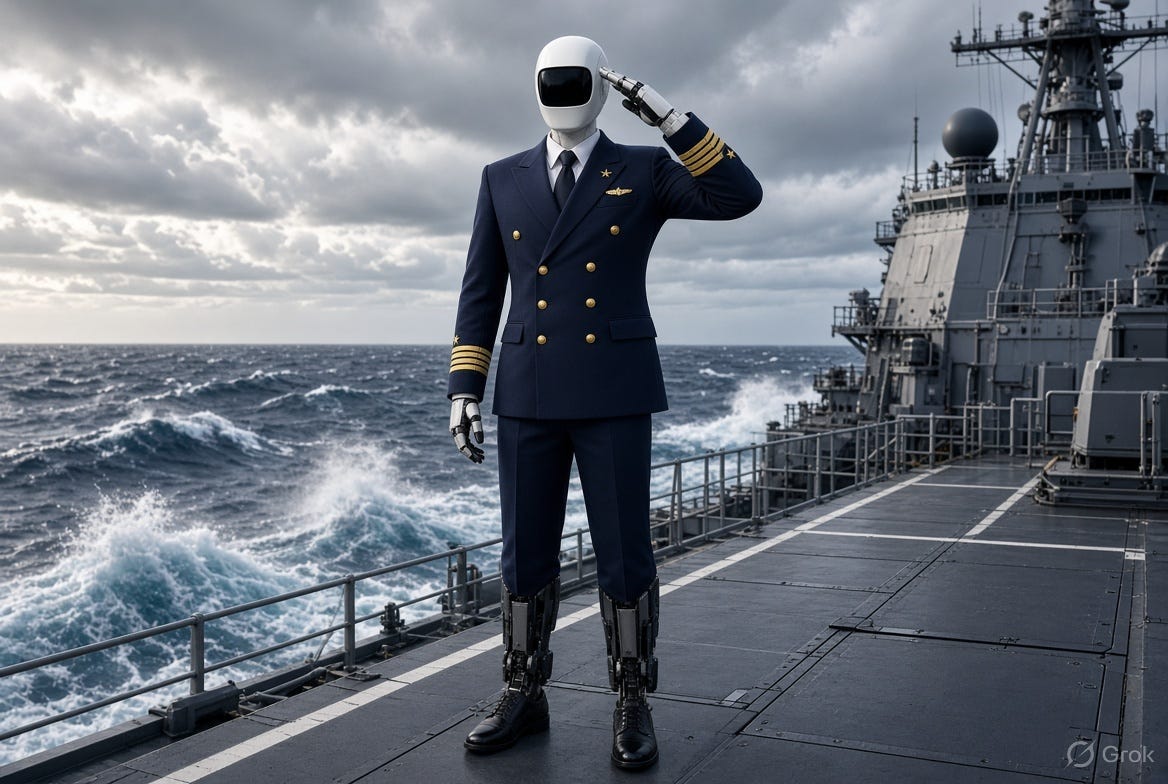
In the quiet hours before dawn at a sprawling shipyard on the Korean coast, the first sparks of a new industrial age are already flying. Not from the hands of weary welders, but from the precise, tireless limbs of machines built in the image of people. Across the world’s oceans and into its blackest depths, humanoid robots are stepping into roles once reserved exclusively for flesh and blood. They do not breathe. They do not tire. And when the sea claims them, the only thing lost is hardware.
Shipyard
Shipbuilding has always been a brutal craft. Workers climb scaffolding into the curved steel canyons of unfinished hulls, breathing fumes, balancing on precarious platforms, and enduring the constant risk of falls, burns, or crushing injuries. The human body was never designed for the scale or hostility of a modern shipyard. Humanoid robots are beginning to change that equation.
At facilities operated by major builders such as HD Hyundai, bipedal machines now move through the same spaces designed for people. They carry welding torches into tight compartments, maintain steady arcs for hours without the tremor of fatigue, and navigate uneven decks with a balance that no exhausted shift worker can match after twelve hours on their feet. These robots do not need respirators in the chemical haze of paint and flux. They do not suffer from heat stress under the summer sun or from cold that stiffens human joints in winter. When a component must be held at an awkward angle for prolonged periods, the machine simply holds it. There is no muscle strain, no cumulative damage to spines and shoulders that eventually forces skilled tradespeople into early retirement or chronic pain.
The economic logic is as compelling as the safety one. A humanoid that can work three consecutive shifts without rest multiplies output while removing the most dangerous tasks from human hands. If a robot is damaged by a falling plate or a sudden collapse of scaffolding, the incident becomes an insurance claim rather than a tragedy that empties a family’s future. Shipyards are learning that the human form factor is not a nostalgic choice. It is the most practical way to deploy advanced machines into environments already built for people, without the need to redesign every walkway, ladder, and workspace.
Sailors
Far from the dry docks, another quiet revolution is underway on the bridges of ships. The open ocean has always extracted a harsh toll from those who sail it. Long watches destroy concentration. Storms turn decks into lethal landscapes of green water and shifting steel. Fatigue has sunk more vessels than enemy action ever did. Humanoid systems are now being tested in roles that once demanded constant human vigilance.
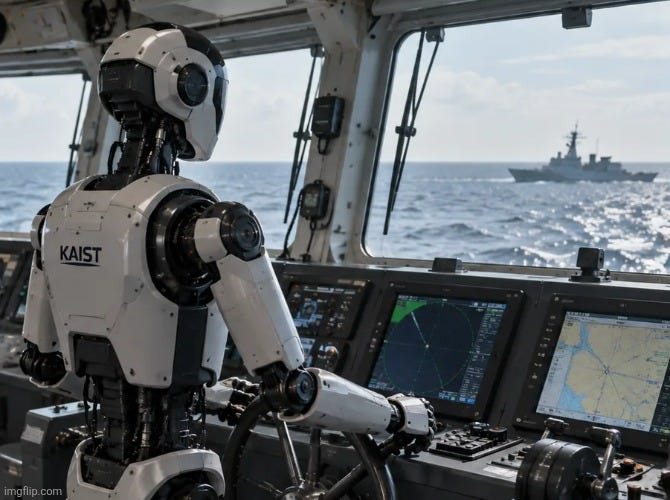
In controlled trials, machines have already taken the helm, responding to spoken commands, adjusting course, and maintaining headings through simulated rough seas and narrow channels. They do not suffer the slow erosion of attention that afflicts even the most disciplined officer after days of broken sleep. They do not need to eat, drink, or step away for a moment of rest. On long transoceanic passages, the advantage compounds. A humanoid can remain fully alert for the entire journey, monitoring instruments, adjusting to weather, and executing precise maneuvers without the cognitive drift that inevitably creeps into human performance.
When conditions turn lethal, the calculus becomes even clearer. In heavy weather, when seas crash over the bow and the risk of a man overboard rises with every wave, a robot can perform critical tasks on deck without the fear that its loss will leave children without a parent. If the machine is swept away or crushed against the superstructure, the event is logged as equipment damage. The ship continues. The crew remains intact. This is not callousness. It is a recognition that human life has a value no amount of cargo or schedule can justify risking lightly. Humanoids allow ships to keep capable hands—mechanical ones—in the most exposed positions while the people they protect remain inside the relative safety of the hull.
Swimming
The dream of a robot that propels itself through water with the same coordinated strokes as a human has proved surprisingly stubborn. While humanoid machines now walk, climb stairs, and even take the helm of ships, true free-swimming humanoids that replicate competitive strokes remain rare and largely confined to research laboratories.
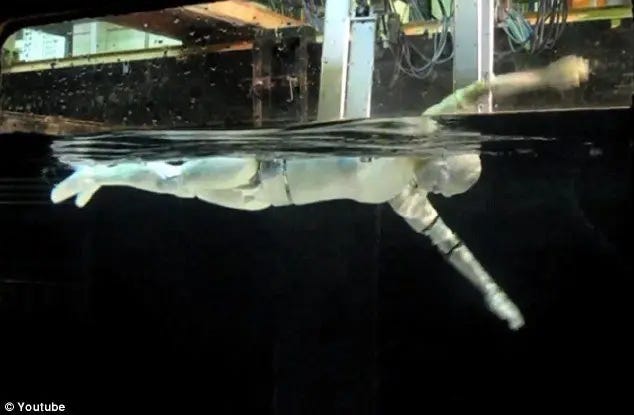
The clearest and most thoroughly documented example is SWUMANOID, developed around 2012 at the Tokyo Institute of Technology by Chung Changhyun and Motomu Nakashima. Built at half human scale from a three-dimensional body scan of an actual swimmer, the robot matched human proportions with remarkable fidelity. Twenty waterproof motors (later versions incorporated additional actuators) drove its joints, allowing computer-controlled reproduction of the complex motions of swimming. Early work focused on the front crawl, the most intricate of the four competitive strokes. Subsequent refinements enabled the breaststroke, backstroke, and butterfly. In free-swimming tests conducted in a 25-metre outdoor pool, SWUMANOID successfully performed the breaststroke, though its speed remained modest—approximately 0.12 metres per second for a 2.3-second stroke cycle, far slower than both simulations and human performance scaled to the same size. The machine was never intended as a practical vehicle. Its purpose was scientific: to provide a perfectly repeatable experimental platform for studying the unsteady fluid forces that act on a swimmer’s body. Human subjects introduce variability that makes precise measurement difficult. A robot does not.
Later papers from the same group explored direction control and further stroke refinements, but SWUMANOID did not evolve into a widely deployed platform. Independent efforts have been even scarcer. A few laboratory prototypes have demonstrated flutter-kick propulsion or rudimentary limb motions underwater, and soft or biohybrid robots have achieved impressive speeds using muscle cells or manta-ray-inspired fins. Yet full anthropomorphic swimming—complete with coordinated arm pulls, body rotation, and breathing-like timing—has seen little commercial or operational progress beyond the Japanese research programme. The technical barriers are substantial. Waterproofing dozens of actuators, managing buoyancy with precision, generating enough propulsive force from human-like limb geometry, and controlling the highly dynamic interaction between body and water all remain challenging. Swimming, it turns out, is an exceptionally demanding test of coordination, balance, and power.
That difficulty is precisely why some researchers continue to regard swimming as an attractive benchmark. Just as walking on two legs forced advances in balance and control, free-swimming humanoids would demand simultaneous mastery of hydrodynamics, multi-joint coordination, and energy efficiency. Success would signal a new level of physical intelligence.
Practical applications, though still distant, are easy to imagine. Lifeguard robots stationed at busy beaches could enter the water without hesitation, swim out in rough conditions, and support a struggling person without risk of drowning or exhaustion. For maritime humanoids already serving on ships, the ability to swim would transform a fall overboard from a potential total loss into a recoverable event. The machine could propel itself back to the vessel or keep itself afloat until recovery. In the longer term, enthusiasts have even speculated about humanoid swimming competitions—an Olympic-style event in which machines race using the same strokes as human athletes, turning the research challenge into public spectacle and accelerating development through competition.
Ironically, while surface swimming has progressed only modestly, diving humanoid technology has advanced much further. Machines such as Stanford’s OceanOne series already operate at depths approaching one kilometre, using thrusters for propulsion and human-like arms for delicate manipulation. They do not swim in the classical sense; they hover and translate with mechanical efficiency that pure limb motion cannot yet match. The contrast is instructive. Propelling a human-shaped body efficiently through open water with its own limbs remains one of the harder unsolved problems in robotics, even as the same form factor proves highly effective once thrusters and depth capability are added.
Diving
Below the surface, the case for humanoid form becomes almost philosophical. The ocean does not merely resist human presence. It actively destroys it. Pressure, cold, darkness, and the ever-present threat of the bends have limited how far and how long people can work underwater. Traditional remotely operated vehicles excel at observation and simple intervention, yet they lack the intuitive dexterity of a human diver when fine manipulation is required among tangled wreckage or delicate archaeological sites.
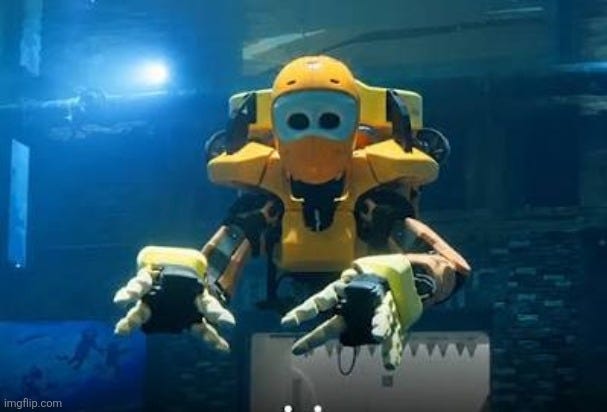
Stanford’s OceanOne series has shown what becomes possible when the human shape is taken into the deep. These machines descend with articulated arms and sensitive hands, guided by pilots who feel the resistance of every object through haptic feedback. They have recovered artifacts from historic wrecks at depths no free diver could safely reach and no conventional robot could so gracefully navigate. At hundreds of meters below the surface, the robot feels no crushing pressure on its lungs because it has none. It cannot suffer decompression sickness. It does not grow cold or disoriented. It simply continues the work.
In salvage operations, the difference is decisive. A human diver operating in strong currents or near unstable wreckage risks entanglement, equipment failure, or sudden shifts that can trap or kill. A humanoid can be sent into the same chaos. If the structure collapses or the machine becomes pinned, recovery teams can treat it as a recoverable asset rather than a body. The psychological burden on surface crews lightens when the figure disappearing into the dark is metal rather than a colleague. Over repeated missions, this changes what is attempted. Sites once considered too dangerous for human intervention become accessible. Work that once required elaborate saturation diving systems and weeks of decompression can be approached with greater boldness and lower human cost.
The deeper implication is cultural as much as technical. For centuries the sea has demanded blood as the price of knowledge and commerce. Humanoid machines do not erase that demand, but they redirect it. They allow people to remain the decision-makers, the pilots, the strategists, while the machines absorb the physical punishment of an environment that was never meant for lungs and soft tissue. In shipyards, on decks, and in the crushing dark below, the humanoid form is proving itself not as a novelty, but as a practical answer to an ancient problem: how to work where the human body itself becomes the greatest liability.