

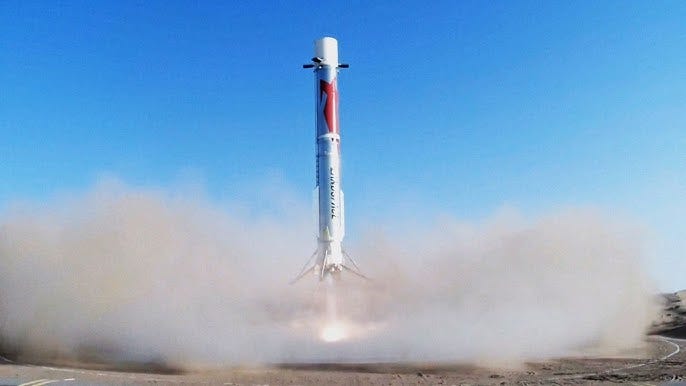
The landscape of global spaceflight shifted dramatically as a sleek, stainless steel vehicle ignited its engines, ascended into the sky, and returned to execute a flawless vertical landing. Developed by the Beijing-based private aerospace firm LandSpace, the Zhuque-3 rocket completed its second flight test with precision, delivering the Honghu 03 satellite into orbit before guiding its massive first-stage booster back to Earth.
This milestone represents a pivotal leap forward for China’s commercial space sector, officially making LandSpace the first private Chinese company to successfully land an orbital-class booster. However, for many Western observers, military strategists, and industry analysts, the sight of a slender cylinder dropping from the sky, deploying landing legs, and stabilizing with aerodynamic grid fins triggers an undeniable sense of déjà vu and intense skepticism.
While there is no public evidence of direct blueprint theft or physical corporate espionage in this specific case, the Zhuque-3 has reignited a fierce international debate regarding the degree to which Chinese aerospace relies on copying and reverse-engineering Western technological triumphs. Critics in the American defense sector frequently point out that Chinese startups are actively bypass-engineering the incredibly costly, high-risk development phases that American companies had to endure.
By adopting the exact operational architecture of the Falcon 9—from the complex multi-engine cluster configuration used for throttling down during descent to the precise vertical recovery profile—LandSpace has effectively utilized a proven American blueprint to fast-track its own domestic capabilities. This rapid mirroring of American tech has fueled severe geopolitical tensions over intellectual property, with many arguing that China is systematically closing the aerospace gap by cloning the hard-earned innovations of its primary geopolitical rival.
Despite these heavy architectural similarities, labeling the Zhuque-3 a mere carbon copy ignores a fascinating technical twist: the vehicle actually skips the painful material evolution that defined the Western path to reusability. When SpaceX built the Falcon 9, they spent years perfecting a highly advanced aluminum-lithium alloy hull. Later, during the early development of Starship, Western engineers spent millions prototyping massive carbon-fiber fuel tanks, only to watch them crack and leak under extreme cryogenic pressures, forcing Elon Musk to completely abandon the material.
LandSpace simply skipped both of these costly developmental dead ends. Standing 66.1 metres tall with a body diameter of 4.5 metres and a gross launch mass of roughly 570 metric tonnes, the vehicle generates more than 750 metric tonnes of liftoff thrust. By constructing this Falcon-sized medium-lift booster straight out of high-strength stainless steel and powering it with clean-burning liquid methane, the Chinese startup fused two entirely separate SpaceX design philosophies into a single operational vehicle. They took the shape and landing method of the Falcon 9 and built it using the cheaper, highly resilient material shortcut of Starship.
The performance specifications of the Zhuque-3 highlight its intended role as a direct commercial competitor. Its first stage is equipped with nine proprietary TQ-12A liquid oxygen-methane engines, featuring a deeply variable throttle range capable of adjusting from 40 percent up to 110 percent of rated power to manage the deceleration necessary for touchdown. In a fully expendable configuration, the rocket is capable of delivering up to 11.8 metric tonnes of payload to low Earth orbit. When executing a down-range recovery onto a drone ship or secondary pad, its capacity changes to 8.0 metric tonnes, while a return-to-launch-site recovery yields a payload capacity of approximately 12.5 metric tonnes on its upgraded variants.
This capability is specifically tailored to support China’s upcoming high-density satellite deployment schedules. LandSpace designed the stainless steel first stage to be robust enough to support at least 20 separate flights, targeting a rapid inspection and refurbishment cycle that strips out the lengthy turnaround times associated with older kerosene-burning rocket fleets.
This successful landing carries massive geopolitical stakes, particularly as China accelerates its plans to deploy its own massive satellite internet networks, the Guowang and Thousand Sails megaconstellations, to directly rival SpaceX’s Starlink. To achieve the high-frequency launch cadence required to put tens of thousands of satellites into low Earth orbit, reusable rocketry is an absolute necessity, not a luxury.
What alarms Western defense officials most is China’s unique dual-track strategy. While private companies like LandSpace are mastering land-based leg recoveries, China’s state-owned aerospace sector recently pioneered an entirely different, highly innovative sea-based net-capture system that catches boosters using steel cables and hooks rather than heavy landing legs. By simultaneously developing two entirely distinct recovery methods, China is proving that it can take Western ideas, adapt them with domestic innovations, and scale them at a speed that threatens America’s long-standing monopoly on cheap access to space.
As the engines of the Zhuque-3 quieted down on the landing pad, they left no room for doubt: the global race for the cosmos has transformed into a fierce, neck-and-neck rivalry where the laws of physics dictate the form, but geopolitical dominance dictates the stakes.