

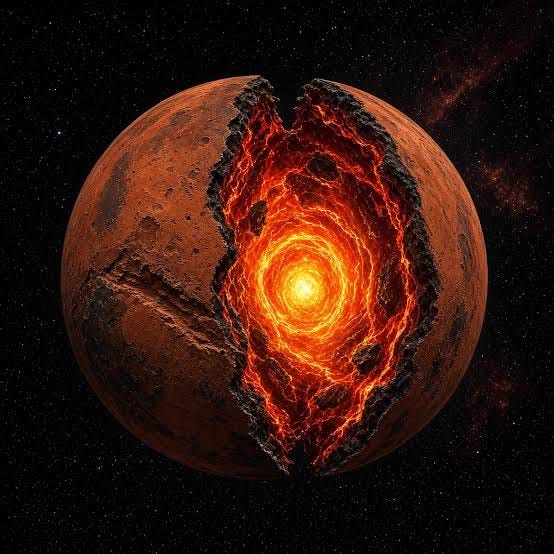
Beneath the rusted, frozen plains of Mars, a quiet revolution is rewriting our understanding of the Red Planet. For decades, scientists viewed the fourth planet from the sun as a geologically dead world, a place where the internal fires had burned out billions of years ago. Recent data from robotic explorers, however, has pierced this icy facade, revealing a massive thermal anomaly brewing deep within the Martian mantle. This hidden reservoir of heat suggests that the planet is not a stagnant desert, but a world that is still very much alive and breathing beneath its scarred surface.
The discovery centers on a region known as Elysium Planitia, a vast plain near the Martian equator. Here, instruments have detected a colossal plume of molten rock rising through the mantle, pushing against the crust from below. This thermal swell acts like a localized furnace, generating temperatures far higher than anything scientists expected to find. The implications of this underground heat source are profound, challenging the foundational timelines of planetary evolution and proving that Mars possesses a dynamic interior capable of active volcanism.
This subsurface warmth changes everything we thought we knew about the potential for Martian life. Liquid water has long been considered the holy grail of astrobiology, yet the planet’s freezing atmospheric temperatures make surface water impossible. The thermal anomaly changes the equation entirely by providing a consistent, powerful heat source capable of melting deep ice sheets. Sheltered from deadly cosmic radiation and sustained by geothermal warmth, vast underground lakes could exist, creating stable, long-term environments where microbial life could potentially thrive in the dark.
Furthermore, this internal engine offers an inspiring glimpse into the future of human exploration. Future astronauts tasked with surviving the harsh Martian environment will need power, water, and resources. A localized region of high geothermal heat could be tapped for energy, providing a reliable power source independent of solar panels, which are frequently rendered useless by global dust storms. Access to sub-surface water melted by this anomaly would also secure the survival of early colonies, turning a hostile wasteland into a viable outpost for humanity.
Mars is revealing itself to be a planet of dualities, where a cold, silent exterior masks a warm, churning heart. The thermal anomaly reminds us that planetary exploration is a journey of constant rewriting, where older dogmas easily shatter under the weight of new discoveries. As we look to the horizon of space travel, the heat beneath Elysium Planitia serves as a beacon of possibility, proving that the Red Planet still holds the vital sparks necessary to ignite our imagination and fuel our cosmic future.