

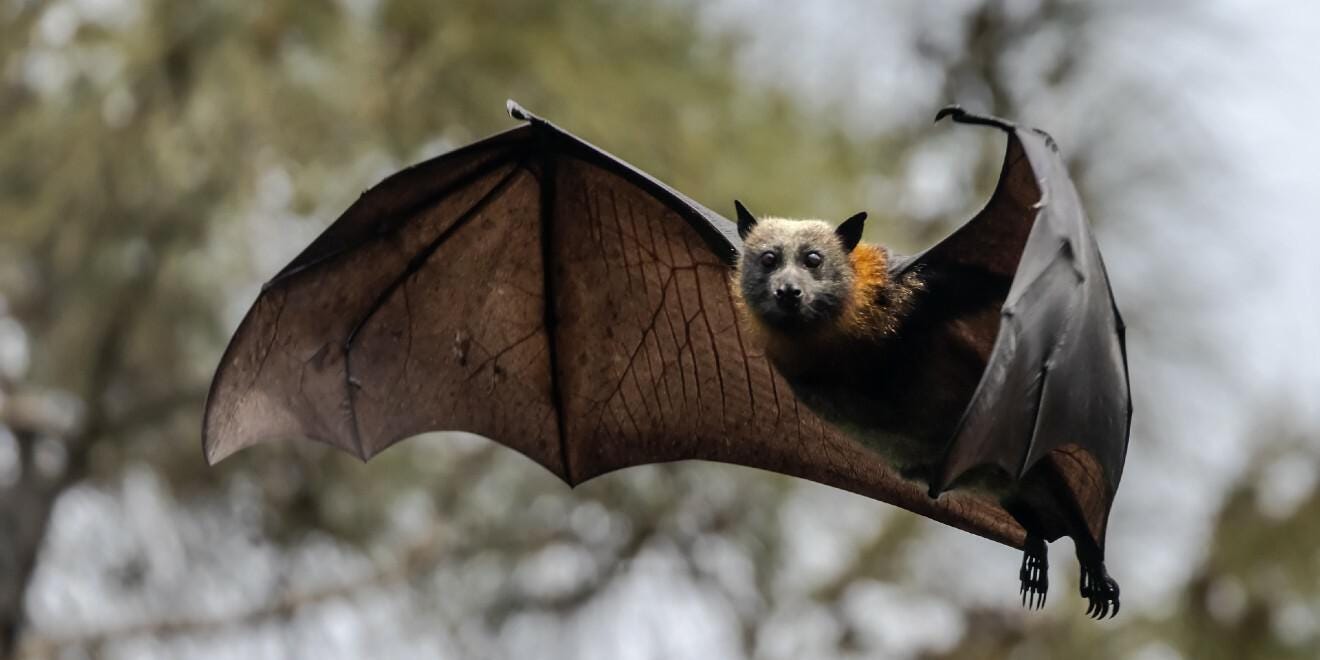
Deep within the shadows of the prehistoric world, an evolutionary miracle was taking flight. For centuries, the origin story of bats has been shrouded in mystery, leaving scientists to wonder how and where these enigmatic creatures first mastered the skies. However, groundbreaking recent research has finally illuminated their dark past, pointing to an unexpected birthplace. It turns out that the ancestors of modern bats likely emerged in Europe, bursting onto the scene around sixty-six million years ago, the exact same dramatic epoch when the dinosaurs went extinct. As the colossal reptiles vanished, these tiny, resilient mammals stepped into the vacuum, beginning an evolutionary journey that would change the world’s ecosystems forever.
Long before they developed the intricate wings we see today, the earliest ancestors of bats were vastly different from their modern descendants. Scientists believe these ancient creatures were small, nocturnal, tree-dwelling mammals. They were insectivores, scurrying along branches and leaping through the primitive forests in search of prey. Over millions of years, the skin between their elongated fingers stretched into specialized membranes, transforming gliding leaps into true, powered flight. Through this incredible transition, bats achieved a feat unmatched by any other furred creature, securing their title as the only mammals capable of sustained flight.
Today, this evolutionary gamble has paid off spectacularly. Bats have conquered nearly every corner of the globe, diversifying into an astonishing array of shapes and sizes. They now rank as the second most diverse group of mammals on Earth, surpassed in species count only by rodents. From the tiny bumblebee bat weighing less than a penny to the massive golden-crowned flying fox with a wingspan stretching over five feet, there are more than one thousand four hundred distinct species. This immense variety allows them to fill vital ecological roles, acting as master pest controllers, essential pollinators for tropical fruits, and crucial seed dispersers for regenerating forests.
Yet, beyond their physical marvels and ecological importance lies a profound cognitive sophistication that scientists are only beginning to fully appreciate and which rivals some of the ocean’s most intelligent inhabitants. Just as dolphins navigate the murky depths of the sea, bats navigate the pitch-black night using an advanced system of aerial sonar. Both groups independently evolved echolocation using identical changes in the same hearing gene and emit ultrasonic frequencies to see in very different environments. By emitting clicks and analyzing the returning echoes, they construct a vivid, three-dimensional acoustic map of their surroundings in real-time. This sophisticated biological radar is so precise that a bat can detect objects as thin as a human hair and intercept a fast-moving insect mid-air in total darkness.
Recent studies have shattered the old misconception that bats are primitive or simple-minded. Researchers exploring bat intelligence have uncovered an extraordinary capacity for understanding complex communication cues, specifically the human pointing gesture. This is a remarkable feat, as the ability to look past a pointing hand and understand that it indicates a distant object is a trait typically associated with highly domesticated animals like dogs, or deeply social creatures like dolphins and elephants.
Bats possess an unusual sensitivity to human communication cues, which likely stems from their own intensely social lives. Living in massive, crowded colonies requires an advanced level of vocal, tactile, and visual communication. When tested by researchers, certain species of bats proved capable of reading human body language and following a person’s gaze or pointing finger to locate hidden food rewards. This reveals a flexible, highly adaptive intelligence capable of cross-species comprehension. As science continues to pull back the curtain on these winged masters of the night, it becomes increasingly clear that bats are not just survivors of a lost dinosaur world, but are among the most intelligent, adaptable, and fascinating creatures sharing our planet today.