

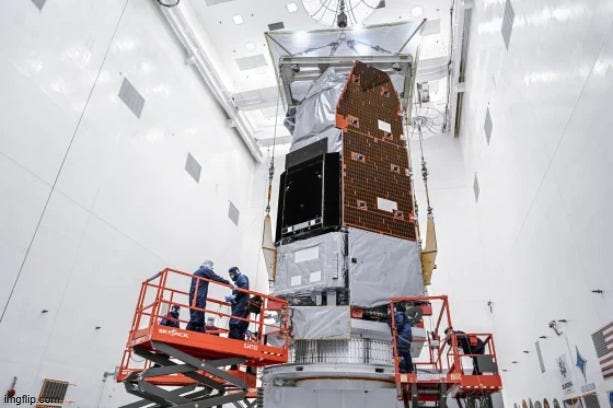
The architecture of cosmic discovery often arises from the ashes of geopolitical secrets. In the late twentieth century, the United States National Reconnaissance Office embarked on a multibillion-dollar spy satellite initiative known as the Future Imagery Architecture, designed to look down at Earth with unprecedented clarity. The project sought to construct ultra-precise reconnaissance satellites with giant mirrors capable of resolving objects smaller than a coffee mug. However, massive financial overruns and severe developmental delays forced the intelligence community to cancel the optical portion of the program in 2005. Left with highly classified, unlaunched hardware sitting silently in climate-controlled storage, the government made an unprecedented pivot in 2012 by donating two of these pristine, military-grade telescope assemblies to NASA.
Transforming a machine built for terrestrial surveillance into an explorer of deep space became a triumph of scientific resourcefulness, though the path to the stars was repeatedly threatened by political turbulence. During his presidency, Donald Trump tried to cancel the mission more than once, zeroing out its funding in multiple annual federal budget proposals under the claim that other space priorities took precedence. Each time, a dedicated coalition of lawmakers, astronomers, and international partners rallied to save the observatory, convincing Congress to restore its funding. They recognized that abandoning a pre-built, Hubble-sized mirror would be a tragic waste of a generational opportunity to map the cosmos.
Now officially named the Nancy Grace Roman Space Telescope in honour of NASA’s first chief astronomer and the pioneering mother of Hubble, the observatory has traded its secret military past for an inspiring civilian future. Instead of monitoring national borders and adversarial movements, its new purpose is to unlock the grandest mysteries of astrophysics. Roman will seek to constrain dark energy, the mysterious force driving the accelerating expansion of the universe, and map the cosmic web of invisible dark matter. Additionally, it will execute a massive statistical census of the Milky Way, observing billions of stars to discover thousands of worlds orbiting distant suns, including rogue planets drifting alone through the dark.
To achieve this immense survey capability, the spacecraft relies on two cutting-edge onboard instruments. The first is the Wide Field Instrument, a three-hundred-megapixel near-infrared camera that gives the telescope a field of view one hundred times larger than that of Hubble’s infrared cameras, allowing it to capture sweeping cosmic panoramas with identical sharpness. The second is the Coronagraph Instrument, a revolutionary piece of starlight-suppression technology designed to act like a cosmic pair of sunglasses, blocking the blinding glare of distant stars so scientists can directly photograph and analyse the faint atmospheres of nearby exoplanets.
Decades of engineering, political survival, and meticulous retrofitting have finally culminated at the launch site, where the spacecraft sits encapsulated inside its protective fairing. The countdown is officially underway for an upcoming launch from Launch Complex 39A at Kennedy Space Center in Florida, where a SpaceX Falcon Heavy rocket will lift the observatory into the skies. From there, Roman will embark on a million-mile journey to the second Lagrange point, shedding its heritage as a weapon of silent surveillance to become a shared beacon of human curiosity and universal discovery.