

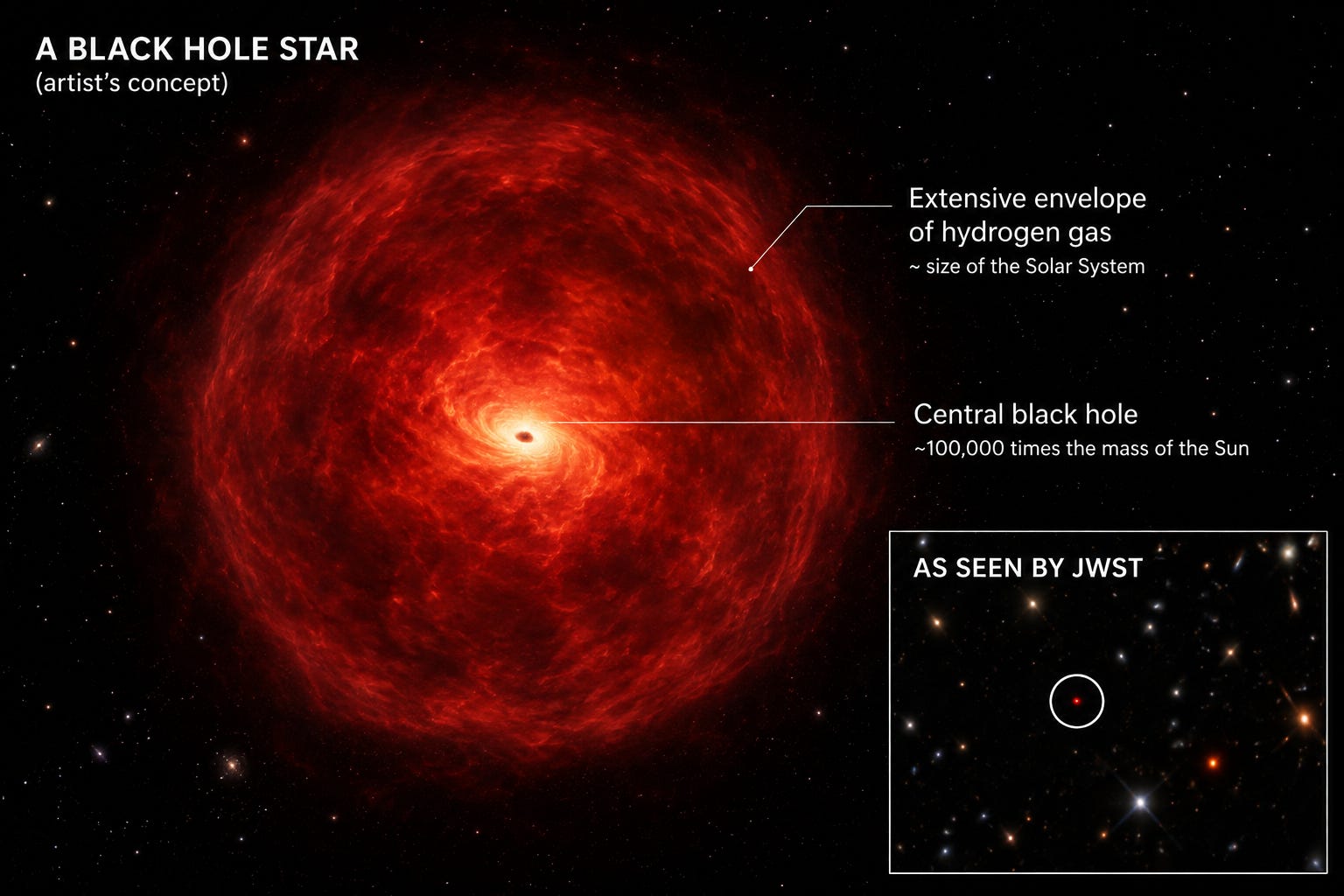
The cosmos has a profound way of shattering humanity’s neatest scientific boundaries, and its latest revelation is perhaps the most awe-inspiring yet. Peering deep into the ancient infancy of space-time, the James Webb Space Telescope has uncovered a brand-new class of celestial body known as a black hole star.
This bizarre hybrid object, officially named MoM-BH*-1, was captured glinting in the constellation Cetus as it existed a mere 660 million years after the Big Bang. It challenges our fundamental definitions of how things shine, pairing the ultimate bringer of light with the ultimate symbol of cosmic darkness.
To look upon a black hole star is to witness an engine of unprecedented scale and fury. At its core sits a voracious black hole packing roughly 100,000 times the mass of our sun. Instead of drifting naked through the empty void, this gravitational titan is wrapped completely in an unimaginably vast, dense cocoon of primordial hydrogen gas that spans the physical size of our entire solar system.
While a normal star generates its warmth through the elegant atomic choreography of nuclear fusion, this hybrid giant pays its energy bills through absolute destruction. As the central black hole forces the surrounding gas inward at extreme speeds, the friction and gravity generate an astonishing 100 billion times more energy than any ordinary star could ever physically produce.
The identification of this cosmic marvel solves a long-standing headache for astrophysicists working on the MIT Kavli Institute and University of Hawaii teams. For months, the space telescope had been spotting mysterious, ultra-bright “little red dots” in the deep universe that defied traditional textbook explanations. MoM-BH*-1 provided the smoking gun when its light was separated by wavelength, revealing a jaw-dropping spectrum signature known as a Balmer break.
The hydrogen gas envelope is so dense that it absorbs and re-emits the violent radiation of the hidden black hole, essentially disguising the monster as a magnificent, glowing crimson star. It appears that many, if not all, of those perplexing little red dots scattered across the early cosmos are actually these black hole stars quietly driving the growth of the universe’s earliest supermassive black holes.
Beyond its raw physical statistics, the black hole star offers an inspirational shift in how we perceive cosmic evolution. For decades, astronomers assumed that galaxies had to form first, acting as stellar nurseries to slowly nurture black holes over billions of years. The discovery of MoM-BH*-1 by the Mirage or Miracle survey hints at a far more dynamic, rebellious origin story where naked black holes can rapidly evolve out of raw gas clouds completely independent of a host galaxy.
It serves as a beautiful reminder that even in the cold, dark, and chaotic beginnings of the universe, nature finds a way to forge structures of brilliant light and complexity, proving that we are still only beginning to turn the pages of the cosmic script.