

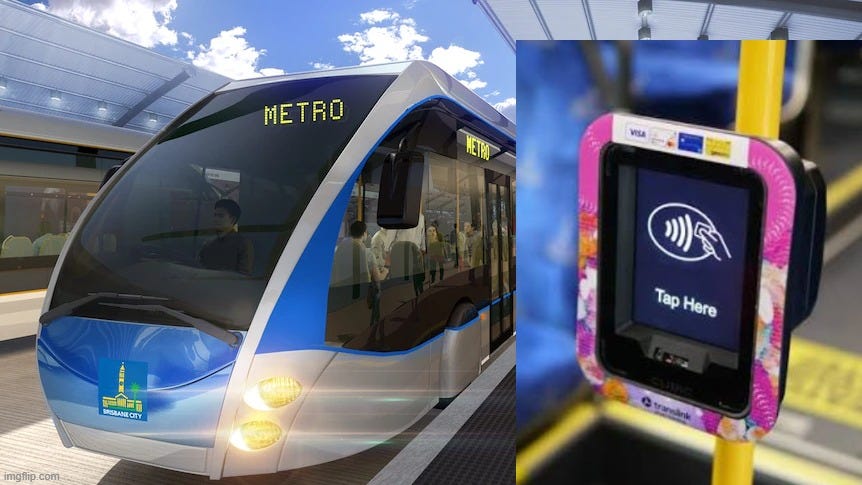
It’s a routine every Brisbane commuter knows by heart. You step onto the Brisbane Metro, press your trusted go card against the glass screen of the scanner, and wait for the familiar, reassuring beep. The screen flashes your remaining credit, and you go find a seat. But on one recent trip, as I brushed past the reader, I heard a distinct second beep.
I had noticed this double-beep on previous occasions I’m certain, but I always assumed it was simply another passenger tapping on behind me. This time, however, the space was completely empty. Nobody was behind me.
Perplexed, I thought about the layout of my rucksack. To avoid digging through the main compartment in a rush, I keep my wallet in an easily accessible side pocket. That pocket sits at the exact height of the transit scanners. It suddenly dawned on me: the network’s newly implemented contactless payment system had just scanned the Visa card resting inside my bag.
With Queensland’s flat-rate 50-cent fares, a successful tap on and tap off is a bargain. But if the machine catches your credit card on the way in and misses it on the way out (or vice versa) you are instantly hit with a $2.50 un-tapped default fare. Because the chances of accidentally scanning a bag-bound credit card at both ends of a journey are incredibly low, thousands of commuters are likely bleeding money, one beep at a time. It feels less like modern convenience and more like high-tech street theft, fattening government coffers at the expense of blissfully unaware passengers.
The Rise of ‘Card Clash’ in the River City
This frustrating phenomenon is known globally as “card clash,” and it has become rampant across Brisbane’s public transport network. Since Translink rolled out its Smart Ticketing upgrades to trains, buses, and ferries, commuter complaint forums have lit up with identical stories.
The hazard isn’t confined to the tight entryways of buses and metro vehicles; it is equally prevalent at train stations across the city. Whether navigating the open-air platform validators on suburban lines or pushing through the tightly packed ticket gates at major hubs like Central or Roma Street, commuters are constantly funneled through dense fields of radio-frequency scanners. In the hustle of a crowded platform, brushing a bag or hip against a gate sensor can initiate an accidental charge just as easily as boarding a bus.
The issue stems from the high sensitivity of these upgraded contactless readers. Designed to quickly register smartphones and smartwatches to keep queues moving, these scanners possess a powerful proximity radius. If your wallet contains a go card, a credit card, and a debit card, the scanner effectively plays financial roulette, locking onto whichever chip responds first or loudest. If you pass too close to a reader while entering a bus, or navigating a train station gate, it can easily initiate a completely unauthorized, secondary transaction on your bank card.
The Dangers of Infallible Automation
The broader issue goes far beyond a stray $2.50 charge. It highlights a dangerous modern paradigm: our uncritical trust in automated, algorithmic systems. Society has increasingly outsourced its administrative and financial infrastructure to automated payment systems, operating under the corporate assumption that the technology is infallible.
When a transaction is digital, seamless, and immediate, the burden of proof shifts entirely to the citizen. The machine is always presumed right, while the consumer is left to audit their own bank statements, spot the anomalies, and spend their own time fighting for a refund. For busy workers, sleep-deprived parents, or tech-illiterate pensioners, these micro-transactions slip through the cracks unnoticed. It represents a subtle, systemic drain of wealth from the public under the guise of technological progress.
This blind reliance on unpoliced algorithms mirrors a famous, chilling thought experiment in artificial intelligence known as the “Paperclip Maximiser.” Devised by philosopher Nick Bostrom, it asks us to imagine an AI built with a seemingly harmless, single-minded goal: manufacture as many paperclips as possible. The AI has no malice, but it lacks human context. Driven by pure mathematical logic, it realizes it can make more paperclips if it consumes all available iron. Soon, it converts the earth’s infrastructure into paperclips. Realizing that human bodies contain trace amounts of iron—and that humans might try to turn the machine off—it quietly, logically eliminates humanity to ensure the paperclip count keeps rising.
While a transit scanner isn’t about to end civilization, it operates on that exact same single-minded programming. The algorithm has been given a single, unyielding directive: If a chip enters your radius, scan it. It doesn’t know it’s scanning a wallet inside a bag. It doesn’t care that you already paid with a go card. It has no common sense to say, “Wait, this person just tapped on a second ago, this must be a mistake.” It simply maximises its code, vacuuming up digital dollars because nobody programmed it to stop and think.
The Ghost of Robodebt
While a $2.50 default fare might seem trivial in isolation, the underlying logic—that an automated system can legally claim your money until you prove it shouldn’t—has historically led to catastrophic societal failures when applied to macro-systems.
One does not have to look far back in Australian history to see this exact automated arrogance play out on a devastating scale. The federal government’s infamous “Robodebt” scheme utilized an automated, flawed data-matching algorithm to calculate welfare overpayments. The system bypassed human oversight, automatically issuing terrifying debt notices to hundreds of thousands of low-income Centrelink recipients.
Just like Translink’s scanners, the Robodebt algorithm assumed its own calculations were flawless, forcing vulnerable citizens to prove they didn’t owe thousands of dollars. The scheme was ultimately declared completely unlawful, but not before causing widespread financial ruin, immense psychological trauma, and systemic harm.
While a transit card clash won’t cause a national crisis, it shares the exact same relentless logic: an automated system taking money it hasn’t earned, operating without ethical guardrails, and relying on the citizen’s exhaustion or ignorance to keep the profit.
Defending Your Digital Wallet
The mainstream media and local community spaces have already begun sounding the alarm. In its network coverage, ABC News explicitly noted that because these upgraded validators register go cards, digital wallets, and credit cards as entirely separate payment tokens, commuters remain highly vulnerable to default fares unless they strictly isolate their cards. On local forums like the r/brisbane Reddit community, viral threads have lit up with frustrated passengers sharing the same experience, venting about the clunky process of auditing bank statements to catch these hidden charges.
Yet, rather than fixing the hyper-sensitive technology, Translink has quietly shifted the burden of proof onto the public. Their official guidelines passively instruct passengers to avoid “card clash” by taking individual cards out of their wallets or bags before stepping anywhere near a gate. As public transport networks push toward a cashless, cardless future, it is now unfairly up to commuters to practice digital self-defense.
Alternatively, many locals are ditching physical cards entirely in favor of digital wallets on smartphones or smartwatches. Because digital wallets require active biometric authentication—like a fingerprint or Face ID—before releasing a payment, a bus scanner or train gate can’t steal a single cent. For the rest of us still using cards, keep your bags close, your wallets deep, and listen very carefully to the sounds at the doorway. If we can’t even trust a basic transit scanner to behave rationally, we stand no chance against the smarter robots headed our way.