

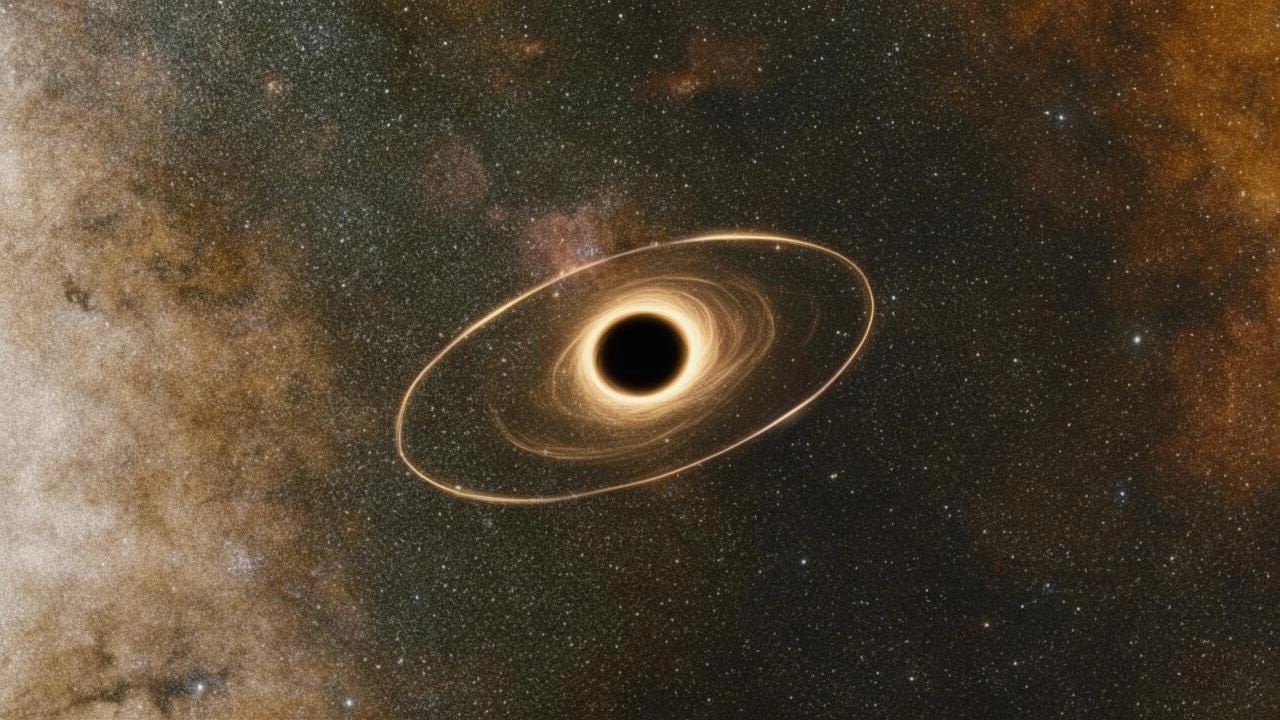
Deep in the shrouded, chaotic heart of the Milky Way, a celestial speed demon is fundamentally reshaping our understanding of the universe. For decades, astronomers have trained humanity’s most powerful telescopes toward Sagittarius A*, the supermassive black hole anchoring our galaxy.
They knew this gravitational behemoth creates an environment of unmatched extremes, but recent observations have unveiled a cosmic resident that defies imagination. A newly discovered star named S301 has officially claimed the title of the fastest known star in the galaxy, performing a high-stakes orbital dance that brings it breathtakingly close to the abyss.
Traveling at a blistering twenty-five thousand kilometres per second, S301 streaks through the cosmos at more than eight percent of the speed of light. To put this mind-boggling velocity into perspective, a commercial airliner would take days to traverse the distance this single star covers in just one second.
Unlike our own sun, which takes hundreds of millions of years to complete a leisurely circuit around the galactic center, S301 wraps up its entire highly elongated orbit in a mere eight point seven years. It is an astronomical sprinter operating on an unprecedentedly tight track, enduring gravitational forces that would tear lesser objects apart.
At the closest point in its cosmic race, S301 approaches the supermassive black hole at a distance roughly equivalent to Saturn’s distance from our sun. In the grand architecture of space, this is virtually spitting distance from a gravity well packed with the mass of over four million suns. Astrophysicists believe the star could not have possibly formed in such a hostile neighborhood.
Instead, it was likely born further out as part of a twin binary system before wandering too close to the center. In a dramatic cosmic heist, the immense tidal forces of the black hole severed the sibling connection, swallowing the orbital energy, trapping S301 in its current extreme path, and slinging its partner out toward intergalactic space.
Beyond its sheer record-breaking speed, S301 represents a holy grail for modern physics. Because it skims so close to the event horizon, it is the first known star that enters the zone where it can actively feel the rotation of the black hole itself. Einstein’s general theory of relativity predicts that a massive, spinning object will literally drag the very fabric of spacetime along with it, creating a subtle wobble in the orbits of nearby bodies.
By meticulously tracking S301 over the coming decade, scientists expect to capture this distortion in real time, effectively using a single star as a glowing lantern to illuminate the invisible contours of warped spacetime. It stands as an inspiring testament to human curiosity that a faint object hidden behind twenty-six thousand light-years of cosmic dust can teach us the deepest secrets of our universe.