


For centuries, humanity has lived under a sky dictated by the turning of the Earth, a natural rhythm of light and shadow that has shaped both our biology and our industries. Today, a bold and disruptive vision from a Silicon Valley startup called Reflect Orbital is seeking to challenge this fundamental paradigm by bringing sunlight into the dark of night. By proposing a constellation of orbital satellites equipped with highly reflective, ultra-thin mirrors, the company intends to capture sunlight high above the planet and beam it directly down to specific targets on the ground. This space-based sunlight could illuminate cities, assist in emergency response during nighttime natural disasters, and most importantly, supercharge the clean energy sector. By reflecting sunlight onto massive solar farms after twilight, this technology promises to transform solar power from an intermittent, daytime-only resource into a continuous, round-the-clock pillar of the global energy grid. It is an inspiring testament to human ingenuity, aiming to reshape our relationship with our nearest star and unlock a future of boundless, sustainable electricity.
To achieve this dream of continuous space-based solar power, the company faces the monumental challenge of precision orbital mechanics and attitude control. Satellites orbiting hundreds of kilometres above the Earth move at speeds exceeding twenty-seven thousand kilometres per hour, requiring highly sophisticated propulsion and reaction wheel systems to maintain alignment. The ultra-thin, lightweight mirrors must be steered with milliradian accuracy to keep a concentrated beam of sunlight fixed on a specific ground-based solar array. Even a minuscule deviation in the mirror’s angle could misdirect the beam by kilometres, rendering the energy transfer useless and potentially illuminating unintended areas. Furthermore, these structures must withstand the harsh environment of space, including atomic oxygen erosion, solar radiation pressure, and thermal expansion cycles, all while maintaining a perfectly flat reflection surface to prevent light scattering.
The economic equation underlying space-based sunlight hinges on a delicate balance between upfront aerospace engineering costs and the competitive pricing of terrestrial battery storage, the current standard for keeping the lights on after dark. Conventional batteries function by hoarding excess energy generated during peak daylight hours and discharging it later in the evening. While effective, this process is bound by the laws of thermodynamic inefficiency, with energy lost during both the chemical charging and discharging cycles, not to mention the high environmental and financial costs of manufacturing massive lithium-ion installations. Reflect Orbital proposes an entirely different paradigm where, instead of capturing and storing electricity, the system extends the production window of the solar infrastructure itself by delivering raw sunlight directly to existing panels during the night. This approach bypasses the storage bottleneck entirely, offering a complementary mechanism that ensures expensive solar farms remain active and productive when market demand and electricity prices are at their highest.
Yet, critics and energy analysts point out that while utility-scale lithium-ion battery costs have plummeted by more than twenty per cent in recent years, the expense of launching and operating a massive satellite constellation remains astronomical. Initial projections suggest that renting a beam of orbital sunlight could cost thousands of dollars per hour per satellite. For a ground-based solar farm to receive a continuous hour of daylight-strength illumination, an orchestrated pass of tens of thousands of satellites would be required, potentially driving the cost of that single hour of power generation into the tens of millions of dollars. Compared to the falling costs of storing excess daytime energy in chemical batteries, the premium for orbital light must drop significantly to become a viable option for mainstream utility companies, though it could find niche financial viability in emergency disaster relief or military operations.
To prove the commercial and technical viability of the concept, the company is aggressively pursuing a strict timeline of orbital demonstrations. The Federal Communications Commission granted official authorization for the startup to construct, launch, and operate its first prototype satellite, named Earendil-1. Scheduled to launch into low Earth orbit in the coming months, this initial spacecraft will deploy an eighteen-metre square thin-film reflector made of aluminum and space-grade plastic. The primary goal of this first mission is to execute a five-minute demonstration, directing a three-mile-wide beam of light to target areas with an illumination roughly equal to the brightness of a full moon. If this initial test succeeds, the startup plans a rapid escalation, aiming to deploy thirty-six satellites to begin refining its service, with an ultimate goal of putting up to fifty thousand mirror-bearing spacecraft into orbit by the mid-2030s to provide hours of daylight-level illumination.
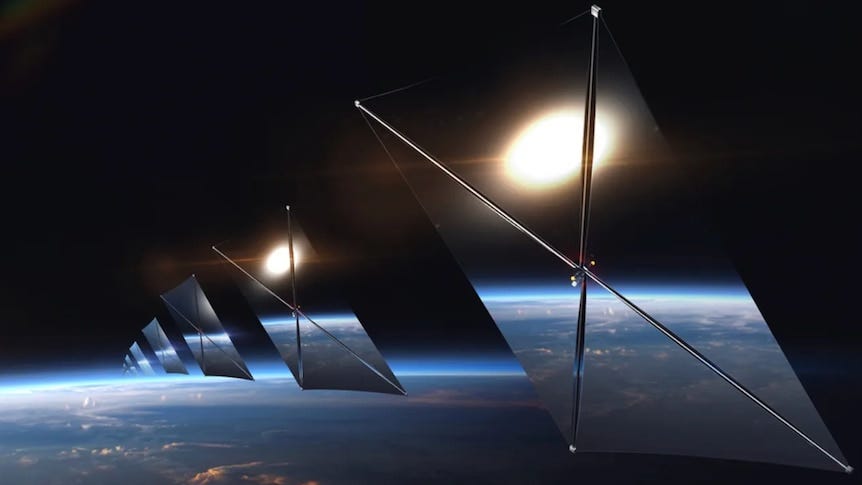
Yet, this ambitious leap toward engineering the planetary light cycle has sent a tremor of deep anxiety through the global scientific community. For astronomers, the darkness of the night sky is not a void to be filled, but a pristine window into the cosmos, essential for decoding the mysteries of the universe. The prospect of multiple highly reflective satellites traversing the heavens threatens to introduce an unprecedented level of artificial light pollution into Earth’s orbit. Even a small fleet of these space mirrors could create brilliant streaks of light across the night sky, easily blinding the ultra-sensitive digital detectors of modern telescopes. Major astronomical projects, which rely on long-exposure photography to capture the faint, ancient light of distant galaxies and passing asteroids, could see their data severely compromised. Scientists warn that a sky punctuated by artificial sunbeams could mask celestial phenomena, hindering our ability to detect planetary threats or make foundational discoveries about the nature of space and time.
Ultra-sensitive observatories, such as the Vera C. Rubin Observatory in Chile, are built in remote deserts specifically to capture the faintest glimmers of ancient light from the early universe. For these state-of-the-art facilities, a sky crisscrossed by thousands of giant orbiting reflectors is a worst-case scenario. Researchers warn that the unexpected glare and bright streaks from these tennis-court-sized mirrors could permanently ruin long-exposure images, blinding the delicate digital sensors used to map dark matter or track dangerous near-Earth asteroids. Leading astronomical organizations argue that unlike the predictable paths of standard communication satellites, a dynamic fleet of mirrors redirecting light on demand presents a chaotic, uncontrollable source of light pollution that threatens the core of modern observational astrophysics.
The environmental concerns extend far beyond the telescopes, touching the very fabric of terrestrial ecosystems. For billions of years, life on Earth has evolved under the steady predictability of natural day-night cycles, a balance that could be fundamentally disrupted by localized twilight illumination. Biologists warn that artificial sunbeams could severely impact nocturnal wildlife, disorienting migrating birds that navigate by the stars and confusing insect populations that form the baseline of global food webs. Furthermore, human communities situated near targeted solar arrays could face unexpected health consequences. Exposure to artificial daylight during normal sleeping hours risks disrupting human circadian rhythms, suppressing melatonin production, and leading to chronic sleep deprivation. Critics argue that altering the natural darkness of the night sky introduces an unprecedented form of ecological pollution whose long-term biological consequences remain entirely unmapped.
On the policy front, the international community lacks a comprehensive legal framework to regulate orbital brightness, forcing astronomers and space lawyers into unchartered territory. The landmark Outer Space Treaty of 1967 guarantees the freedom of scientific exploration but does not explicitly address light pollution or the preservation of the dark night sky. Astronomers are actively lobbying bodies like the United Nations Committee on the Peaceful Uses of Outer Space and the International Astronomical Union to establish binding limits on satellite reflectivity. Current mitigation discussions focus on implementing mandatory dark coatings for satellite chassis, limiting mirror operations to specific non-astronomical hours, and creating internationally recognized quiet zones in the sky. Humanity is not without historical reference for this dilemma; during the 1990s, the Russian Znamya experiments successfully deployed a twenty-meter space mirror from the Mir space station, proving that orbital light reflection was possible while triggering early outcries about the commercialization of the night.
As this new space rush accelerates, humanity stands at a critical crossroads where two profound visions for our future hang in the balance. On one side is the immediate, terrestrial necessity to combat climate change through revolutionary green energy infrastructure that utilizes every possible watt of solar radiation. On the other side is the timeless, existential drive to look outward and preserve our view of the wider universe, a pursuit that requires an unblemished and dark night sky. The unfolding debate over space-based mirrors highlights the urgent need for an international framework to govern orbital light pollution before the heavens become too crowded and bright. It challenges us to find a delicate equilibrium, ensuring that our quest to power life on the ground does not inadvertently close the window to the stars above.