

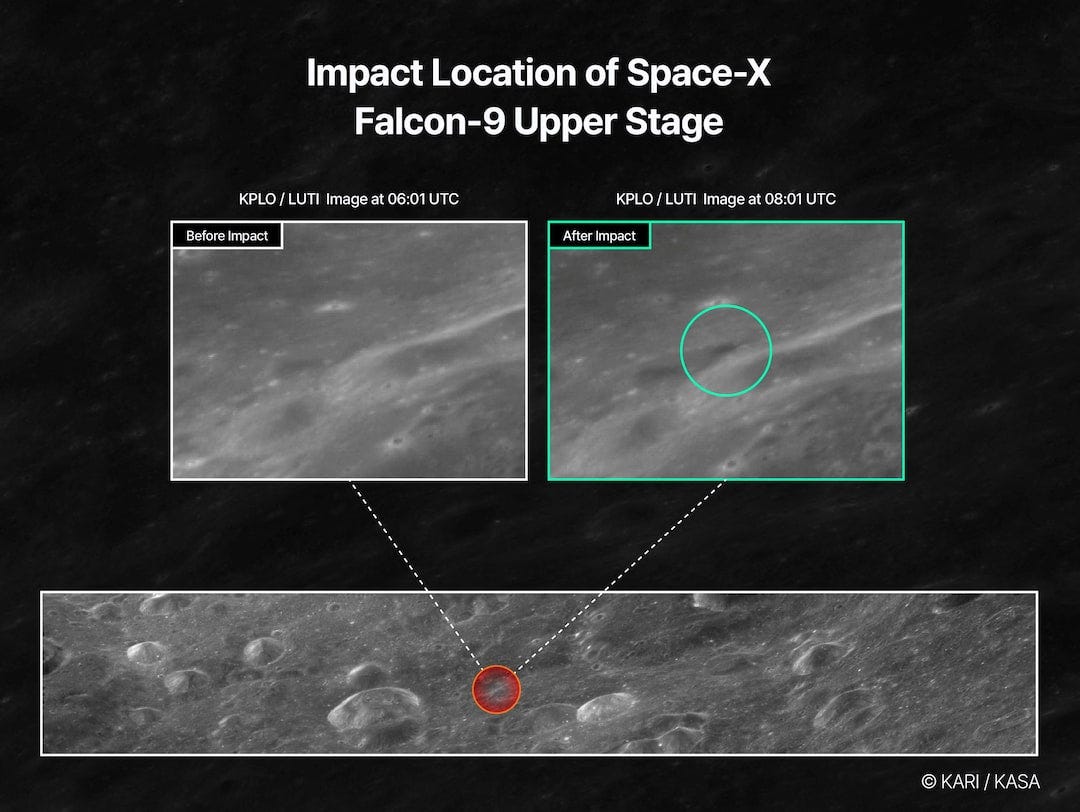
SpaceX has finally reached the moon. In an unexpected fashion. Space exploration has always been a game of precise trajectories, but every so often, a cosmic miscalculation delivers a profound scientific gift. In early 2022, a spent SpaceX Falcon 9 upper stage that had drifted aimlessly through the Earth-Moon system for seven years finally succumbed to gravity, slamming into the far side of the Moon at nearly ten thousand kilometres per hour. While the collision occurred out of sight from terrestrial telescopes, NASA’s Lunar Reconnaissance Orbiter has now successfully located and imaged the crash site. The resulting data has provided planetary scientists with a rare, controlled glimpse into how high-velocity impacts reshape the lunar surface, transforming a piece of space junk into a vital tool for deep-space geology.
When the robotic orbiter swept over the impact zone, its high-resolution cameras revealed a structure that immediately defied standard expectations. Instead of a single, uniform depression, the images exposed a complex, double crater consisting of an eastern bowl overlapping a western bowl. This unusual morphology suggests that the rocket stage carried a significant amount of mass at both ends, rather than just a heavy engine assembly at the base. By analyzing the unique geometry of this fresh scar, engineers can now better understand the structural dynamics of large, tumbling objects hitting airless bodies, which will prove essential for protecting future lunar habitats from similarly massive debris.
Beyond the mechanical insights, the successful imaging demonstrates the incredible utility of long-lived orbital assets like the Lunar Reconnaissance Orbiter. Spotting a crater only a few dozens of metres wide across the vast, rugged expanses of the lunar highlands is akin to finding a needle in a planetary haystack. The team accomplished this feat by meticulously comparing before-and-after imagery of the predicted impact zone, tracking subtle changes in the reflectance of the surrounding soil. This level of precision shows that humanity can now actively monitor the changing face of the Moon in real time, documenting our expanding technological footprint on another world.
Ultimately, this accidental experiment bridges the gap between human history and planetary evolution. The double crater left by the Falcon 9 will remain preserved in the vacuum of space for millions of years, joining the historic impact sites of the Apollo Saturn V third stages from decades ago. It reminds us that as humanity ventures further into the cosmos, our path will be marked not just by intentional landings, but by the chaotic, unintended monuments we leave behind. Each one, however accidental, offers a fresh page of data to help us decipher the violent history of the solar system.