

Abstract
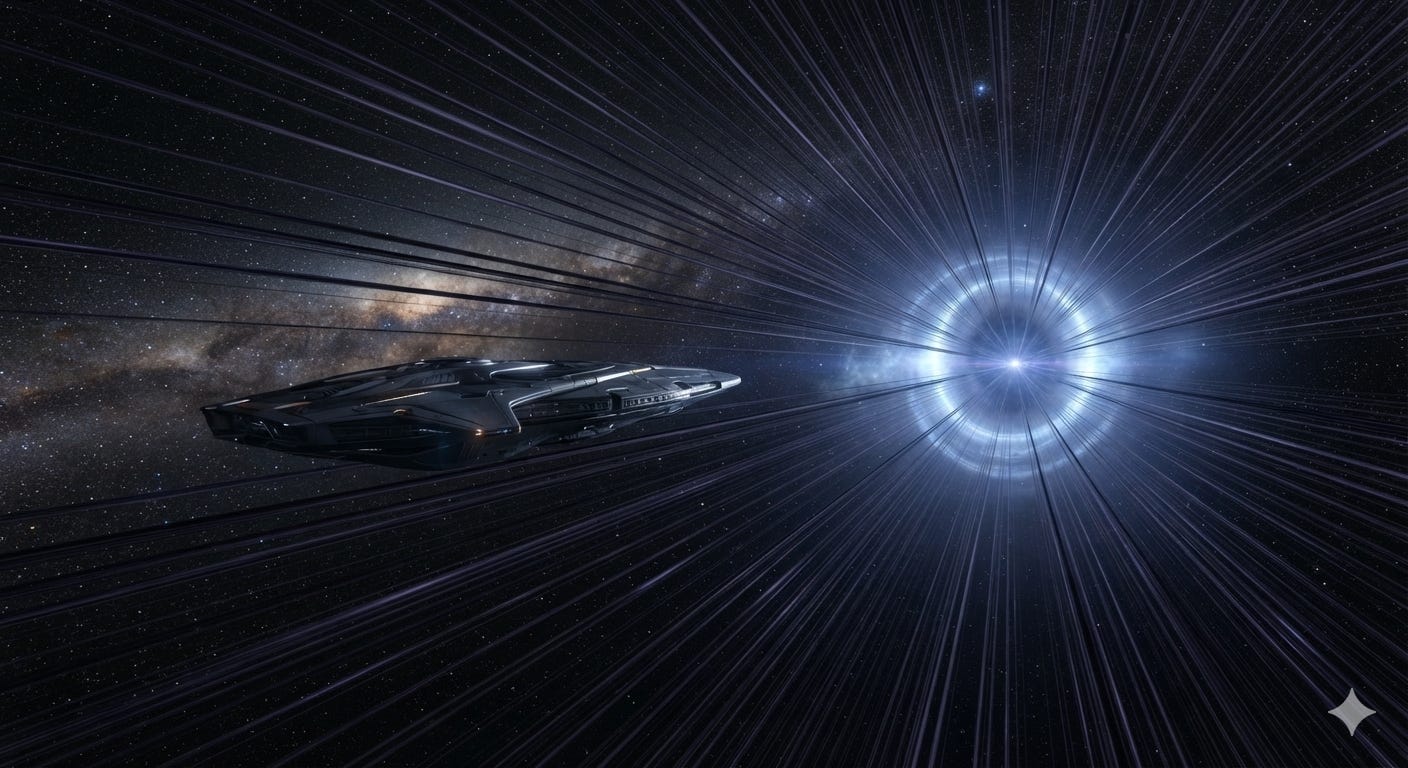
We examine a propulsion concept in which dense concentrations of dark matter are formed and maintained ahead of a spacecraft by intersecting, controllable dark-matter beams. The ship free-falls toward these concentrations, achieving high coordinate accelerations while experiencing zero proper acceleration. Order-of-magnitude calculations are presented for the mass required as a function of acceleration and standoff distance, the associated power budget, tidal limits, beam divergence, and comparisons with laser-sail and other relativistic propulsion methods. The scheme presupposes the ability to create, accelerate, focus, and modulate intense beams of dark matter — a capability that does not exist and may never exist. Under that assumption, and in an energy-rich (Kardashev II–III) setting, the architecture offers unique advantages for rapid, high-comfort interstellar travel.
How I came upon this idea
The idea did not begin with dark matter at all. The more obvious starting point is light: photons carry energy, and in general relativity, energy curves spacetime exactly as mass does. This raises a tempting possibility — could enough crossed, sufficiently intense laser beams concentrate energy at their intersection point densely enough to warp spacetime into a usable gravitational well, pulling a spacecraft along behind it? This configuration has a name in the theoretical physics literature: a kugelblitz, a hypothetical black hole formed from pure electromagnetic radiation rather than matter. It is not a fringe notion — Wheeler-style "geon" solutions and subsequent work have shown it is a mathematically valid solution to Einstein's field equations.
It is also, as far as we can tell, physically unreachable. The energy density required sits roughly fifty orders of magnitude beyond anything current or foreseeable laser technology can produce. Worse, recent theoretical work (Martín-Martínez et al., 2024) suggests the concept may fail even in principle: as electromagnetic energy is concentrated toward the densities required, quantum electrodynamics intervenes first — the Schwinger effect converts the photons into electron-positron pairs before an event horizon can ever form. The light, in effect, turns into ordinary matter and disperses before it can finish becoming a gravitational trap. There is a second, more geometric obstacle as well: a single beam, moving uniformly at light speed, cannot serve as a gravitational source at all, since its curvature effects would not be consistent across different reference frames. Only crossed or intersecting beams can, in principle, satisfy the required symmetry — a detail that turns out to anticipate the architecture explored in this piece.
Dark matter possesses rest mass and negligible self-interaction with itself and with ordinary matter alike, meaning many thousands, millions or billions of overlapping beams can be driven through the same volume simultaneously without the beams scattering off one another or being absorbed by intervening dust and gas the way an equivalent density of crossed light or particle beams would be. Photons fail this scheme because concentrating them to useful densities triggers pair production long before a useful well can form. Dark matter, if it can ever be produced and directed at all, might sidestep the problems discovered with photons.
Ruling out photons is what motivates the turn to dark matter. The appeal of dark matter is that it is close to the only known category of "stuff" that might combine appreciable mass with negligible self-interaction — precisely the two properties a workable gravitational-well drive would require, and precisely the two properties photons conspicuously fail to provide.
1. Introduction
Conventional and most advanced propulsion concepts either impart proper acceleration to the vehicle or rely on momentum transfer from an external beam. An alternative is to place a gravitational mass concentration ahead of the ship so that the vehicle free-falls toward it. If such concentrations can be formed sequentially or continuously advanced, the ship can be accelerated to relativistic speeds while remaining in free fall. Dark matter is an attractive working fluid for this purpose because, by definition, it interacts negligibly via electromagnetism and the strong force. In principle, it can be concentrated to high mass density without Coulomb or nuclear repulsion. The present note explores the resulting architecture, quantifies its energy and mass requirements, and states the necessary (and currently unavailable) technological prerequisites.
2. Concept
Intersecting dark-matter beams create a localized overdensity of mass (M) at a controlled distance (r) ahead of the spacecraft. The ship free-falls toward the overdensity with coordinate acceleration:
a ≈ GM / r²
(Newtonian limit; general-relativistic corrections become important only at small r/R_S). By continually forming new overdensities farther ahead (or by translating a continuous “ridge” of dark matter), the ship can be kept in a prolonged free-fall state. Deceleration is accomplished symmetrically at the destination.
3. Order-of-Magnitude Calculations
3.1 Mass required
M = a·r² / G
For a = 10³ m/s² (≈100 g) and a standoff r = 100 m:
M ≈ 1.5 × 10¹⁷ kg
(approximately 0.025 Earth masses). Reducing r to 30 m lowers M by an order of magnitude but increases tidal stresses.
3.2 Tidal limits
The differential acceleration across a ship of length (L) is:
Δa ≈ 2GM·L / r³
For L = 100 m, M = 1.5 × 10¹⁷ kg and r = 100 m:
Δa ≈ 20 m/s²
Smaller r or larger L rapidly makes tides destructive. A compact vehicle or a more extended, lower-density mass distribution is required for high-a operation.
3.3 Power budget
The solar luminosity is 3.8 × 10²⁶ W, equivalent to ≈4 × 10⁹ kg/s of mass-energy. Assembling one 1.5 × 10¹⁷ kg concentration at 100% efficiency requires ~1 year of the Sun’s entire output. Continuous or sequential operation for a relativistic trajectory multiplies this figure. A star of 20–50 solar masses (luminosity 10⁴–10⁶ L☉) reduces the wall-clock time proportionally. Galaxy-scale infrastructure can distribute the load across many stars.
3.4 Beam divergence
Dark-matter particles free-stream. Any velocity dispersion δv produces a transverse spreading δx ≈ (δv/v)·D after distance D. Maintaining a focus of order 100 m at 1 AU already demands δv/v ≲ 10⁻¹⁰–10⁻¹²; interstellar distances require correspondingly tighter collimation or intermediate re-focusing stations.
3.5 Comparison with laser sails
A laser-sail system must deliver momentum p = γmv via radiation pressure. At γ ≈ 2–10 the energy that must be radiated is already many times mc². The dark-matter-well architecture does not push the ship; it causes the ship to fall. The energy is invested in the gravitational source rather than in the kinetic energy of a photon beam. In an energy-rich environment the two approaches become complementary: laser sails for modest γ and low infrastructure, gravitational wells for high-γ, high-comfort crewed transit.
4. Prerequisites and Assumptions
The scheme requires the ability to:
produce intense, directed beams of dark matter;
focus and modulate those beams with extreme precision;
concentrate dark matter to the densities calculated above without uncontrolled collapse or dispersal.
None of these capabilities exist. Dark matter has never been detected in the laboratory, and its non-gravitational couplings (if any) remain unknown. The entire architecture is therefore conditional on a major, presently unforeseeable advance in fundamental physics and engineering. Additional assumptions include the availability of stellar-scale energy collection and a network of control stations spanning interstellar distances.
5. Performance in Energy-Rich Environments
Around supermassive black holes or inside Dyson spheres powered by very massive stars, the energy constraint is relaxed. In such settings the concept’s principal remaining advantages — zero proper acceleration at high coordinate a, and absence of onboard propellant, — make it competitive with, and in some regimes preferable to, photon sails, antimatter drives, or black-hole Hawking-radiation engines. A galaxy-spanning implementation (Kardashev III) would allow essentially arbitrary terminal velocities limited only by shielding and navigation.
6. Limitations and Risks
Extreme sensitivity to beam collimation and timing.
Tidal and merger dynamics if concentrations approach black-hole densities.
Incomplete shielding against interstellar particles at γ ≫ 1.
Catastrophic outcome if a concentration is misplaced relative to the ship.
7. Conclusions
Sequential dark-matter gravitational wells constitute an original speculative propulsion architecture that cleanly separates coordinate acceleration from proper acceleration. Quantitative estimates show that the mass and power requirements are large but lie within the output of stars once full stellar energy collection is assumed. The decisive prerequisite — controllable dark-matter beams — lies beyond present physics. Should that prerequisite ever be met, the scheme would rank among the most attractive options for rapid interstellar travel in an energy-rich civilization.
As it happens, humanity may be about to learn something directly relevant to this entire architecture. NASA's Nancy Grace Roman Space Telescope launched on August 30, 2026, and is now en route to the Sun-Earth L2 point, where it will spend its mission mapping the large-scale distribution of dark matter across the cosmos via gravitational lensing, at a scale roughly 100 times wider than Hubble's field of view. Roman won't detect dark matter particles directly, and it certainly won't tell us how to beam or collimate them — that leap remains as distant as ever. But it may meaningfully sharpen our understanding of how dark matter clusters, behaves, and interacts gravitationally at scale, which is precisely the foundational knowledge any future attempt at an architecture like this would need before the far harder question — whether dark matter can ever be manipulated at all — could even be seriously asked.
Collection vs Manufacturing of Dark Matter
It is also worth noting that the economics of this architecture look considerably better if the necessary dark matter is collected rather than manufactured outright. Producing a single 1.5×10¹⁷ kg concentration from pure energy, via E = mc², costs on the order of 10³⁴ joules — roughly a full year of the Sun's entire output, as noted above. Collecting an equivalent mass from the ambient dark matter already present in space avoids that conversion cost entirely, though it trades one immense problem for another: at the measured local dark matter density of the galactic neighborhood, gathering that much material means sweeping a volume comparable to the entire solar system out to Neptune's orbit. And because the beam architecture does not consume the dark matter it uses — particles pass through an intersection point and continue on, rather than being spent the way propellant is — a sufficiently advanced civilization would only need to solve that collection problem once. The same reservoir could, in principle, be recirculated and redirected indefinitely to form well after well, turning what looks like a recurring fuel cost into something closer to a one-time capital investment in collection infrastructure.
None of this changes the honest status of the underlying premise, and it is worth being precise about what is actually established versus inferred. Decades of gravitational lensing, galaxy rotation curves, and large-scale structure observations show that dark matter behaves as though it carries mass and interacts negligibly with itself and ordinary matter — strong, repeated, independent evidence, but evidence drawn from gravitational effects at a distance, not from a particle held and measured in a laboratory. Whether that behavior reflects a single, uniform particle species amenable to any form of directed manipulation, or something stranger still hiding beneath the label "dark matter," remains genuinely open. History offers real precedent in both directions: barriers that looked permanent until they weren't, and barriers that have held for a very long time despite enormous sustained effort. Dark matter's near-total absence of non-gravitational interaction may prove to be the harder kind of barrier, closer to a defining property than an engineering gap — the same difficulty, in a different guise, that closes off the photon-based kugelblitz explored earlier in this piece. That does not make the architecture impossible. It only means that everything here rests on learning something about the universe we do not yet know, and that the learning has already begun.