

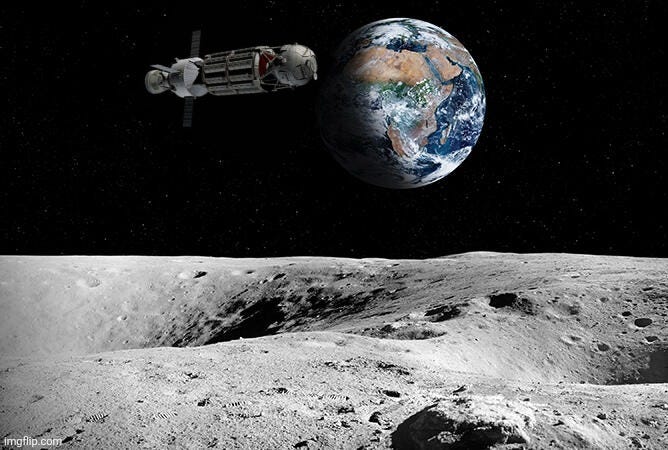
A War Room With No Walls
Most people picture a battlefield as a place with edges, a front line, a hill worth taking, a river worth defending. Cislunar space, the roughly quarter-million-mile volume stretching from Earth’s orbit to the Moon and beyond, has none of that. There is no ground to hold and no fixed line to draw. And yet military planners on at least three continents have spent the last several years treating it as exactly the kind of terrain worth fighting over, complete with high ground, chokepoints, and blind spots, all of it built not from rock and elevation but from the quiet mathematics of gravity.
The High Ground Nobody Can See
In ordinary warfare, the high ground matters because it lets you see farther and strike first. In cislunar space, the equivalent advantage comes from a set of five points where the gravitational pull of Earth and the Moon balance out almost perfectly, known as the Lagrange points. A spacecraft parked at one of these locations can loiter there for a fraction of the fuel it would cost anywhere else, watching, listening, or waiting, for months or years at a time. L1, sitting between Earth and the Moon, offers a clear line of sight to lunar activity on the near side. L2, tucked just behind the Moon, is far enough from Earth’s noisy radio environment to make it a natural perch for deep space sensing, and far enough from prying eyes on Earth to make it a natural place to hide something too.
This is the closest thing cislunar space has to a mountain pass, a place whose value has nothing to do with what is physically there and everything to do with what can be seen, reached, or denied from it. NASA itself spent nearly a decade developing the Gateway station specifically for a near-rectilinear halo orbit chosen for its efficient access to both the lunar surface and this wider cislunar volume, only to pause the project this past March in favor of a surface-first strategy, redirecting the same orbital mechanics insight toward landers and a planned lunar base instead of a permanent waypoint station. The cancellation changed NASA’s architecture, not the underlying geometry; the same halo orbit CAPSTONE proved workable in 2022 remains exactly as valuable to whoever eventually wants to loiter there, and China and Russia have discussed their own joint lunar research station in terms that suggest an awareness of the same terrain. Nobody involved is being coy about why these particular points in empty space keep showing up in mission planning documents from more than one country at once, Gateway’s cancellation included.
Watching a Region Too Big to Watch
The United States has spent decades building an elaborate sensor network to track objects in low Earth orbit, radar installations, optical telescopes, a well-worn system refined since the earliest days of the Space Age. Cislunar space breaks almost all of it. Objects out there are fainter, farther, and moving through a volume so much larger than low Earth orbit that traditional tracking methods essentially run out of reach. The Space Force’s answer has been to build purpose-made tools for exactly this problem, including a new sensor system called the Deep Space Advanced Radar Capability and a satellite named Oracle, designed specifically to extend space domain awareness out to lunar distances. Even with these in place, officials involved in cislunar security work have been candid that the region remains, in practical terms, mostly unwatched, a battlefield where an adversary’s opening move could plausibly go unnoticed for longer than anyone would like to admit.
The First Admission
For years, discussion of weapons in this environment stayed carefully hypothetical, confined to war-gaming exercises and academic papers. That changed on September 15, 2026, when Air Force Secretary Troy Meink confirmed for the first time that the United States already has weapons stationed in orbit, offering no further detail on their number, type, or location. China’s government responded within days, condemning the disclosure as proof of exactly the militarization it had long warned against. The statement did not specify whether any of these systems extend into cislunar space specifically, but it did something more important than any single detail could have: it confirmed that the era of pure ambiguity, of officials neither confirming nor denying, had ended. The United States has since run its first live orbital dogfighting exercise, Apollo Maneuvers, training spacecraft crews to maneuver directly against one another rather than simply observe from a distance, a rehearsal for exactly the kind of contested environment cislunar space is expected to become.
A Prize Worth the Trouble
None of this would carry much weight if cislunar space were still the empty transit corridor it was for most of the last half-century, useful only as a waypoint on the way to somewhere else. That description no longer holds. Water ice confirmed at the Moon’s poles has turned the lunar south pole from a scientific curiosity into a genuine strategic resource, since that ice can be split into drinking water, breathable oxygen, and rocket propellant, the raw materials for a self-sustaining presence rather than a series of expensive one-off visits. Artemis II carried a crew back through this exact region this year, the first time since Apollo, and the Space Force has stood up a dedicated Cislunar Coordination Office specifically because enough missions, American and otherwise, are now moving through the area to need active coordination rather than passive tracking. China continues advancing its own lunar ambitions in parallel, with the south pole named as a target for both nations, a coincidence of geography that has nothing to do with coincidence at all. A region only earns a defense budget once it becomes worth defending, and the water ice at the lunar poles has given cislunar space precisely that kind of value for the first time in its history.
A Battlefield Still Being Drawn
What makes this moment unusual, even by the standards of a domain that has always moved faster than the language describing it, is that the map is still being drawn in real time. The gravitational chokepoints have existed since the Earth and Moon formed. The sensors capable of watching them are only now being built. The weapons are only now being acknowledged. The resource worth fighting over was only confirmed within the last two decades. Every element of an actual contested battlefield, terrain, visibility, weapons, and a prize worth taking, has arrived in cislunar space within roughly the same narrow window of time, which is a genuinely unusual thing for any domain of warfare to experience all at once. Armies have spent centuries learning the terrain they fight over before the first shot is fired. In cislunar space, for the first time, the terrain and the fight are arriving together.
Great analysis, keep it coming! Oh yes, that's pretty rich of China to be lecturing us about militarizing space. Their 2007 satellite shoot-down created, by far, the largest artificial cloud of orbital debris in history.