

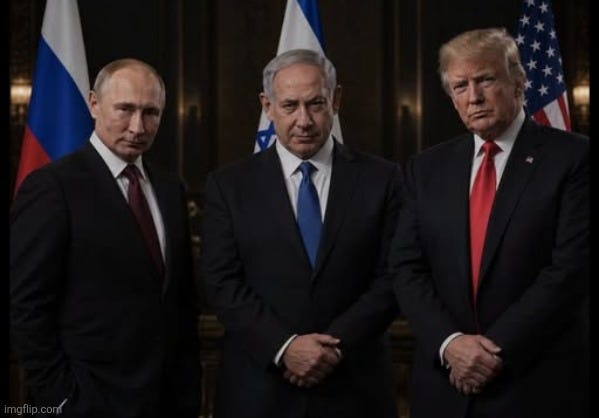
The era of the untouchable strongman is fracturing, driven not by armed revolutions or foreign interventions, but by a quieter, more devastating force: absolute domestic unpopularity. Across the globe, hyper-polarized leaders who once seemed to hold an iron grip on power are finding that the walls are closing in. Israeli Prime Minister Benjamin Netanyahu stands on the precipice of becoming the first domino to fall, with Russian President Vladimir Putin and U.S. President Donald Trump facing remarkably similar undercurrents of domestic exhaustion that threaten to sweep away their political futures.
The traditional playbook of the modern autocrat is built on the illusion of permanent indispensability. For years, leaders who bend democratic institutions to their will or eliminate opposition entirely have relied on a mixture of nationalist fervor, manufactured crises, and the systematic erosion of checks and balances to maintain their position. Yet beneath the surface of absolute control lies a foundational vulnerability: the sheer weight of public disapproval.
Across different political systems, from fractured parliamentary democracies to entrenched autocracies, the mechanism of collapse is proving remarkably consistent. When a leader’s survival becomes entirely decoupled from the public good, the resulting domestic alienation and public rejection creates a structural fragility that no amount of state leverage can permanently fix.
The Netanyahu Precedent: The Breaking of the Security Contract
Benjamin Netanyahu has long mastered the art of political survival by positioning himself as the sole guarantor of his nation’s security. By polarizing the electorate and systematically weakening judicial oversight, he constructed a political fortress that appeared impervious to standard democratic removal. However, the catastrophic security failures under his watch shattered the core premise of his political existence. Rather than rallying the public around the flag indefinitely, the prolonged conflict and economic strain have triggered an unprecedented wave of domestic fury. The public sentiment has shifted from standard political opposition to a profound, existential exhaustion with a leader viewed as prioritizing personal legal immunity and political longevity over collective stability. Netanyahu’s vulnerability demonstrates that when the transactional promise of an authoritarian figure—offering security or prosperity in exchange for compromised freedoms—is definitively broken, popularity plummets to a terminal velocity from which institutional manipulation cannot rescue them.
The Putin Paradox: The Fragile Illusion of Absolute Control
Further east, Vladimir Putin operates within a highly centralized autocracy designed to insulate the Kremlin from the whims of public opinion. For over two decades, dissent has been criminalized, independent media dismantled, and the electorate subjected to intense state propaganda. Yet, the assumption that an absolute dictator is immune to the laws of popularity is a dangerous miscalculation. The immense human and economic toll of prolonged external aggression has quietly corroded the social contract in Russia. While state-run polls project outward compliance, the undercurrents of domestic dissatisfaction are visible in widespread labor shortages, persistent inflation, and the quiet desperation of a population bearing the brunt of systemic isolation. Putin’s regime is trapped in a cycle where maintaining power requires escalating repression, a strategy that inherently betrays deep internal anxiety over shifting public loyalty. As domestic unpopularity grows, the elite networks supporting the regime begin to question the long-term viability of a leader who has transformed their nation into a pariah state, proving that even a tyrant cannot rule effectively over a completely demoralized and resentful population.
The Trump Trajectory: The Hard Ceiling of Grievance Politics and Personality Cults
In the United States, Donald Trump represents the democratic variant of this populist-authoritarian trend, relying on a deeply loyal base and the systematic polarization of the political landscape. His strategy relies on convincing a large segment of the population that the nation’s institutional framework is inherently corrupt and that he alone represents the true will of the people. However, this model faces a hard mathematical ceiling defined by broader public fatigue. The chaotic governance style, continuous legal challenges, and divisive rhetoric that fuel his core supporters simultaneously alienate the vital majority of the electorate required for sustained governance. Trump’s political trajectory shows that a movement built exclusively around personal grievance and institutional destruction eventually exhausts the broader populace, which craves stability over perpetual conflict. When a leader becomes a symbol of unending societal friction, their unpopularity among the wider public acts as an immovable barrier, limiting their ability to reclaim or hold power cleanly through democratic processes.
The Universal Mechanics of Democratic and Autocratic Decay
The common thread binding Netanyahu, Putin, and Trump is the inevitable friction between a leader’s self-preservation and the collective well-being of the state. Whether operating within a battered democracy, an outright autocracy, or a polarized republic, these leaders share a reliance on personalization—substituting the health of state institutions for their own political survival. This approach creates an inherent expiration date. As economies strain under isolation, societal divisions deepen, and the costs of maintaining power multiply, the general public arrives at a collective tipping point. The fall of the first domino, likely accelerated by the acute parliamentary and civic pressures facing Netanyahu, serves as a blueprint for the others. It reveals that the ultimate vulnerability of modern autocracy is not always an organized external force or a sudden coup, but rather the slow, grinding reality of a population that simply refuses to sustain the burden of a leader’s personal ambition any longer.
The View from Beijing: Xi’s Calculus on The Fragility of Power
From the high-walled compound of Zhongnanhai, President Xi Jinping likely views the potential unraveling of these foreign counterparts not as a foreign anomaly, but as a stark vindication of his own governance philosophy. For Xi, the simultaneous decline of leaders in Jerusalem, Moscow, and Washington reinforces the absolute necessity of total, centralized institutional control over the volatile whims of public popularity.
Unlike democratic leaders who must constantly court public opinion, or hybrid autocrats who rely on engineered electoral mandates, Xi operates on the principle that the Party’s survival depends on suppressing dissent before it can crystallize into a political force. Watching Netanyahu buckle under the weight of domestic rage, Xi likely sees the inherent danger of a leader becoming larger than the state itself, allowing personal survival to compromise national stability. In the potential falls of Trump and Putin, Xi recognizes the limits of personalist rule when divorced from a disciplined, all-encompassing party apparatus. He understands that while charismatic authority and nationalist fervor can sustain a leader during periods of growth, they offer thin protection when the economic engine slows or military adventures stall.
Consequently, the spectacle of failing global strongmen likely deepens Xi’s commitment to internal security and aggressive ideological conformity. His takeaway is not to reform, but to double down on the grid-style management of Chinese society, the elimination of factional rivals, and the preemption of any grassroots economic grievance that could morph into political resistance. Xi watches the democratic chaos of the West and the administrative decay of Moscow with a conviction that only the absolute, unyielding supremacy of the Chinese Communist Party can insulate a leader—and a nation—from the chaotic, destructive forces of popular discontent.
The Great Realignment: How the Fall of Netanyahu, Putin, and Trump Reshapes the World
According to foreign policy analysts and international relations historians, the simultaneous or sequential collapse of Benjamin Netanyahu, Vladimir Putin, and Donald Trump would not merely represent a changing of the guard; it would signal the definitive end of the early 21st-century populist-authoritarian wave and trigger a profound realignment of global power.
For over a decade, these three leaders—each operating in vastly different political systems—reinforced one another. They validated a style of governance rooted in ethno-nationalism, transactional diplomacy, and the systematic erosion of democratic norms. Their collective exit from the world stage would fundamentally alter international security, alliance structures, and the global ideological balance.
1. The Collapse of the Populist International
For years, right-wing populists and illiberal leaders worldwide looked to Washington, Moscow, and Jerusalem for ideological cover, financial backing, and rhetorical playbooks.
The Demoralization of Illiberalism: Without Trump’s institutional validation of “America First” nationalism and Putin’s overt backing of anti-Western factions, minor autocrats and populist challengers across Europe, Latin America, and Asia would lose their primary geopolitical anchors.
The Rebirth of Democratic Prestige: The fall of these leaders due to sheer domestic unpopularity would debunk the authoritarian myth of the “invincible strongman.” It would prove that public discontent remains the ultimate arbiter of political longevity, instantly revitalizing the morale of global democratic movements.
2. The Middle East: From Permanent Conflict to Regional Restructuring
Netanyahu’s political survival has long been tethered to a strategy of managed conflict, regional polarization, and the absolute rejection of a Palestinian state. His departure would break a multi-decade political logjam.
Resuscitating Diplomatic Frameworks: A post-Netanyahu Israel would likely see a return to centrist or center-left coalitions more amenable to working with regional Arab partners and Western allies. This could revive stalled conversations around a viable two-state solution or a more sustainable regional security architecture.
De-escalation with Iran: Netanyahu’s exit would remove the primary champion of total military confrontation with Iran, opening windows for the United States and European powers to pursue more stable, deterrence-plus-diplomacy strategies in the region.
3. Europe and the Decisive Defeat of Neo-Imperialism
Vladimir Putin’s fall would represent the most immediate shockwave to global security, fundamentally shifting the European continent’s balance of power.
The Resolution of the Ukraine War: Any successor regime to Putin—even a nationalistic or bureaucratic one—would face immense economic and social pressure to unwind the costly, isolating war in Ukraine. This would likely lead to a frozen conflict or a negotiated withdrawal, securing Ukraine’s sovereignty and its integration into the West.
A Secure NATO and European Sovereignty: With the Russian military threat neutralized by internal political chaos or a reformist transition, the European Union and NATO would shift from a footing of existential dread to one of reconstruction, stabilization, and the integration of the post-Soviet periphery.
4. The United States: The Restoration of Predictable Power
The permanent sidelining of Donald Trump from American politics would remove the single greatest source of unpredictability in the international system.
The Return of Alliance Reliability: Foreign allies would no longer have to hedge against a mercurial U.S. presidency that threatens to abandon NATO or weaponize tariffs arbitrarily. Institutional, treaty-based diplomacy would regain its status as the bedrock of American foreign policy.
The Healing of Democratic Institutions: Domestically and internationally, the fever of election denialism and the weaponization of state bureaucracy would break, allowing the U.S. to model democratic resilience rather than democratic decay.
5. The Geopolitical Vacuum and the Sino-American Balance
With Moscow in transition and Washington stabilizing, the global calculus shifts entirely to Beijing. As explored in the previous section, President Xi Jinping would find himself highly isolated. The “no-limits” partnership with Russia would be exposed as a strategic liability, forcing China to recalculate its ambitions regarding Taiwan and its economic coercion in the Indo-Pacific. A stabilized, democratic West would be far better equipped to present a unified economic and military front to counter Chinese hegemony.