

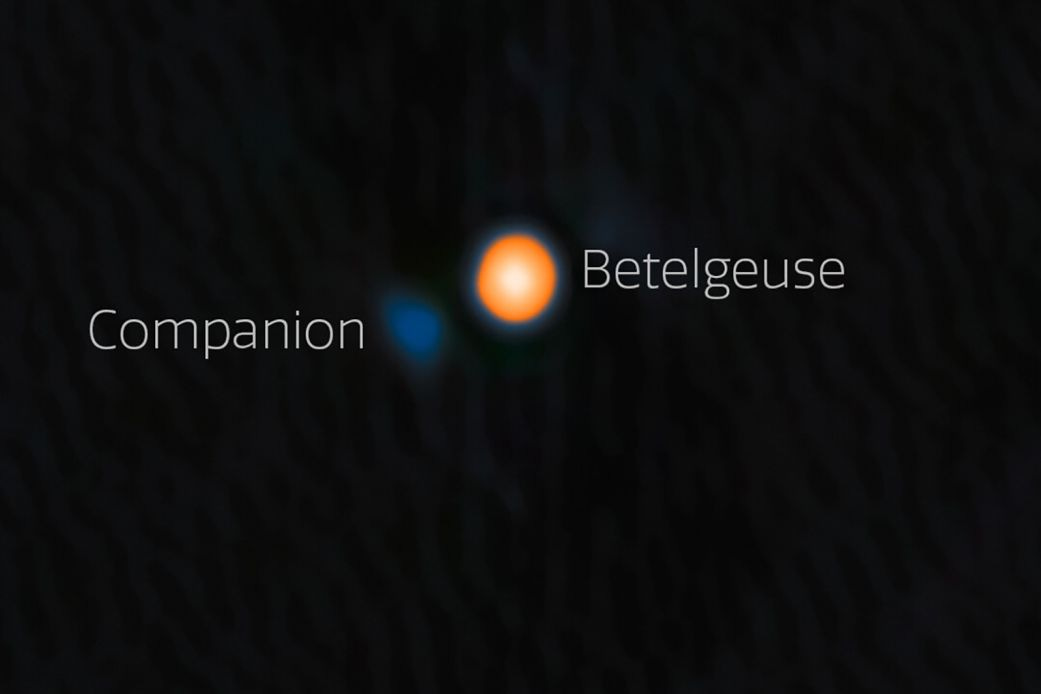
For generations, the crimson heart of Orion has captivated stargazers and scientists alike, its rhythmic pulsations acting as a cosmic beacon. Betelgeuse, the massive red supergiant nearing the end of its life, has long held a reputation as a volatile recluse. Yet, for nearly a century, astronomers suspected that this dying titan was not entirely alone. Hints buried deep within the star’s complex light variations suggested the gravitational tug of an unseen partner, a ghostly companion hidden within the blinding glare of the supergiant’s outer atmosphere. For ten decades, technology lagged behind human intuition, leaving the existence of this celestial partner a tantalizing mystery whispered across generations of astrophysics laboratories.
The breakthrough finally arrived not with a sudden flash of light, but through the patient, precise orchestration of modern interferometry and advanced space telescopes. By filtering through the chaotic storms of gas and dust coughed up by the dying giant, researchers managed to separate the glare from the reality. The hidden companion, long a mere mathematical anomaly on graph paper, emerged into the light of scientific certainty. This discovery redefines our understanding of stellar evolution, proving that even the most well-studied stars in our night sky still hold profound secrets capable of reshaping our cosmic maps.
Finding this companion changes everything we thought we knew about the dramatic lifecycle of Betelgeuse. This nearby partner likely shapes the supergiant’s behavior, influencing its famous dimming episodes and the way it sheds mass into the surrounding void. It is a poignant reminder that space exploration is a game of immense patience, where answers are sometimes handed down like heirlooms from one generation of scientists to the next. Looking up at Orion tonight, the familiar red dot feels entirely new, no longer a solitary giant waiting for death, but a dynamic duo dancing on the edge of eternity.