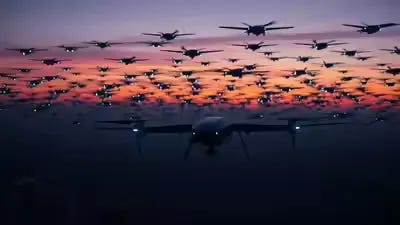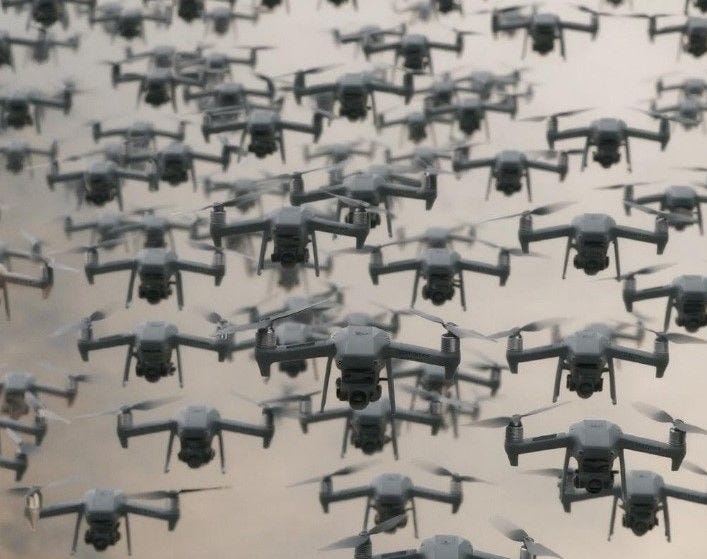
For most of the Russo-Ukraine war, a drone has meant a person and a joystick, one operator staring at a single video feed, flying one aircraft toward one target. That relationship, one human mind tethered to one machine, has quietly become the bottleneck of modern drone warfare. There are only so many trained pilots, only so many hours in a day, only so many radio channels that can survive a determined jamming effort. The technology now being built to break that bottleneck goes by an unglamorous name inside the industry, swarm avionics, and it may be the most consequential shift in drone warfare since the FPV drone itself arrived on the battlefield.
The idea is simple to state and brutally hard to build. Instead of one pilot flying one aircraft, a single operator sets an objective, and software distributes the work across many drones at once, coordinating their movement, sharing what each one sees, reassigning tasks when one is shot down or loses contact, and continuing the mission even when the radio link back to a human disappears entirely. Ukraine’s Wild Hornets, maker of the Sting interceptor drone, has described the shift bluntly: current systems mostly run on what one representative called primitive algorithms, and true swarming represents a genuine leap toward what he termed real remote warfare, rather than simply more of the same technology scaled up.
Why Ukraine Cannot Afford to Wait
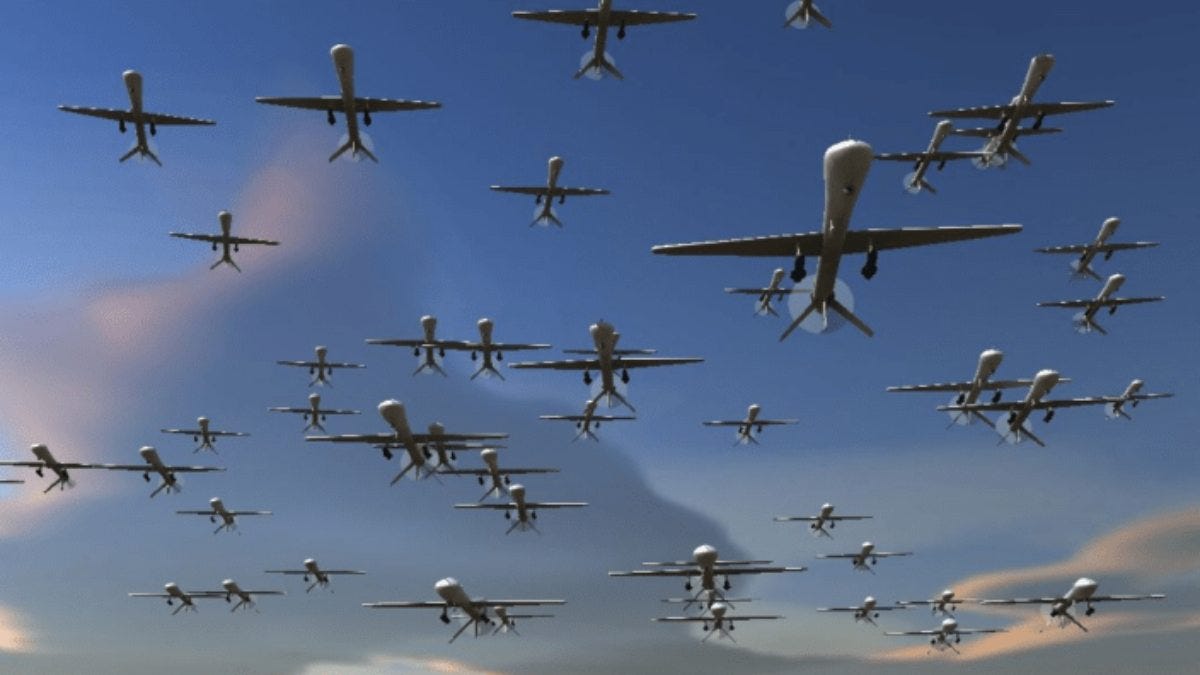
The urgency behind this push is not abstract. Ukraine deployed close to five million drones into active combat in 2025 alone, and Russia answers with regular mass attacks that combine hundreds of drones with cruise missiles and decoys in a single wave. No number of individual pilots can keep pace with that kind of volume indefinitely, and Ukraine’s own military leadership has been explicit that the country’s survival increasingly depends on software doing the coordination work human operators physically cannot. When Russia launched one such combined assault at the end of May 2026, Ukrainian forces reportedly intercepted roughly ninety percent of the incoming threats, a result officials directly credited to the aggressive application of AI and robotics rather than pilot skill alone.
Ukraine’s government has organized much of this effort through Brave1, a state-backed innovation hub coordinating dozens of private defense technology developers working the problem from different angles. Some of that work is defensive by design: engineers there are building autonomous interceptor swarms specifically meant to bring down Russia’s Shahed kamikaze drones with minimal human input, pursuing two parallel approaches at once, letting a single operator control many interceptors simultaneously, and teaching the interceptors to communicate and coordinate with each other directly, without waiting on instructions from the ground at all.
The Engineers Building It
No single company embodies this shift more directly than Swarmer, a Ukrainian-founded firm that has become the country’s most prominent name in drone autonomy software. Rather than building its own aircraft, Swarmer builds the coordination layer that sits above whatever hardware a customer already flies, translating a human-defined objective into distributed, autonomous action across an entire fleet at once. Founder and chief executive Serhii Kupriienko has described the ambition plainly: giving Western democracies the ability to field as many drones and robots as they can manufacture, without being limited by how many trained pilots exist to fly them. The company’s technology first saw real combat in April 2024 and has since been used in more than one hundred thousand live missions, generating the kind of real-world data that lets its models learn to replicate the judgment of an experienced pilot at a scale no training pipeline for human operators could ever match. In February 2026, Swarmer raised fifteen million dollars in the largest single funding round any Ukrainian defense technology company has attracted since the war began, led by American investors betting the software, not any one aircraft, is the part of this war worth owning.
Swarmer is far from alone. France’s Atreyd has demonstrated an experimental system in which a coordinated group of first-person-view drones forms what its engineers call a wall, intercepting incoming threats as a single distributed unit rather than as individually piloted aircraft. Ukrainian manufacturer SkyFall and autonomy specialist Auterion announced a program this year involving fifty thousand Shrike drones fitted with autonomous terminal guidance, designed to keep flying toward a target even after communication with any human operator is lost. Former Google chief executive Eric Schmidt has entered the field too, through a venture called Swift Beat that is building autonomous drones and supporting modules directly for Ukrainian forces, a notable vote of confidence from someone who built a career studying where computing power creates decisive advantage.
A War That Rewards Whoever Solves Autonomy First
The reason so much of this work is happening in software rather than hardware traces directly back to electronic warfare. A conventional drone tethered to a human pilot by radio is only as reliable as that radio link, and both sides in this war have become extraordinarily good at jamming exactly that connection. A drone that can only fly while someone is actively steering it becomes useless the instant a jammer finds its frequency. A drone built with onboard visual navigation and terminal guidance, by contrast, can keep flying toward its target after the link goes dark, which is precisely why so much of the current engineering effort is focused on pushing decision-making down into the aircraft itself rather than keeping it in a human operator’s hands on the ground.
It would be a mistake, though, to assume genuine swarming has already arrived at scale on either side of this war, and Ukraine’s own military has been careful not to overclaim it. Colonel Ivan Pavlenko, who leads electronic and cyber warfare for Ukraine’s armed forces, has drawn a sharp distinction between mass and true swarm intelligence. Russia can and does launch hundreds of drones in a single attack, he has noted, but simply launching many aircraft is not the same as coordinating them as one intelligent system, and by his own assessment, Russia has not yet demonstrated genuine autonomous swarming in real combat. Russia’s own defense industry, through firms like Kronshtadt, has been openly pursuing swarm architecture since 2021, describing systems capable of shifting leadership between drones and redistributing tasks without constant human oversight, but the gap between that ambition and what has actually been proven on a real battlefield remains a live and contested question, not a settled one. Even inside Ukraine, detailed assessments this year concluded that battlefield use has largely stayed confined to small coordinated groups rather than the large, fully autonomous swarms the technology is ultimately aiming toward.
That gap is exactly where the real engineering fight is happening now, and it is a harder problem than it looks from the outside. A swarm has to keep functioning when GPS is denied, when communication between drones is patchy or jammed, when one aircraft’s sensor fails, or when the terrain and enemy countermeasures change faster than any pre-written plan anticipated. Solving that reliably, at scale, in an active war zone rather than a test range, is the actual frontier this generation of engineers is working, and whichever side gets there first is likely to hold a meaningful advantage over the other for as long as it lasts. In a war already being fought largely through drones, the side that teaches its drones to fight as one coordinated system, rather than as many individually brave but isolated machines, is the side likely to define what the next phase of this war looks like.