

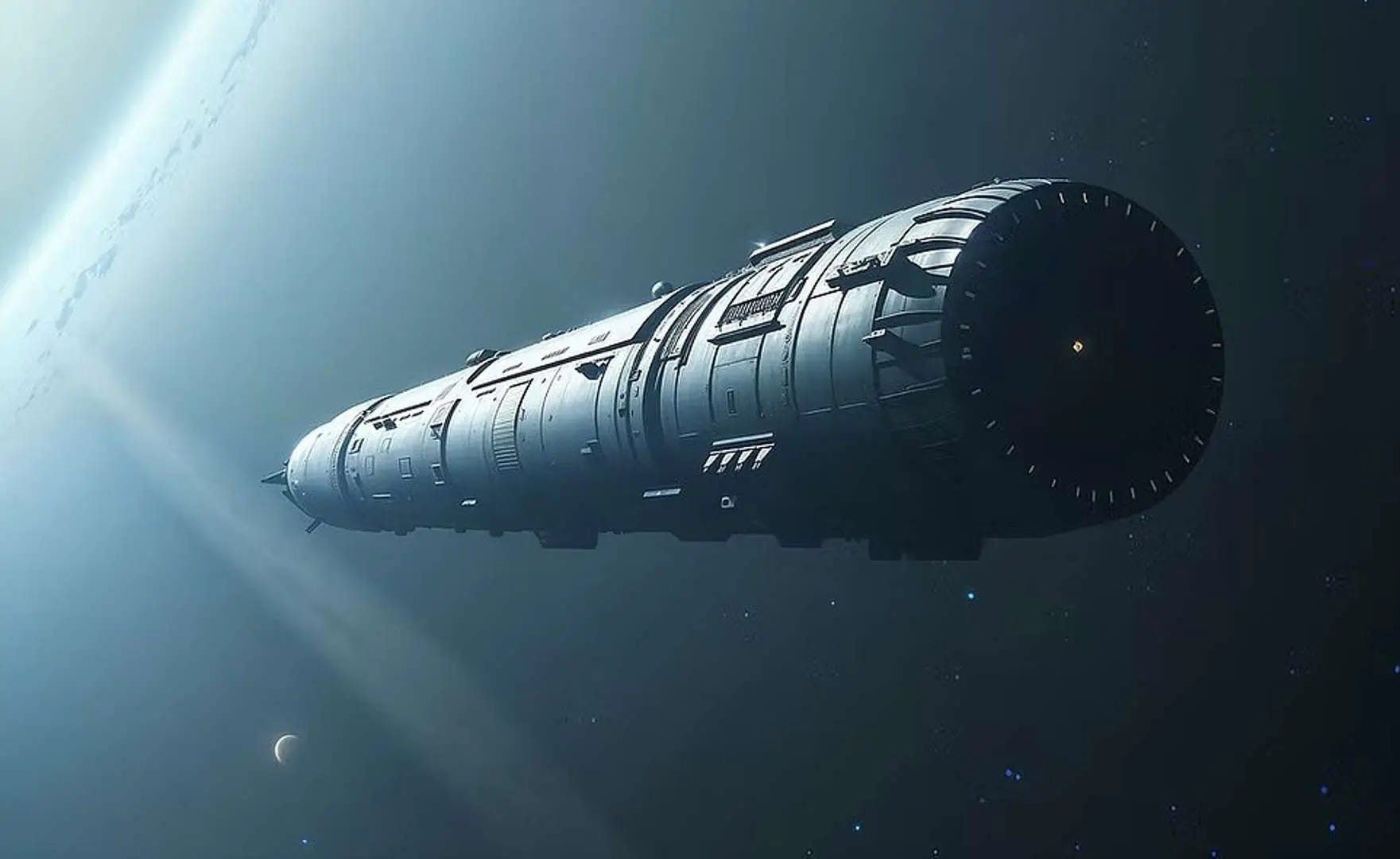
There is a version of this story where humanity never leaves. Where the last generation watches the last star gutter out, and that is that. This is not that version.
This is the version where a ship leaves — not to reach anywhere in particular, but to reach whenever particular. A ship built not to outrun distance, but to outrun time itself, in the one way physics actually permits: by going so close to the speed of light that the universe’s remaining lifespan compresses into something a crew could live through.
We are going to build this ship together, as a thought experiment, and we are going to be honest about every place the physics breaks. Then — because the story is more interesting broken than abandoned — we are going to wave our hands, exactly once per problem, and keep going anyway.
The Premise
By the time our ship departs, the numbers already look bleak. Stars are dying faster than they’re born. Galaxies beyond the Local Group have long since slipped past the cosmic event horizon, their light frozen at the edge of visibility, then gone. The crew — if “crew” is even the right word for beings who may by now be more architecture than biology — have one goal: survive long enough, moving fast enough, that time outside the hull passes in eons while time inside passes in years. Somewhere out past incomprehensible stretches of empty future, they hope, there might be something. A new Big Bang. A membrane collision spawning a fresh cosmos. A crack in the dark.
The odds are not good. The ship goes anyway.
Problem one, immediately: the energy. To compress trillions upon trillions of years into a survivable human lifetime requires a Lorentz factor — the “time-shrink number,” astronomically large — so extreme that accelerating any mass to it would require more energy than exists in the entire observable universe, converted with perfect efficiency. This is not a fuel problem. It is a “the fuel does not exist anywhere, in any quantity, held by anyone” problem.
For the sake of the story, let’s say they solve it. Perhaps they harvest the dying embers of the last stars over unthinkable spans of patience. Perhaps they find some exotic mechanism we have no name for yet. We will not pretend to know how. We will simply let them have it, and move on, the way every good impossible voyage requires one unearned miracle at the start.
Departure
They leave in the era after the last stars, when the sky has gone the color of nothing — a black so complete that the old word “night” doesn’t really apply anymore, because night implies a day to contrast it with. The engines, whatever they are, do not roar. There is nothing left to disturb.
One of the crew — call her the ship’s chronicler, because someone always ends up being that — logs the moment plainly: “Today we stopped trying to arrive somewhere, and started trying to arrive somewhen.”
Problem two: shielding. As the ship’s velocity climbs toward its terrible, borrowed limit, the universe’s leftover background radiation — ancient microwave light, by now stretched thin and cold — starts to look very different from the crew’s onboard perspective. Blueshifted by their own extreme speed, that gentle whisper of radiation rises toward gamma-ray intensity: a wall of lethal light generated not by anything hunting them, but by their own velocity, turning the empty dark itself into a hazard. Stray atoms of interstellar gas, harmless at rest, become armor-piercing rounds at these speeds.
For the sake of the story, let’s say the hull holds. Some shielding humanity’s descendants built, layered and re-layered across ages we’re not going to detail, absorbs what it can. We won’t ask how. We’ll just let them keep flying.
The Long Middle
This is the part of the story with no plot, because there is no plot to have. Outside, years become millennia become epochs become numbers that stop meaning anything to a human mind. Protons — if the physicists are right about this — begin, one by one, unimaginably slowly, to simply cease to be protons at all. Not exploding. Not dramatic. Just quietly no longer existing, the way a word stops being remembered once no one is left alive to say it.
Inside the ship, none of this touches the crew. Their protons are their protons, at rest relative to them, aging on their own unhurried clock. Time dilation was never a shield against decay — it just means their few subjective decades pass while the universe outside logs a span so long that “decade” and “eon” and “age of the universe” all become the same kind of small.
The chronicler writes less now. There’s less to say. At one point she writes only: “Passed the point where anything we can still see is ours. We’re the only thing moving. Possibly the only thing, full stop.”
Problem three: vacuum decay. Somewhere out in that vast silence, there is a real, unresolved possibility that the very vacuum of space is not as stable as it looks — that some quantum fluctuation, anywhere, at any time, could tip it into a lower-energy state that expands outward at the speed of light, forever, rewriting the rules of physics as it goes. It would give no warning. The light announcing it and the wall causing it would arrive at the exact same instant. No velocity, no route, no foresight could ever help the ship avoid it, because outrunning something moving at light speed is, definitionally, not a thing that can be done.
For the sake of the story, let’s say it simply doesn’t happen to them. Not because they’re clever. Not because they’re shielded. Because in this telling, they are lucky, and luck is the one form of magic we’re allowing ourselves twice.
Arrival, of a Kind
Eventually — and “eventually” is doing more work in that sentence than it has any right to — the ship’s instruments start registering something. Not stars. Not galaxies. A statistical whisper: a fluctuation, vanishingly unlikely, more likely to be a stray particle or two flickering briefly into existence out of nothing than the birth of a new cosmos. The chronicler, ever hopeful, still writes it up as the moment.
Problem four, the honest one, saved for last: this probably isn’t a new universe at all. The physics of extremely rare quantum recurrence favors small events, overwhelmingly — a few particles, not a fresh sky full of stars. A full new universe, complete with galaxies to explore, is so many orders of magnitude less likely than “one lonely atom, briefly,” that hoping for the former is really hoping against the mathematics itself.
And even if it were more — even if, by some fluke far beyond fluke, an entire nursery of stars sparked into being somewhere out past the reach of ordinary numbers — there is the final, quietest problem of all: at the speeds needed to survive the journey, the crew might blink, subjectively, and miss it. A new small cosmos born, aged, and faded to its own heat death, all while their own onboard clock ticked forward by what felt like a held breath. They would not get to walk on new worlds. They would, at absolute best, get to witness — a flicker of light in the dark, gone again by the time they thought to slow down.
For the sake of the story, we’ll let them see it anyway. Let’s say the chronicler is standing at the viewport when it happens — a smear of impossible light, there and gone, and for one subjective heartbeat, the ship is not alone in the universe.
Then it’s gone.
Suppose, too, that they see it coming early enough to try something. Suppose the instruments catch the fluctuation building, and someone gives the order to decelerate — to trade their terrible velocity for a chance at actually reaching it, rather than flashing past it as a blur. This is, at least, physically coherent: nothing stops a ship from shedding speed as readily as gaining it, and a slower approach would let more of that borrowed future light up around them before it guttered out. So they burn what they have left, bleed off the speed that has kept them alive this long, and aim themselves at the flicker instead of away from it.
And say they reach it. Say the hull, against every reasonable expectation, crosses the boundary between what was empty a moment ago and whatever this new, tiny, impossible spark of existence now is.
This is where the story has to stop pretending the ending is happy, because here the physics stops being generous even in theory. A recurrence event, or a bubble of new vacuum, isn't simply "a place" the way a new solar system is a place — it is, potentially, a region where the constants that make a proton a proton, a hull a hull, a person a person, are not guaranteed to be the ones that held true on the other side of that boundary. The ship and its crew are only stable, only themselves, because every particle in them is playing by one specific, consistent rulebook. Crossing into a domain running a different rulebook isn't survivable in the way crossing a border is survivable — there's no reason to expect "ship" or "person" to remain meaningful concepts once the underlying physics they were assembled from no longer applies. Not destroyed the way a wall destroys a speeding object. Unmade, in the sense that the instructions for what they were stop being valid the instant they cross over.
Not an explosion, not a collision, but a dissolution of the very terms that let a ship and a crew be a ship and a crew in the first place. There is no wreckage, because wreckage still requires physics that hold together long enough to be wreckage. There is just the boundary, and then, on the other side of it, nothing that was recognizably them.
Even If They Had Made It
Suppose, for one more indulgence, that the rulebook problem wasn’t fatal. Suppose whatever crossed over came out the other side intact — ship, crew, memory, all of it — standing at the edge of something that actually did unfold into stars.
It still likely wouldn’t be salvation, and that’s worth sitting with honestly rather than skipping past.
A new universe born from a chance fluctuation isn’t a homecoming. It’s a beginning, and beginnings don’t care who’s already tired. The crew who reached it would still be exactly what they always were: refugees from an old cosmos, carrying old bodies, old wear, old damage accumulated across a journey longer than the first universe’s entire history from Big Bang to heat death. A fresh universe doesn’t reset its visitors. It would take that new cosmos its own billions of years to cool, to form the first stable elements heavier than hydrogen, to build a single world capable of holding them upright, let alone feeding them. The crew probably wouldn’t be arriving at a garden. They’d be arriving at a delivery room, aeons before anything in it could sustain a single human breath.
And even that assumes the physics on the far side is compatible with them in any form — that carbon still bonds the way it needs to, that gravity still pulls the way it needs to, that whatever fundamental constants this new pocket of existence settled into happen to permit something like a person. Nothing about a random fluctuation owes them a habitable set of rules. It could just as easily be a universe with no chemistry worth the name, no stable atoms past hydrogen, no possibility of a second star ever lighting a second sky. A universe that starts wrong, by every measure that would matter to something built in the old one.
So even the miracle isn’t automatically a door out of the cold empty infinity they languished in. It’s a different, quieter kind of ending — not annihilated at the border, but stranded newborn-early on the other side of it, in a cosmos that has no idea they’re there and no obligation to ever make room for them. Reaching it was never the same question as being saved by it. Those were always two different problems.
Could these far flung time travellers once again accelerate towards near lightspeed in this strange new universe and wait for habitable planets to form?
Yes, under the extreme assumptions of the thought experiment (overcoming every physical impossibility around energy, shielding, survival across the boundary, and landing intact in a new region with compatible physics), the same near-lightspeed time-dilation strategy could in principle be reused to “wait out” structure formation.
Cooling, nucleosynthesis, the formation of the first stars, galaxies, and planets capable of supporting anything like the crew’s chemistry would still take on the order of hundreds of millions to billions of years (or the local equivalent) after the new “Big Bang”-like event. The arriving crew would be early arrivals at a cosmic delivery room, not a garden.
If the new universe’s laws of physics are sufficiently similar—special relativity still holds, there is an expanding background with a meaningful cosmic rest frame after the earliest phases, and energy can somehow be extracted or stored for propulsion—then extreme Lorentz factors would again compress external cosmic time relative to the ship’s proper time. The crew could accelerate relative to the new cosmic microwave background (or equivalent), let the new universe age through the long epochs of structure formation while only years or decades pass on board, then decelerate when instruments indicate suitable planets or resources have appeared.
That is the same mechanism the original voyage relies on: time dilation works because the ship’s clocks (and the aging of whatever constitutes the crew) run according to proper time, while the external universe races ahead. Nothing fundamental about a new compatible cosmos would prevent applying it a second time.
The practical and conceptual obstacles still remain enormous.
Energy budget again. Reaching the absurd gamma factors needed to compress billions of years into a short subjective interval still requires energy on scales that dwarf what exists in the observable volume of a young universe. In the earliest phases there are no long-lived stars to harvest; the environment is radiation-dominated and rapidly expanding. The same “miracle” of unlimited energy that we granted for the first voyage would have to be granted again.
Early-universe hazards. High-speed travel through a denser, hotter plasma or residual radiation field produces even more severe blueshifted radiation and particle impacts than the late-time residual microwave background of the original universe. Shielding that “somehow holds” would need to work under far more punishing conditions.
Reference frames and expansion. Immediately after a fluctuation or bubble nucleation the geometry may not yet have a clean cosmic rest frame. Once it settles into something expansion-like, the ship still has to choose a direction and velocity relative to that frame carefully so that deceleration later is possible without missing the window of habitability.
The crew’s own state. The article notes that a new universe does not reset the travelers’ accumulated wear, damage, or finite resources. Time dilation slows their proper aging while they wait, but it does not repair or replenish them. Post-biological or computational successors would fare better than purely biological ones.
Nature of the recurrence. Realistic quantum or statistical recurrence favors tiny, short-lived fluctuations over a full, expanding cosmos with the same low-entropy initial conditions and particle content that produce stars and chemistry. Assuming this mathematically extreme unlikelihood of a suitable full universe is already the largest concession.
In short, the physics of time dilation itself does not break just because the travellers have crossed into a new region with compatible laws. If every other impossibility is set aside (as the thought experiment repeatedly does), they could attempt the same acceleration strategy a second time and, in principle, arrive at an era when planets exist. The deeper point remains: even success of this kind is not salvation so much as a temporary postponement of the same thermodynamic problem in a fresh setting. The journey continues, but the underlying closure of heat death is only deferred.
What This Thought Experiment Actually Tells Us
Strip away the borrowed miracles — the impossible engines, the shielding that shouldn’t hold, the outrageously phenomenal luck that shouldn’t be and what’s left is not really a story about escape. It’s a story about how thoroughly heat death closes every door, and how the ones we managed to pry open here (extreme time dilation genuinely does work, as physics; a ship’s own matter genuinely would age on its own clock, not the universe’s) still don’t add up to a way out.
The honest version of this thought experiment doesn’t have a crew standing at a viewport. It has a ship that never leaves, because the energy to leave never existed; or a ship that leaves and is quietly unwound by starlight turned lethal, or matter turned to shrapnel, long before “trillions of years” becomes a number worth worrying about; or, in the kindest failure, a ship that survives everything, outlives the material universe, is technically present at the absolute end of physical time, finds nothing there at all. Not a new universe. Not even the “flicker of light” we let them have. Just the dark, going on, with nothing left in it to even measure the going-on.
That’s the part worth sitting with. Not that the ship fails to reach a new universe — that was always the improbable ask. It’s that even succeeding, in the narrowest possible sense — outliving matter itself, being present at the literal end — buys nothing. There’s no reward for endurance here. No door on the other side of that particular finish line. Just more of the same nothing, forever, with a crew of the last things that ever moved, watching it not change.
Maybe that’s the real shape of the question underneath all of this: it was never really “could we escape the end of the universe.” It was “is there anything, anywhere, to escape to“ — and on every honest reading of the physics we have, right now, the answer keeps coming back the same.
No.
Not because we haven’t imagined hard enough.
Because, as far as we can tell, there’s nowhere else.
If heat death is the fate of the Universe, it really is all about the journey.