

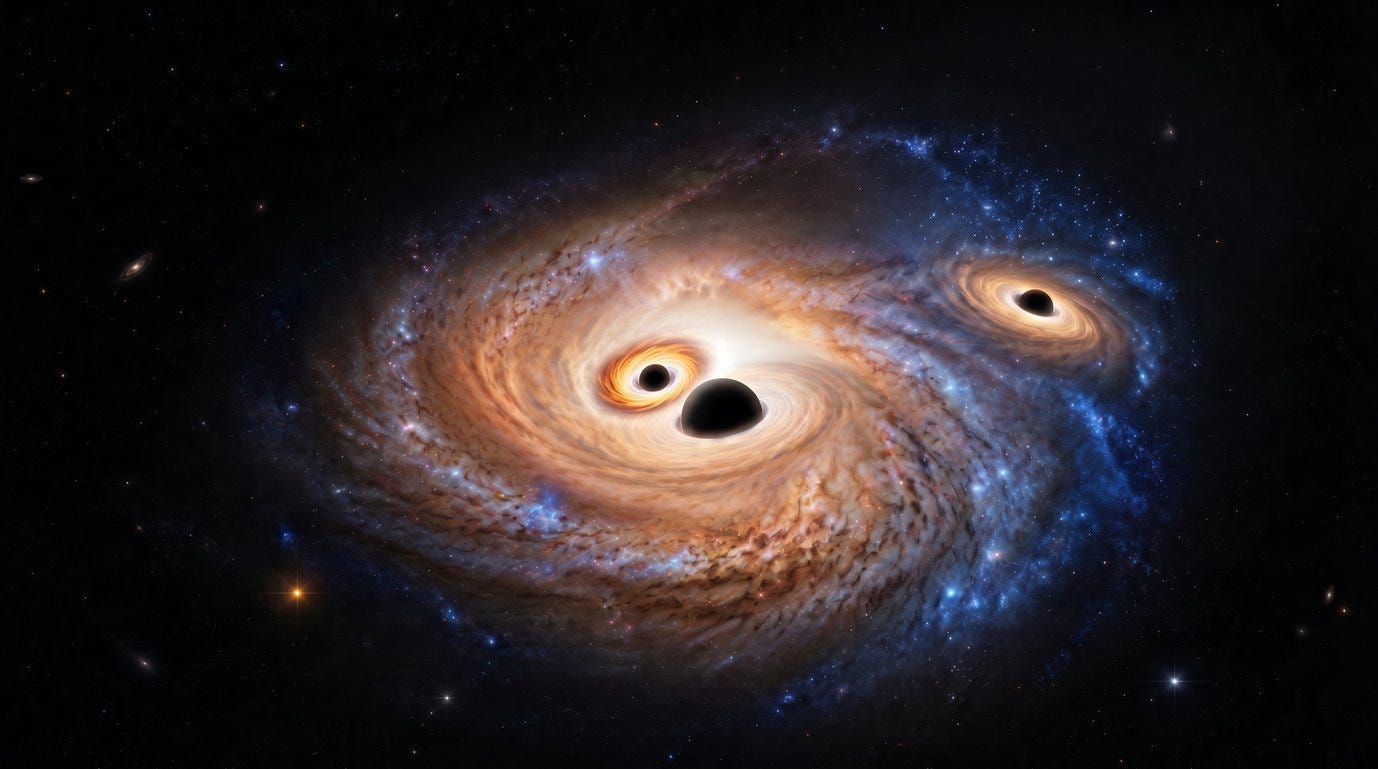
At the dark heart of almost every large galaxy sits a monster. It doesn’t roar, and you can’t see it, but it dictates the fate of hundreds of billions of stars. This is the supermassive black hole, an object so packed with matter that it warps the very fabric of space and time into a point of no return. While a typical stellar black hole might weigh as much as a few suns, these cosmic titans weigh millions to billions of times the mass of our Sun.
The Cosmic Cradle: Where Do They Come From?
How does an object get that big? Astronomers are currently locked in a friendly but fierce debate because the math doesn’t quite add up. We know supermassive black holes existed when the universe was in its absolute infancy, but normal black holes grow too slowly by eating passing gas and stars to reach billions of solar masses that quickly.
One possibility is the light seed scenario, where the very first generation of massive stars burned hot, died fast, and collapsed into normal-sized black holes. Over billions of years, these seeds aggressively feasted on surrounding gas and merged with other black holes to balloon into giants.
Alternatively, the heavy seed scenario suggests that massive clouds of primordial gas collapsed directly into giant black holes without ever forming stars first. This direct collapse method gives the black hole a massive head start, skipping millions of years of slow growth.
The mystery has only deepened with recent observations from the James Webb Space Telescope. The telescope has spotted fully formed, monstrously large black holes sitting in the incredibly early universe. They are far too big to exist so early in cosmic history, throwing our entire timeline of how the first galaxies evolved into total chaos and forcing astrophysicists to completely rethink their models.
The Ultimate Cosmic Dance: Mergers, Misses, and Slingshots
Galaxies are not static, and they move dynamically through the universe. When two galaxies interact, their central supermassive black holes are drawn together by gravity like magnets. What happens next is a masterclass in orbital physics.
As the two black holes sink toward the center of a merged galaxy, they stir up the surrounding stars and gas. By kicking stars out of the way, the black holes lose energy and spiral closer together. However, this reveals another profound puzzle known as the final parsec problem. Once the black holes get within a few light-years of each other, a distance astronomers call a parsec, there are no longer enough stars or gas left between them to slow them down further. According to standard physics equations, they should stall out and orbit each other forever. Scientists are still trying to map out exactly how gas configurations or gravitational waves, which are ripples in space-time itself, manage to bleed away the remaining energy and push the titans across the finish line to finally collide.
Sometimes, a third galaxy joins the party before the first two black holes have finished merging. When three supermassive black holes interact, the gravitational math gets chaotic. The gravitational forces can violently destabilize the system, resulting in one black hole being violently slingshot completely out of the galaxy at millions of miles per hour, destined to drift through the empty void of intergalactic space forever.
The Galactic Misconception: The Myth of the Dark Anchor
Ask a random person what keeps the Milky Way together, and they will likely say that the supermassive black hole at the center does the heavy lifting. It makes intuitive sense since the Sun’s gravity holds the solar system together, so the black hole must hold the galaxy together.
Actually, it doesn’t. This is one of the most perplexing realizations for introductory physics students. Our local supermassive black hole, Sagittarius A*, weighs about four million suns. That sounds huge, but the Milky Way weighs roughly one and a half trillion suns. The black hole accounts for a measly fraction of a percent of our galaxy’s total mass. Its gravitational reach is irrelevant to stars on the outer edges, like our Sun.
If Sagittarius A* vanished tomorrow, the solar system wouldn’t even notice. This lack of sufficient gravity to hold galaxies together is what forced physicists to realize that something else must be acting as the cosmic glue, which is a mysterious, invisible substance we now call dark matter.
The Coin Flip: Will the Milky Way Meet Andromeda?
For decades, astronomers believed our galaxy was on an inevitable, head-on collision course with the neighboring Andromeda galaxy. However, data from the Hubble Space Telescope and the Gaia mission have upended this certainty. By accounting for the complex gravitational pull of smaller surrounding dwarf galaxies, scientists have revealed that a collision is actually a coin flip, with only a roughly 50-50 chance of a merger occurring over the next 10 billion years.
If a collision does happen, it will be a deeply asymmetric affair. Andromeda is significantly larger than the Milky Way, and its central black hole is a true titan, weighing up to 200 million suns—roughly fifty times more massive than Sagittarius A*. Because Andromeda completely outclasses us, the merger will relegate the Milky Way to a minor, swallowed component of the newly formed galaxy. This cosmic smashup will eventually strip both galaxies of their beautiful spiral structures, leaving behind a single, dull, featureless, giant elliptical galaxy known as Milkomeda.
Cosmic Fireworks and Space-Time Ripples
If the central black holes of Milkomeda finally spiral into a direct collision, the event will unleash forces of a scale difficult to imagine. As they draw close, the black holes will emit powerful gravitational waves. While these ripples violently warp the fabric of space-time, they interact very weakly with matter. As they wash over surrounding stars and planets, they will harmlessly stretch and compress space by less than the width of an atom.
The real danger comes from energy bursts. As the black holes plunge into one another, they will violently churn up leftover galactic gas, creating a blazing accretion disk known as a quasar. This phase will unleash devastating torrents of X-rays and gamma-ray radiation. Planets unfortunate enough to be orbiting stars near the galactic core will have their atmospheres completely stripped away, effectively sterilising them. Fortunately, because galaxies are mostly empty space, the vast majority of stars and planets—including our own solar system—will be located tens of thousands of light-years away from the core, safely isolated from these lethal radiation beams.
Supermassive Black Holes as Starship Gateways
For a technologically advanced civilization, these terrifying gravity wells might actually serve as the ultimate transit hubs. In deep space, the intergalactic medium separating galaxies is far emptier than the interstellar medium found inside them. Solid dust grains are exceptionally scarce intergalactically. Because a spacecraft traveling through intergalactic space encounters far fewer particles and destructive dust grains per unit distance than one traveling through the dense disk of a galaxy, crossing the void between galaxies is highly efficient if you can achieve the speed required.
Supermassive black holes might offer the perfect means to cross these vast voids. A starship could execute a gravitational slingshot maneuver around the black hole, stealing a fraction of its immense orbital energy to accelerate to near-lightspeed, launching it directly into intergalactic space.
Furthermore, these giants are the perfect time machines. According to Einstein’s theory of general relativity, extreme gravity warps time. A starship orbiting just outside the event horizon would experience severe time dilation. For the crew, a few weeks in orbit could equal centuries or millennia passing back in the wider universe, allowing them to travel forward into the distant future.
Crucially, supermassive black holes are vastly preferable for this kind of travel over smaller, stellar-mass black holes. Tidal forces near the event horizon scale inversely with mass. Around a small black hole, the gravitational pull on your feet would be vastly stronger than on your head, tearing a ship apart via spaghettification. But around a supermassive giant, the gravitational gradients are gentler, allowing a ship to coast safely through the warped space-time environment.
The Final Fate: Death by a Trillion Whispers
What happens to these monsters at the end of time? Once all the gas in the universe is consumed, stars fizzle out, and galaxies dissolve, only the supermassive black holes will remain. They will rule an empty, frozen universe.
But even they are not immortal. Thanks to a mind-bending quantum effect discovered by Stephen Hawking called Hawking Radiation, black holes slowly leak mass over time. However, this evaporation process introduces the black hole information paradox, which stands as one of the biggest crises in modern physics. Quantum mechanics states that physical information can never be permanently destroyed. Yet, if everything that falls into a black hole is trapped, and the black hole eventually dissolves into generic radiation, where does that information go? If it vanishes completely, a fundamental pillar of physics is broken.
Resolving this paradox remains a premier quest for theoretical physicists, but assuming they do evaporate, the timeline is staggering. For a supermassive giant, it takes roughly a googol of years, which is a one followed by one hundred zeros. In their final moments, these cosmic titans will shrink down and pop out of existence in a brilliant, silent flash of gamma rays, leaving behind a perfectly cold, dark, and empty universe.