

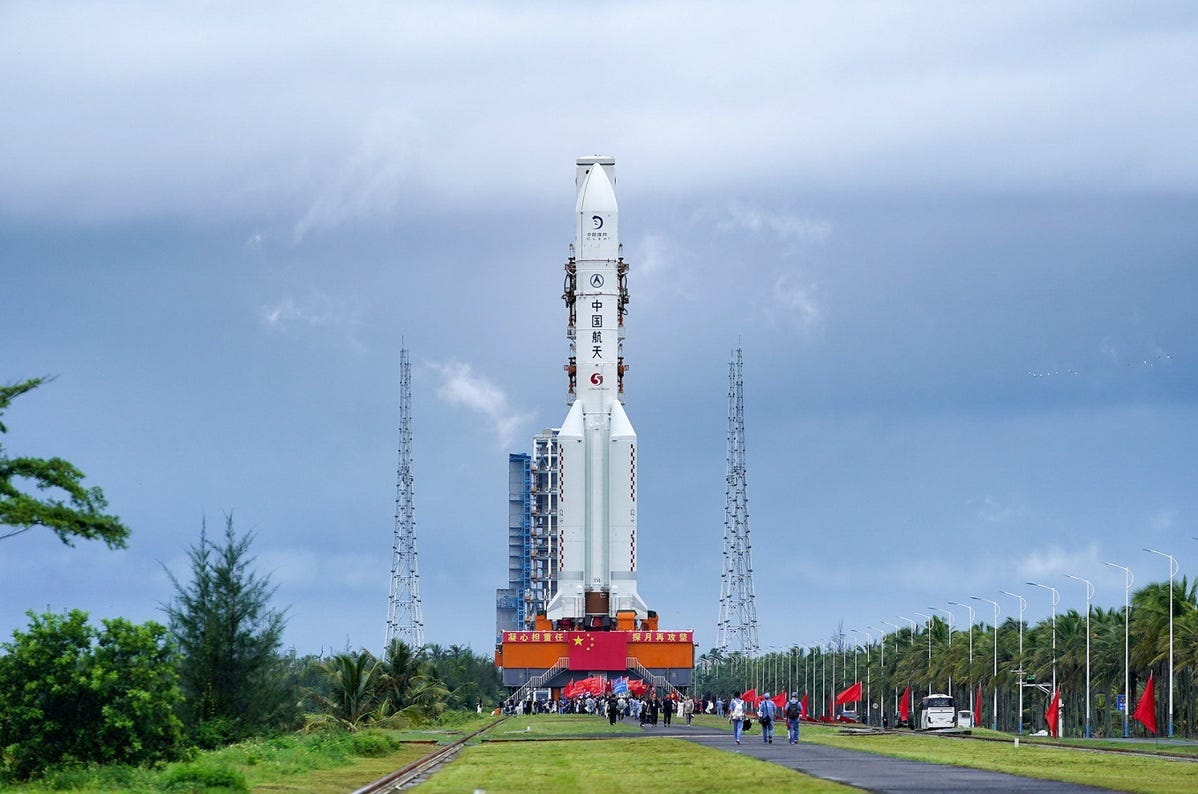
The vertical rollout of the Long March 5 rocket at the Wenchang Space Launch Site had initially promised the dawn of a new era in lunar exploration. However, the China Manned Space Agency’s official announcement on Sunday, 23 August 2026, confirmed that the historic Chang’e 7 mission to the moon’s south pole has been indefinitely postponed. Due to severe weather risks, the spacecraft will not fly during its remaining launch window this year.
The primary catalyst for the stand-down was the rapid development of Tropical Depression Narra in the Gulf of Tonkin, which threatened the island province of Hainan with hazardous high-altitude winds and storm conditions. In space exploration, the margins for error are non-existent, and Chinese space officials opted to return the rocket to its assembly building to prioritize absolute mission safety and reliability. Because navigating to the lunar south pole requires highly precise celestial alignment, missing this tight orbital window means a delay that will likely push the launch to 2027.
This high-stakes pause reshapes the timeline of the international lunar race but does nothing to diminish the awe-inspiring scope of the mission. Chang’e 7 is designed as a sophisticated robotic armada, uniquely equipped with an orbiter, lander, rover, and a specialized hopping mini-probe. Its core objective is to venture into the permanently shadowed craters near Shackleton Crater to directly hunt for and drill for ancient water ice.
For the international teams and scientists who spent years preparing research instruments for this unprecedented leap, the delay serves as a reminder of the immense difficulty of deep-space voyages. Waiting out the storm ensures that when the Long March 5 eventually ignites, it will do so with the highest probability of success. Humanity’s next major step toward prospecting the moon’s resources must wait, but the promise of uncovering the secrets hidden in lunar darkness remains firmly on the horizon.