

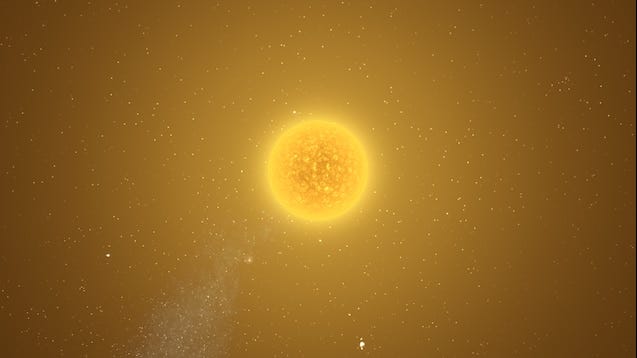
Across the vast expanse of the cosmos, the death of a massive star is typically viewed as a violent finale, marked by the blinding fury of a supernova that rips through space and leaves behind a dense cinder. However, astrophysicists have recently begun to observe a subtle, unspoken ghost story unfolding in the deep shadows of these stellar graveyards. When certain giant stars collapse into stellar-mass black holes, they do not always trigger a visible explosion; instead, they experience a silent collapse, vanishing directly from sight as their mass folds completely inward. For a brief, fleeting epoch on the cosmic timeline, the dying star’s outermost hydrogen envelope detaches from the plunging core, floating like an untethered shroud around the newly born singularity. This creates an entirely unmapped, ephemeral cosmic structure: a dark-core stellar nebula, where a newborn black hole is briefly cradled inside the pristine atmosphere of the very star that birthed it.
This short-lived celestial phenomenon operates as a closed, inverted planetary system on a microscopic scale. Within this ghostly shroud of gas, the immense gravitational pull of the central black hole begins to harvest the innermost layers of the remnant cloud, drawing the matter inward in a perfectly symmetrical, silent spiral. Unlike the chaotic accretion disks found around mature black holes feeding on neighboring stars, this internal consumption is incredibly smooth and shielded from the harsh radiation of the interstellar medium. The outermost layer of the original star acts as a perfect insulation barrier, trapping the intense heat and x-rays generated at the event horizon. This creates a hyper-pressurized, ultra-dense thermodynamic cocoon where the temperature gradient drops precipitously from millions of degrees near the center to near absolute zero at the outer edge, allowing for unprecedented chemical anomalies to occur within a single, continuous pocket of gas.
Inside this dark-core nebula, the extreme conditions foster an entirely unique manifestation of nuclear and chemical synthesis. As the intense radiation from the central singularity bakes the inner walls of the hydrogen shroud, it forces the gas to undergo localized, non-stellar fusion without the presence of a traditional stellar core. Heavy elements that were forged in the final moments of the star’s conscious life are instantly recycled, smashed together by gravitational tidal forces into exotic crystalline configurations and dense molecular chains that cannot form anywhere else in the active universe. This hyper-isolated environment allows for a rapid, uninterrupted chain of molecular evolution, generating massive clouds of complex carbon networks and heavy metallic vapor that hover in the dark, completely invisible to the outside universe.
The profound tragedy of these hidden structures lies in their inevitable, rapid dissolution into the cosmic background. This state of dark equilibrium can only exist for a few hundred thousand years, a mere blink in geological time, before the central black hole consumes enough internal pressure to trigger a final, quiet collapse of the outer shroud, or before the expansion of the gas dilutes the cloud into nothingness. If a stray wandering planet were captured by this passing system, an observer on its surface would witness a sky split into two impossible halves. One half of their horizon would be dominated by the towering, glowing walls of the amber shroud, lit from within by the invisible friction of the event horizon, while the other half would face a completely pitch-black gravity well that slowly drinks the very air they breathe. These transient micro-environments remind us that even in the moments of total cosmic erasure, the universe utilizes the architecture of destruction to build brief, hidden sanctuaries of astonishing complexity, drifting like secret thoughts through the crowded theater of space.