

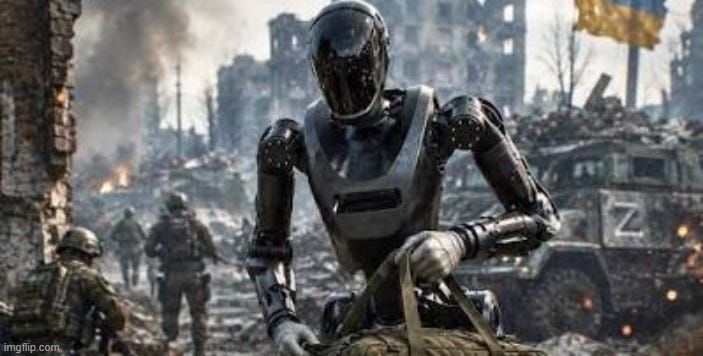
In the early months of 2026, two sleek, black humanoid figures stepped into one of the most dangerous environments on Earth. Built by the San Francisco startup Foundation Future Industries and standing nearly six feet tall, the Phantom MK-1 robots arrived in Ukraine not as conquerors but as quiet substitutes for human risk. Their mission was deliberately modest yet profoundly meaningful: to move supplies through contested zones, map interiors under threat, and perform reconnaissance where a flesh-and-blood soldier would face immediate danger.
Powered by the company’s Cortex AI system—a physics-informed reasoning engine that blends task planning with real-world prediction—the machines navigated with cameras rather than bulky lidar, translating high-level goals into careful, adaptive motion. Each successful delivery or scan represented one fewer exposure for a Ukrainian defender, turning abstract engineering into concrete protection of life.
Foundation Future Industries, founded in 2024 by Sankaet Pathak and colleagues with deep experience in robotics and defense, designed the Phantom from the outset for dual industrial and military use. The first-generation model, weighing roughly 80 kilograms and capable of carrying about 20 kilograms, revealed both its promise and its current limits during the Ukrainian trials.
Battery endurance, weather sealing, and payload capacity still required improvement, yet the robots proved they could operate in the chaotic, high-stress conditions of an active conflict zone. Lessons from those tests are already shaping the next iteration, the Phantom 2, which promises greater strength, waterproofing, dust resistance, and the ability to handle heavier loads. The company’s stated ambition is clear and humane: place machines in the roles that demand the greatest personal risk so that human soldiers can remain farther from the kill zone.
Ukraine itself has not waited for external solutions. Through its Brave1 defense-technology initiative, the country has launched grant competitions specifically aimed at developing indigenous humanoid platforms. These efforts sit alongside a broader explosion of unmanned ground vehicles that already conduct thousands of missions each month—holding positions for weeks, delivering logistics under fire, and even prompting enemy surrenders without committing infantry.
The arrival of true bipedal forms adds a new dimension: machines shaped like people can interact more naturally with the built environment of trenches, buildings, and urban rubble that wheeled or tracked systems struggle to enter. In this partnership between a determined Ukrainian defense industry and an ambitious American startup, technology is being forged under pressure and refined by necessity.
What elevates these developments beyond technical curiosity is their underlying ethic. Every Phantom that walks into a hazardous corridor is, in essence, an act of substitution—metal and algorithms accepting the danger that once fell only on young men and women. CEO Pathak has repeatedly framed the work in moral terms: if a machine can perform a dangerous task as well as a person, then deploying the machine is the highest form of good robotics can achieve.
The same principle animates Ukraine’s own programs. Commanders speak of reducing infantry exposure by significant percentages, of reclaiming positions with remote systems, and of preserving the irreplaceable resource of trained soldiers. The robots remain under human oversight; lethal decisions stay with people. They are tools, not autonomous arbiters of life and death.
Looking ahead, the path is neither simple nor guaranteed. Scaling production, hardening systems against electronic warfare, extending endurance, and integrating these platforms into existing doctrine will demand continued innovation and rigorous testing. Yet the direction is unmistakable and hopeful. In factories the same humanoids already assist in manufacturing; on future battlefields they may breach, clear, and supply while keeping humans at a safer distance.
The inspirational truth emerging from Ukraine’s eastern front is that courage need not always be measured by personal exposure to fire. Sometimes the bravest step is the one taken by a machine so that a human can live to take many more. Foundation’s Phantoms and Ukraine’s parallel efforts are early chapters in that story—imperfect, evolving, and already saving lives one calculated stride at a time.