

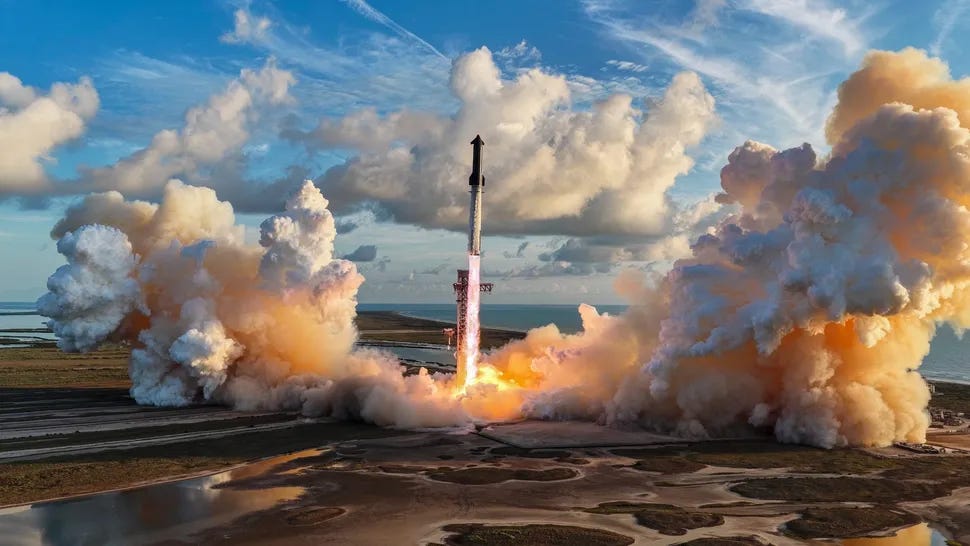
In the coastal flats of South Texas a new kind of industrial rhythm is taking shape. What began as a windswept test site for experimental prototypes is becoming the busiest rocket factory and launch complex on Earth. SpaceX’s Starbase is no longer simply a place where vehicles are tried and sometimes lost. It is the physical expression of a bet that rockets can be built and flown the way airliners once transformed travel: rapidly, repeatedly, and at a scale that changes what is possible.
The most concrete signal of that ambition arrived in mid-October 2026 when the Federal Aviation Administration opened a formal environmental review of SpaceX’s request to conduct as many as 456 Starship launches and 912 landings each year from Starbase. The number is not yet approved. It sits at the beginning of a lengthy review process that will examine noise, wildlife, air quality and community impact. Yet the request itself reveals the scale of thinking now underway. Current authorisation allows only twenty-five launches annually. The new proposal unfolds in phases. An initial step would permit one hundred launches and two hundred landings in a year, available any day and any hour. A later phase, expected within several years if the vehicle matures as hoped, would raise the ceiling to 456 launches, restricted to weekdays but still permitted at any hour. The figure of 456 works out to roughly one and three-quarter flights every weekday. It is an operational number rather than a round marketing target, calculated to match the production rates and turnaround times SpaceX believes it can eventually achieve while still leaving weekends for maintenance and recovery.
Starbase itself is expanding to meet that vision. Two orbital launch pads already stand, with towers capable of catching returning boosters and ships. Production halls known as Mega Bays and the still-rising Gigabay are filling with vehicles in various stages of assembly. Stainless-steel rings become tanks, tanks become ships and boosters, and engines arrive from testing stands farther inland. Recovered hardware returns from distant oceans for inspection, including one Starship that survived splashdown and completed a long sea voyage back to Texas so engineers could study its heat shield and structure in detail. Concrete continues to be poured, new work stands rise, and the site grows denser with the infrastructure of high-cadence flight. The goal is not merely more launches. It is a closed-loop system in which vehicles fly, land, are inspected and refurbished, and fly again with minimal time on the ground.
The larger purpose of all this activity extends far beyond Texas. Starship is designed as a fully reusable transportation system capable of carrying people and cargo to Earth orbit, the Moon, Mars and eventually farther. For Mars the architecture is especially demanding. Transfer windows open only every twenty-six months. To place meaningful mass on the surface during those brief opportunities, SpaceX must be able to launch dozens and later hundreds of vehicles in a compressed period. Elon Musk has spoken of ultimately needing a fleet measured in the thousands, with production rates that could one day reach a thousand ships per year. Early uncrewed missions would test entry and landing. Later windows would deliver infrastructure, power systems, habitats and, in time, people. A self-sustaining city on Mars would require millions of tonnes of cargo and a continuous flow of ships. The same high flight rate also serves nearer-term needs: denser Starlink constellations, point-to-point Earth travel, and support for NASA’s Artemis lunar landings.
None of the deep-space ambitions work without a capability that has never been demonstrated at this scale: the transfer of large quantities of cryogenic propellant between vehicles in orbit. A Starship departing Earth cannot carry enough methane and oxygen to reach the Moon or Mars with a useful payload. The solution is orbital refuelling. Tanker versions of Starship would launch, rendezvous with a waiting ship or depot, and transfer propellant until the departing vehicle is fully loaded. Internal tank-to-tank transfers have already been shown on earlier test flights. Ship-to-ship transfer remains the critical missing step. Until it is proven reliable, every lunar and Martian timeline carries significant uncertainty. Once mastered, however, it turns Starship from a powerful launcher into a true interplanetary transport system.
The path from today’s handful of test flights to hundreds of launches per year is steep. Engines must become more durable, heat shields more reliable, catch attempts routine, and ground operations almost choreographed. Regulatory approval must keep pace with engineering progress. Yet the direction is clear. Starbase is being built not for occasional spectacular missions but for the steady, industrial cadence of a transportation network. If the 456-launch request eventually becomes reality, and if production and refuelling mature alongside it, the sky above South Texas will fill with the regular thunder of vehicles climbing toward orbit, some bound for satellite deployment, others for the Moon, and still others beginning the long journey that could one day make humanity a multi-planetary species. The stainless-steel ships rising from the Texas coast are no longer prototypes chasing milestones. They are the early fleet of a new age of spaceflight.