

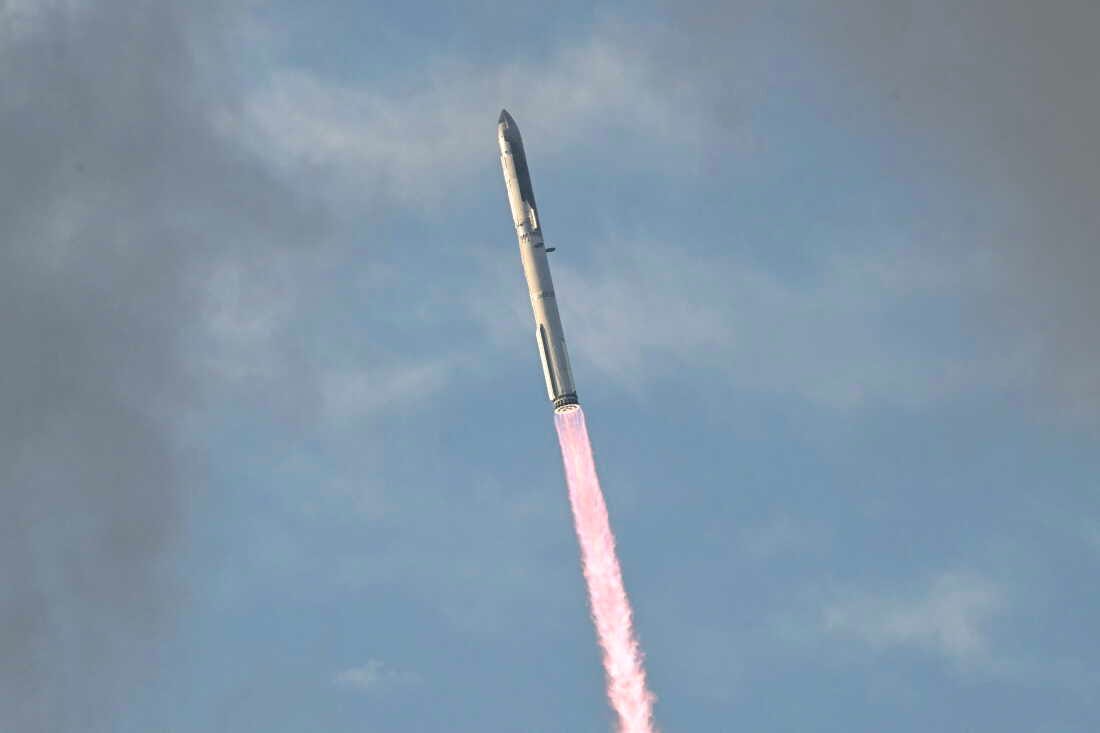
On the morning of September 28, 2026, the fourteenth flight of SpaceX’s Starship system lifted off from Orbital Launch Pad 2 at Starbase in South Texas and became the first to place a Starship upper stage into a sustained orbit around Earth. The vehicle, consisting of Super Heavy Booster 21 and Ship 41, both Block 3 variants, rose on the combined thrust of thirty-three Raptor engines and within minutes had completed hot staging. The booster executed its boostback and landing burns before making a controlled splashdown in the Gulf of Mexico. Ship 41 continued under its own power, survived the early shutdown of one of its six engines during ascent, and after a careful health assessment by flight controllers performed the orbital insertion burn that carried it into a low Earth orbit of roughly 275 kilometers.
Once on orbit the cargo bay opened and twenty-six Starlink Version 3 satellites, designated Starlink Group 31-1, were released in sequence. Three of those satellites carried cameras intended to image the ship’s heat shield; all twenty-six were later confirmed in contact with ground stations. The deployment marked both the first operational payload carried by Starship and the first time the larger, higher-capacity V3 satellites had been placed into service by the new vehicle. Each of the new satellites is designed to deliver approximately one terabit per second of capacity, a substantial increase over earlier generations.
Although the original mission plan called for roughly six orbits and a flight duration approaching ten hours, the loss of one Raptor during ascent led controllers to shorten the profile. After approximately two hours in space Ship 41 ignited a single engine for the deorbit burn, reoriented for entry, and began its return through the atmosphere. The vehicle survived peak heating, transitioned from hypersonic to subsonic flight under flap control, performed the landing flip, and executed a multi-engine landing burn that stepped down to a single engine before soft splashdown in the Pacific Ocean west of Chile. The controlled descent and water landing closed the mission a little more than three hours after liftoff.
Flight 14 therefore accomplished several firsts in a single day: the first orbital insertion of a Starship, the first deployment of operational Starlink satellites from the vehicle, the first in-space deorbit burn from a sustained orbit, and a successful atmospheric reentry and landing after orbital flight. The booster’s ocean recovery and the ship’s survival through the full sequence of ascent, orbit, payload release, deorbit and reentry supplied a large volume of flight data on the Block 3 hardware, engine reliability, heat-shield performance and guidance systems. While neither stage was recovered for reuse on this flight, the demonstration that Starship could reach orbit, deliver commercial satellites and return safely under control removed the last major suborbital limitation that had constrained the preceding thirteen tests. The mission stands as the clearest indication yet that the system is transitioning from experimental flights toward operational capability.