

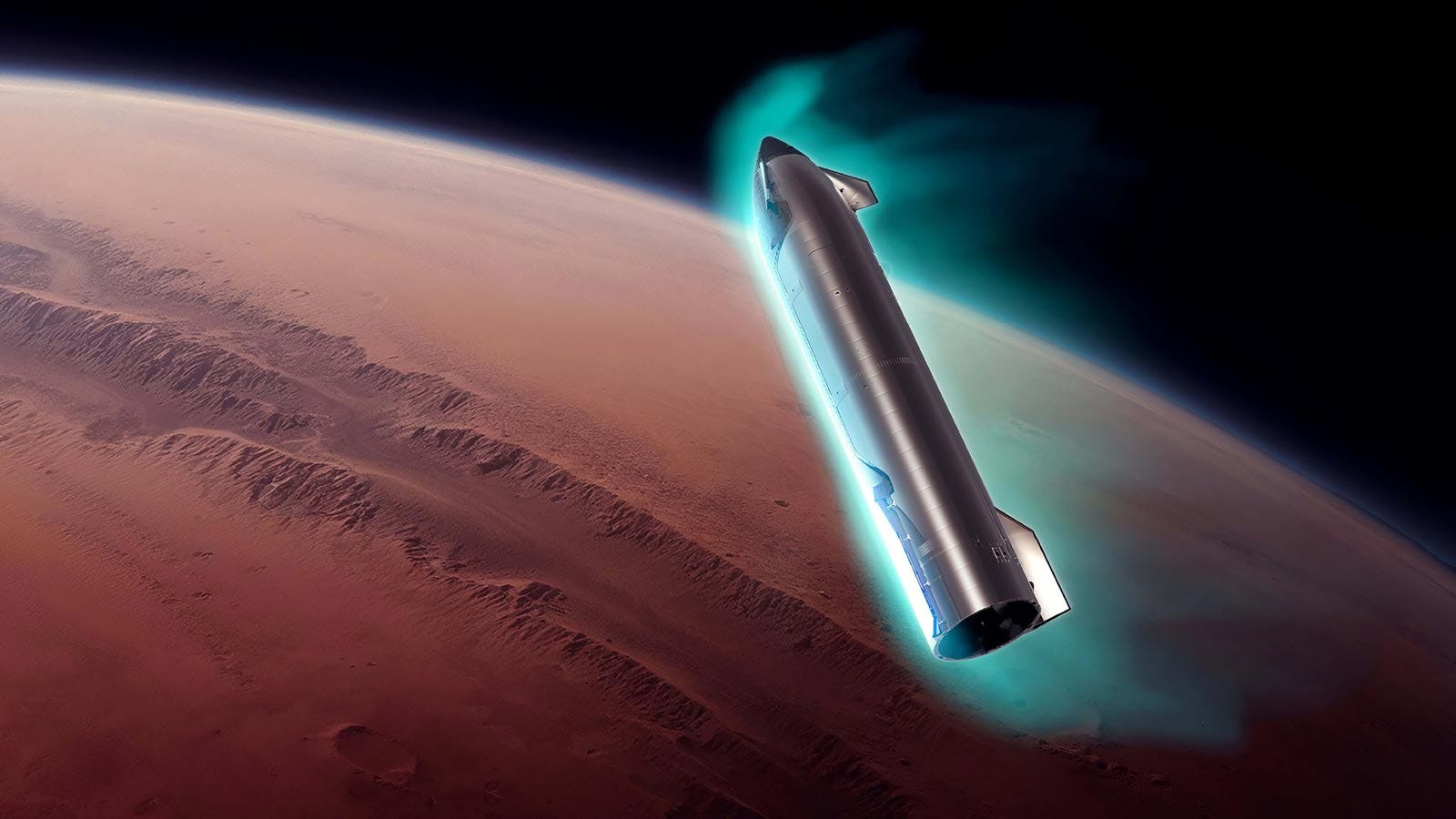
SpaceX’s long-term goal of making life multiplanetary centers on Mars. The company’s architecture relies on the fully reusable Starship system to deliver both cargo and crews across the roughly 26-month Earth–Mars transfer windows. Public statements and official materials in 2025–2026 show a pattern familiar from earlier years: bold near-term targets followed by more cautious revisions as technical milestones prove harder than hoped.

The Current Picture

By mid-2026, SpaceX’s public messaging had adjusted earlier hopes of launching uncrewed Starships during the late-2026 transfer window. Company materials now describe cargo flights to the Martian surface beginning “no earlier than 2028.” Elon Musk has separately indicated that substantive progress toward a Mars presence, including people on the surface, is more likely in a five-to-seven-year timeframe, with landers possibly arriving sooner.

A temporary prioritization of lunar activities has also been discussed. Musk noted that a self-growing city on the Moon could potentially be achieved on a shorter horizon than a comparable effort on Mars, leading SpaceX to place greater near-term emphasis on lunar capabilities while keeping Mars as the ultimate destination.

The Technical Path

Any Mars mission with Starship depends on several unproven or still-maturing capabilities. The most critical is orbital propellant transfer: multiple tanker flights must refuel a Mars-bound Starship in Earth orbit before the trans-Mars injection burn. Demonstrating reliable, large-scale cryogenic transfer in orbit remains a pacing item.

Entry, descent and landing on Mars present additional challenges. Starship will arrive at high speed and must decelerate in a thin atmosphere before a propulsive landing. Early uncrewed flights are intended to gather data on these phases and prove that vehicles can arrive intact. Payload concepts for initial missions have included scientific instruments, infrastructure precursors, and Tesla Optimus humanoid robots to perform surface tasks before crews arrive.

If early landings succeed, later transfer windows are planned to scale up rapidly—more vehicles, higher payload masses, and eventually crew. The long-term vision remains a self-sustaining city requiring large numbers of flights and the ability to produce propellant and other resources on Mars itself.

Realism and Risk

Mars transfer opportunities are inflexible. Missing a window adds more than two years before the next favorable alignment. Starship flight testing has made visible progress in reusability and performance, yet full orbital refueling, long-duration deep-space operations, and reliable Mars landings have not been demonstrated. Regulatory, production-rate and reliability factors add further uncertainty.

SpaceX’s approach continues to emphasize iterative flight testing and rapid design evolution. The company’s track record with Falcon 9 shows that ambitious schedules can eventually be met after delays. Whether the same pattern will hold for the far more complex Mars architecture is the central open question.

Looking Forward

The next few years will be defined by Starship’s continued test campaign, the first attempts at meaningful orbital propellant transfer, and any concrete steps toward uncrewed interplanetary flights. Success on those fronts would reopen more aggressive Mars timelines. Setbacks would push the first landings and crews further into the 2030s.

The destination has not changed. The schedule, as it has many times before, remains fluid.