

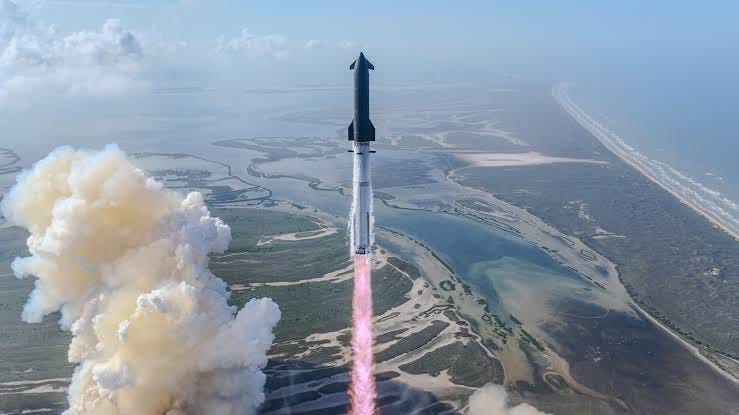
SpaceX’s Starship is rapidly redefining the boundaries of human spaceflight, moving from an ambitious blueprint to the most powerful rocket ever built. Representing a monumental shift in aerospace engineering, this fully reusable transportation system is designed to carry both crew and cargo to Earth orbit, the Moon, Mars, and beyond.
The Engineering Marvel
The Starship system consists of two core components: the Super Heavy booster and the Starship spacecraft. Standing at a staggering 121 meters (397 feet) tall when stacked, it dwarfs every historical predecessor, including NASA’s legendary Saturn V.
The Powerhouse: The Super Heavy booster is powered by 33 Raptor engines, which utilize subcooled liquid methane and liquid oxygen. Together, they generate an unprecedented 17 million pounds of thrust—more than double the power of the Saturn V.
The Payload Capacity: Starship is capable of carrying up to 150 metric tonnes in its fully reusable configuration, and up to 250 metric tonnes if expended.
The Structural Choice: Unlike modern aerospace designs that favor carbon fiber, Starship is built from a specialized stainless steel alloy. This material choice offers extreme thermal durability at a fraction of the cost, making it ideal for the intense heat of atmospheric reentry.
Redefining Reusability
The true paradigm shift of Starship lies in its approach to economics. Traditional spaceflight has historically treated multimillion-dollar rockets as disposable hardware. SpaceX aims to break this cycle entirely.
By creating a system where both stages return to Earth, refuel, and fly again within hours, SpaceX hopes to reduce the cost of space access by orders of magnitude. The company’s ultimate goal is a launch cost of just a few million dollars per flight, making space exploration financially sustainable for the first time in history.
Destination: Moon, Mars, and Beyond
Starship is not just a concept; it is the cornerstone of several generation-defining missions.
Returning to the Moon: NASA has selected a modified version of Starship as the Human Landing System (HLS) for its high-profile Artemis III and Artemis IV missions. It will be responsible for lowering American astronauts back onto the lunar surface for the first time since 1972.
The Martian Frontier: For Elon Musk and SpaceX, the Moon is merely a stepping stone. Starship’s architecture is designed to support the eventual colonization of Mars. A fleet of Starships could establish a self-sustaining human civilization on the Red Planet, transporting thousands of people and millions of tons of cargo over the coming decades.
Point-to-Point Earth Travel: Beyond outer space, SpaceX has envisioned using Starship for commercial Earth travel. By flying through the vacuum of space, the vehicle could transport passengers from New York to Shanghai in under 40 minutes, radically reshaping global logistics.
Through relentless rapid-prototyping and a willingness to learn from spectacular test-flight failures, SpaceX is turning what once sounded like science fiction into a tangible future. Starship isn’t just a new rocket; it is the machine that may finally turn humanity into a multi-planetary species.
With the fundamental design and early capabilities of SpaceX’s Starship already established, the focus of the aerospace community is shifting toward an almost unfathomable next chapter: mass production. Elon Musk’s vision does not stop at a boutique fleet of a dozen reusable rockets. To achieve the stated goal of making humanity a multiplanetary species, SpaceX is actively laying the groundwork to scale production to thousands of Starships per year.
Here is a look at what lies ahead for the upcoming flight manifests, how SpaceX plans to build an industrial assembly line for spaceships, and the brutal orbital mechanics that make such a massive fleet absolutely necessary.
The Immediate Horizon: High-Frequency Testing
Before the assembly lines can run at full throttle, Starship must finish its transition from an experimental prototype to a reliable commercial workhorse. The upcoming schedule of flights is focused heavily on operational milestones:
Orbital Refueling Demostrations: Critical tests will soon attempt to transfer cryogenic propellant between two Starships in low Earth Orbit (LEO). This is the linchpin technology required for any deep-space mission.
The Artemis Moon Landing: Under NASA’s Artemis program, a specialized Human Landing System (HLS) variant of Starship must successfully land astronauts on the lunar surface.
Uncrewed Mars Voyages: Rapid-fire test flights to Mars are being planned for the upcoming orbital alignment windows to test entry, descent, and landing in the thin Martian atmosphere.
Factory to Orbit: Scaling Production to Thousands
Building thousands of the largest rockets in human history requires a total reimagining of aerospace manufacturing. SpaceX is replacing traditional, slow aerospace craftsmanship with automotive-style mass production.
At Starbase in Boca Chica, Texas, and the expanding facilities at the Kennedy Space Center in Florida, the construction of “Starfactory” is underway. These mega-facilities are designed to utilize automated precision welding, standardized steel ring sections, and modular component assembly lines. The goal is to turn out multiple Starship upper stages and Super Heavy boosters every single week, treating spaceships less like bespoke maritime vessels and more like commercial airliners.
Why Does Humanity Need Thousands of Starships?
To the casual observer, building thousands of 165-foot-tall spaceships seems like overkill. However, the math behind establishing a self-sustaining civilization on Mars leaves SpaceX with no other choice.
The Tyranny of the Synodic Period: Earth and Mars only align favorably once every 26 months. This brief transport window opens for just a few weeks. To send meaningful amounts of cargo and personnel, SpaceX cannot rely on a few ships making round trips. They must launch an entire armada—hundreds of ships—simultaneously during that narrow window.
The Fuel Multiplier (Orbital Logistics): Starship requires a massive amount of fuel to leave Earth’s gravity well. To send a single fully loaded cargo Starship to the Moon or Mars, SpaceX must first launch anywhere from 4 to 8 “tanker” Starships into LEO to refuel that primary vehicle. A single deep-space mission effectively demands a dozen supporting launches.
The One-Way Ticket Problem: Early in the colonization of Mars, many structural, habitat, and industrial Starships will not return to Earth. They will be harvested on Mars for their high-grade stainless steel, electronics, and methane tanks. This constant consumption of hardware creates a permanent demand for replacement ships back on Earth.
Megaconstellations and Earth Logistics: Beyond Mars, a scaled fleet will support the deployment of next-generation Starlink satellites, deep-space scientific outposts, and a point-to-point suborbital transport network on Earth capable of moving cargo anywhere on the globe in under an hour.
The upcoming flights of Starship are not just about proving that a giant rocket can fly; they are the validation steps for an interplanetary logistical pipeline. If SpaceX succeeds in scaling its factories to thousands of ships per year, the sky will no longer be a limit—it will simply be the departure lounge.