

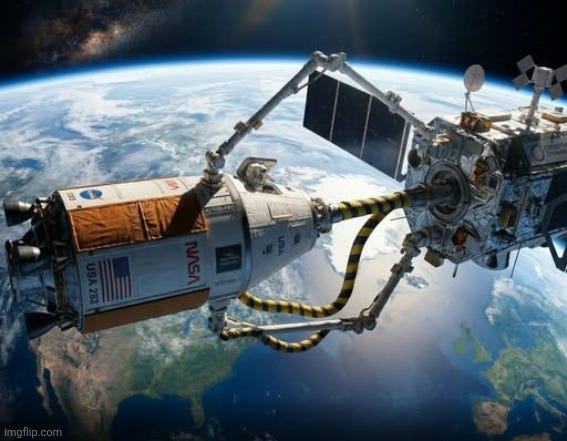
For decades, the business model of spaceflight mirrored that of a disposable camera. You buy it, you use it once, and when the film—or in this case, the fuel—runs out, you throw the whole multimillion-dollar machine away.
That wasteful era is coming to a close. As we push through September 2026, the aerospace industry is undergoing a paradigm shift toward sustainability, longevity, and high-stakes orbital maintenance. Welcome to the age of Spacecraft Servicing, Refueling, and Repair—the dawn of the cosmic mechanic.
⛽ The Next Big Milestone: Starship’s Orbital Gas Station
If you want to understand how serious the space industry is about cosmic refueling, look no further than SpaceX. As the aerospace community eagerly anticipates the upcoming Starship Flight 14 test, the company is racing toward its most daunting challenge yet: large-scale ship-to-ship propellant transfer.
For NASA’s Artemis program to successfully land humans on the Moon, a single Lunar Starship will need to be refueled in Low Earth Orbit (LEO) via multiple automated tanker flights. To make this possible, SpaceX has designed an automated docking mechanism utilizing massive internal cryocouplers.
The concept sounds simple: two giant Starships dock tail-to-tail in zero gravity, use a specialized pressure differential system, and actively push hundreds of metric tons of supercooled liquid oxygen (LOX) and liquid methane (LCH₄) from one ship to the other. Because fuel floats freely in microgravity, the ships must use settling thrusters to artificially push the liquid to the bottom of the tanks. It is an orbital ballet where one wrong move means losing two of the largest flying vehicles in human history.
🛰️ The Commercial Mechanics: New Space to the Rescue
While SpaceX tackles heavy-lift refueling for deep-space missions, a sleek new fleet of commercial space companies is setting up shop in Geostationary Orbit (GEO) and LEO to service standard military and commercial satellites.
Four pivotal government-backed missions are slated to demonstrate operational satellite servicing:
Astroscale U.S. (APS-R): Expected to perform the first-ever hydrazine refueling operation in GEO by docking with a U.S. Space Force Tetra-5 satellite to transfer fresh fuel.
Northrop Grumman SpaceLogistics: Building on the success of their Mission Extension Vehicles, their new Mission Robotic Vehicle (MRV) will use advanced robotic arms (developed by the Naval Research Laboratory) to catch, repair, and install specialized life-extending pods on aging satellites.
Orbit Fab: Famously known for pitching the “gas stations in space” concept, Orbit Fab has developed the RAFTI (Rapidly Attachable Fluid Transfer Interface)—a standardized refueling port that new satellites can install before launch so they can simply pull up to an orbital tanker later in life.
Starfish Space & ClearSpace: Companies focused on the other half of the servicing coin: active debris removal and tugboat services. Starfish Space recently secured a major $52.5M Space Development Agency contract to autonomously dock with and safely de-orbit defunct space junk.
❄️ The Nightmare of Cryofluidics and Orbital Depots
Keeping a satellite running on hydrazine is one thing, but establishing permanent orbital propellant depots packed with supercooled cryogenic fuels is an entirely different beast. Cryofluidics—the study of ultra-cold fluids in motion—presents a gauntlet of physics problems that keep aerospace engineers awake at night.
The primary villain? Boil-off. Cryogenic propellants like liquid hydrogen with a temperature of −430°F and liquid methane must remain blindingly cold to stay liquid. In space, direct sunlight can instantly flash these liquids into gas, causing the fuel tanks to overpressurize and vent precious energy away. To counter this, orbital depots require high-tech multi-layered sun-shields, active solar-powered cryo-coolers, and specialized vacuum-jacketed internal plumbing.
Furthermore, fluid sloshing during docking maneuvers creates massive thermal mixing inside the tanks. Without gravity to separate liquid from gas, bubbles can form at the tank walls (pool boiling) or inside the fuel lines (cavitation), potentially choking pumps and tearing delicate plumbing apart. NASA is currently combatting this by running rigorous ground tests on a new L3Harris-developed cryocoupler designed to handle extreme thermal contraction and misaligned dockings safely.
🚀 A Sustainable Horizon
The transition from disposable rockets to an in-orbit circular economy is no longer a sci-fi dream—it is an economic imperative. By transforming our satellites and spacecraft from short-term throwaways into long-term, modular, and maintainable assets, we aren’t just cleaning up our orbital backyard; we are building the interstate highway system for the future of human exploration.
I hope this comes to fruition, there's no reason that it cannot. Closer to Earth, we've kept the B-52 flying for 70 years and it may well still be flying 100 years after entering service.