

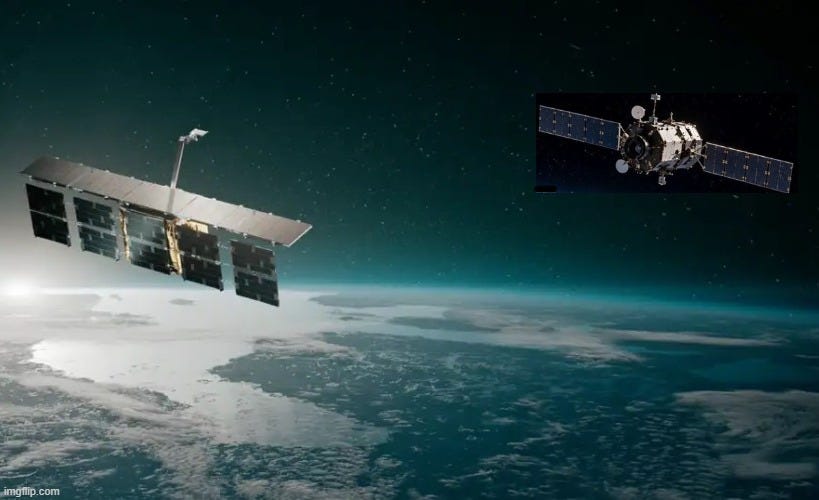
In the silent vacuum above Earth, where velocities exceed seventeen thousand miles per hour and the margin for error is measured in meters, a Russian military satellite named Kosmos-2612 executed one of the most deliberate and provocative orbital maneuvers yet observed. Over several days in mid-October 2026, this spacecraft closed from hundreds of kilometers to extreme proximity with ICEYE-X36, a commercial synthetic aperture radar satellite operated by the Finnish company ICEYE through its United States subsidiary. The two objects loitered in the same orbital neighborhood at altitudes around 555 kilometers, with separations dropping at times to roughly five hundred meters and, according to some tracking reconstructions, possibly far closer. Independent analysts and the space-tracking firm LeoLabs described the sequence as a controlled approach, repeated small maneuvers to shift relative position, extended loitering, and a measured departure. It was not a chance conjunction. It was rendezvous and proximity operations performed without the consent of the target’s operators, and it stands as the boldest known instance of such behavior directed at an active commercial satellite in low Earth orbit.
The significance of this encounter lies less in any confirmed physical contact—none has been reported—and more in what it reveals about evolving norms in the space domain. Kosmos-2612 belonged to a cluster of six Russian satellites launched from Plesetsk in April 2026. Within weeks, several of them had adjusted their orbital planes to align with ICEYE-X36. One earlier pass in late May brought a sister satellite within about two and a half kilometers, prompting ICEYE to maneuver its own craft in response. After a quieter summer of natural drift, Kosmos-2612 resumed energetic burns in late September. It raised its altitude to exploit nodal precession, realigned its orbital plane, then dropped back to match the target’s height and inclination. By mid-October it had closed the remaining hundreds of kilometers through careful phasing burns, settling into formation flying with near-zero relative velocity. Public orbital data carry uncertainties of hundreds of meters, so precise closest-approach figures remain estimates, yet the pattern is unambiguous: sustained, fuel-intensive pursuit culminating in station-keeping so tight that ground radars occasionally struggled to distinguish the two objects.
This episode did not emerge from nowhere. It is the latest chapter in a longer Russian pattern of invasive orbital approaches that has unfolded for more than a decade. In geostationary orbit, the Luch satellites, also known as Olymp, have repeatedly parked near Western communications spacecraft operated by Intelsat, Eutelsat, and the Franco-Italian military system Athena-Fidus. These loitering periods often lasted weeks or months at distances of tens of kilometers—close enough, in some assessments, to place the Russian craft inside the uplink beams of ground terminals and potentially collect signals intelligence. French officials publicly accused one such satellite of espionage in 2018. Parallel activity has occurred in low Earth orbit under programs associated with the Nivelir series. Russian Kosmos satellites have been inserted into coplanar orbits with United States National Reconnaissance Office imaging spacecraft, maintaining separations of tens of kilometers that allow continuous observation under favorable lighting and geometry. Some of these missions have released smaller objects, fueling speculation about inspection or even kinetic capabilities. Domestic testing has grown more sophisticated as well; in 2026 pairs of Russian military satellites demonstrated formation flying at separations measured in single-digit meters while traveling at orbital speed.
China has pursued a comparable trajectory. Its Shijian and Shiyan satellites have conducted approaches to foreign geostationary communications craft and, more notably, demonstrated docking and towing of a defunct Chinese navigation satellite to a graveyard orbit. Multi-satellite proximity operations among Chinese platforms have achieved relative distances of tens of meters with very low closing speeds. These activities, like Russia’s, blur the line between legitimate space situational awareness or servicing technology and potential counterspace tools. The United States operates its own inspector satellites under the Geosynchronous Space Situational Awareness Program, so the underlying capability is not unique. What distinguishes the Kosmos-2612 operation is the combination of extreme closeness, lack of coordination, and the identity of the target: a commercial radar satellite whose imagery has supported Ukrainian forces.
The choice of ICEYE-X36 is unlikely to be coincidental. Synthetic aperture radar satellites can image through cloud and darkness, providing persistent battlefield intelligence that has proven valuable in a conflict defined by artillery, drones, and rapid maneuver. ICEYE’s constellation has supplied high-resolution data to Ukraine under commercial arrangements. By approaching one of these satellites so closely, Russia demonstrated the ability to inspect, characterize, shadow, or potentially interfere with a platform that contributes to Ukrainian situational awareness. Possible motives range from technical intelligence collection—photographing antennas, solar arrays, or radar apertures—to electronic disruption experiments or simply coercive signaling that commercial assets supporting Kyiv are not beyond reach. The Outer Space Treaty prohibits weapons of mass destruction in orbit and requires states to avoid harmful interference, yet it leaves substantial room for interpretation around proximity operations. The absence of clear rules of the road for uncooperative rendezvous has allowed these activities to proliferate.
The timing of the maneuver invites a broader political reading. More than four and a half years after the full-scale invasion of February 2022, the war in Ukraine has settled into a grinding attrition that exacts heavy costs on both sides. Russian forces have made incremental gains in some sectors at enormous human and material expense, yet they have failed to achieve the rapid collapse of Ukrainian resistance once anticipated in Moscow. Western military aid, including intelligence derived from commercial and governmental satellites, has helped Kyiv offset numerical disadvantages. Domestic Russian economic pressures, sanctions, demographic losses, and the steady erosion of high-end military stockpiles have accumulated. In this context, expanding the contest into orbit can be understood as an attempt to raise the stakes and probe for vulnerabilities that conventional ground operations have not fully exploited. A demonstration that Russia can reach commercial imaging assets used by Ukraine sends a message both to Kyiv and to the private companies and governments that enable its intelligence picture. It also tests the willingness of the United States and its allies to respond when the target is not a national security satellite but a commercial one registered under a partner flag.
Whether this reflects strategic calculation or a form of desperation is a matter of interpretation. Prolonged wars often produce escalation into new domains as each side seeks asymmetric advantages. Russia’s investment in inspector satellites and co-orbital capabilities long predates the current conflict, yet the willingness to press so close to a commercially operated, Ukraine-linked platform in low Earth orbit marks a qualitative shift. The risk of miscalculation rises with every meter of reduced separation. A collision, even accidental, could generate debris clouds that endanger the entire orbital regime upon which modern economies and militaries depend. The technical sophistication required for these maneuvers also consumes limited propellant, meaning each such operation shortens the operational life of the inspecting satellite. That Russia is prepared to expend that resource against a commercial target suggests a prioritization of political and intelligence effects over pure longevity.
The broader consequence is an accelerating normalization of contested space. What began as occasional close approaches in geostationary orbit has migrated into the more crowded and commercially vital low Earth orbit. Tracking networks operated by companies such as LeoLabs and government space surveillance systems now routinely flag these events, stripping away some of the deniability that once surrounded them. Yet transparency alone has not deterred the behavior. Without clearer international norms defining safe distances, notification requirements, or thresholds for harmful interference, further incidents appear probable. Kosmos-2612 eventually drifted away from ICEYE-X36, but the capability it demonstrated remains on orbit and can be replicated. The quiet contest above Earth has entered a more assertive phase, one in which the satellites that map battlefields and transmit data have themselves become potential points of friction in a war that continues to expand beyond the fields and cities of Ukraine.
It gets even worse: China is training autonomous spy satellites:
https://thedebrief.org/a-new-cold-war-is-unfolding-in-orbit-as-china-advances-satellite-surveillance/