

The final frontier is experiencing a profound geopolitical shift as the United States transitions from a posture of passive space deterrence to an active, more aggressive stance on satellite defense and orbital weaponry. For decades, Washington treated space as a sanctuary—a domain primarily used for surveillance, communication, and scientific exploration. However, as the theater becomes increasingly contested and technically complex, the Pentagon is rapidly pivoting. The era of treating space purely as a support mechanism for terrestrial forces is over; tomorrow’s conflicts will be fought, won, or lost in orbital space.
This strategic evolution is driven by the rapid scaling of orbital artificial intelligence and expanding cislunar activity. The deployment of advanced AI in orbit has transformed satellites from static hardware into autonomous, decision-making agents capable of real-time threat detection and evasive maneuvering. Concurrently, the race to control cislunar space—the vast region between Earth and the Moon—has escalated the stakes. As both state and non-state actors eye the Moon for strategic high ground and resource extraction, the U.S. military recognizes that securing these distant vectors is vital to national security.
In response to perceived threats from other spacefaring nations, American defense policy has embraced a doctrine that blurs the line between defense and offense. Acknowledging the aggressive capabilities developed by adversaries, including ground-based anti-satellite lasers, electronic jamming, and “nesting doll” inspector satellites, the U.S. is heavily investing in its own counterspace capabilities. This includes developing technologies to neutralize orbital threats, disable adversary communications, and project power directly within the orbital plane. The establishment and maturation of the U.S. Space Force has codified this reality, shifting the organizational culture toward preparing guardians for active orbital combat.
Ultimately, the commercialization and militarization of space have converged to create an environment where passivity equals vulnerability. By adopting a more assertive, offensive-minded strategic framework, the United States aims to establish a dominant position that deters aggression by demonstrating a clear readiness to fight in space. As AI continues to accelerate the tempo of orbital operations and cislunar infrastructure expands, the nation’s ability to wage space offense will likely dictate the balance of global power for the next century.
Orbital AI Changes the Game
This shift reflects a growing recognition within Washington that defending satellite architecture now requires the ability to deter, disrupt, and neutralize adversarial capabilities in real time. The modern orbital ecosystem is scaling at a pace that traditional defense frameworks cannot sustain. The deployment of orbital AI has enabled satellites to process massive datasets autonomously, shifting command and control from ground stations to the edge of space.
Cislunar Infrastructure and Lunar Resources
Simultaneously, the strategic landscape is expanding beyond Geostationary Orbit into cislunar space, the vast region between Earth and the Moon. As nations scramble to establish infrastructure on the lunar surface and in stable Lagrange points, securing these deep-space trade routes and military outposts has become a vital national security priority, forcing military planners to prepare for conflict millions of miles from Earth.
From Defense to Offense
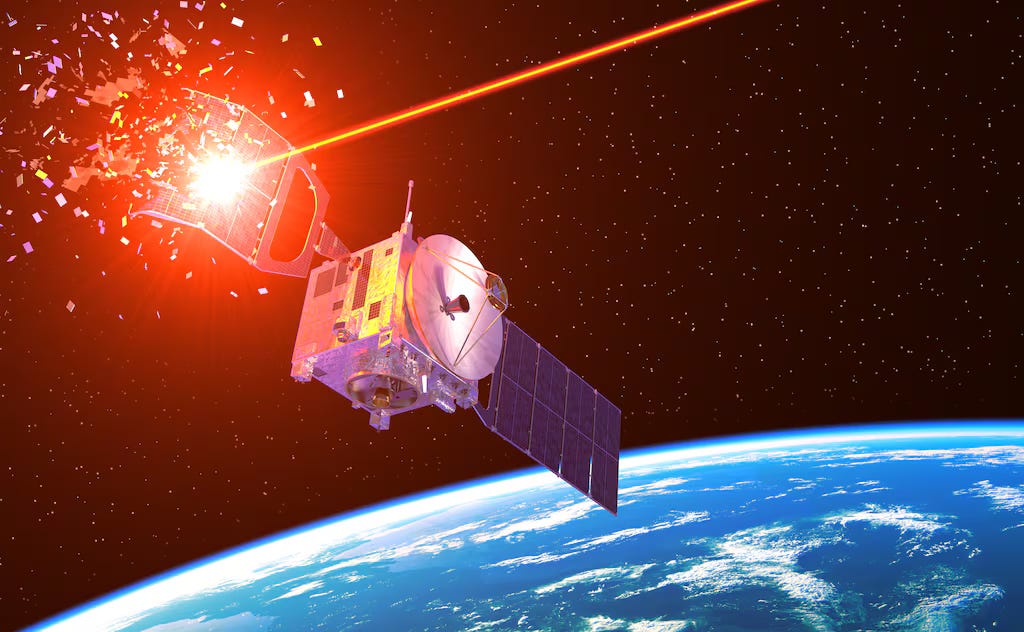
To operate within this environment, military doctrines consider various categories of orbital capabilities. Kinetic systems, including co-orbital interceptors designed for physical interception, represent one technological approach. Concurrently, defensive and offensive strategies often emphasize non-kinetic and directed-energy mechanisms, which disrupt operations without generating long-lasting orbital debris fields. These include high-powered lasers, high-power microwave systems, and electronic countermeasure units intended to neutralize sensors, affect internal circuitry, or interrupt communication links.
Surviving a contested orbital environment depends on comprehensive sensor networks and enhanced spacecraft maneuverability. Space situational awareness relies on distributed constellations of space-based radar and optical sensors designed to track orbital objects continuously. When potential threats are identified, asset protection depends on rapid satellite orbital changes. Assisted by autonomous processing, modern defense satellites are designed to execute precise maneuvers using chemical or electric propulsion systems, altering their orbital parameters to degrade the tracking accuracy of adversarial systems. Using up limited fuel to evade possible targeting.
The Orbital Weapons Arsenal
The modern space arsenal has evolved far beyond theoretical concepts into deployable, multi-tiered offensive technologies.
Kinetic Kill Vehicles
These weapons rely on physical impact to destroy targets. Direct-ascent anti-satellite (ASAT) missiles launched from Earth, or co-orbital interceptors deployed from nearby satellites, slam into targets at orbital speeds. The catastrophic impact obliterates the asset but creates hazardous fields of space debris.
Directed Energy Weapons (DEWs)
DEWs offer high-precision, speed-of-light engagement without generating physical debris.
Laser Systems: Used to permanently blind optical sensors (dazzling) or structurally damage critical components.
High-Power Microwaves (HPM): Tailored to fry the internal electronics and processors of a target satellite, rendering it a useless piece of space junk while leaving its exterior intact.
Electronic Warfare (EW) and Cyber Weapons
Often the most frequent line of offense, EW includes localized jamming and spoofing of GPS, communication, and telemetry signals. Cyber weapons go a step further, hacking into a satellite’s control software to seize command, alter its orbit, or permanently shut down its payloads.
Co-Orbital Inspections and Robotic Manipulators
Satellites equipped with robotic arms or close-proximity capabilities can rendezvous with a target under the guise of maintenance. Once in position, they can physically manipulate, degrade, or capture an adversary’s asset.
Detection and Survival: Sensors and Orbital Avoidance
Survival in a contested space environment requires a fusion of advanced tracking and dynamic evasive capabilities.
Space Domain Awareness (SDA) Sensors
To counter offensive threats, nations rely on a dense matrix of ground-based radars and space-based optical sensors. These systems continuously track thousands of objects, mapping anomalies in real-time to provide early warning of an impending ASAT launch or an adversary satellite executing an unauthorized rendezvous.
Dynamic Satellite Orbital Changes
Historically, satellites remained in rigid, predictable orbits. Today, modern military satellites are designed with high-thrust propulsion systems—including electric and chemical capabilities—to perform sudden, unpredictable orbital maneuvers. By rapidly altering their altitude, inclination, or phase, assets can successfully break the tracking locks of incoming kinetic weapons or guided co-orbital threats.
The Global Players
The race for space dominance is defined by an intense competition between three primary superpowers.
United States
The United States has structured its approach around maintaining space superiority. Washington has explicitly transitioned the U.S. Space Force and U.S. Space Command from an architecture of passive defence to active deterrence and offensive readiness. Acknowledging that space is a warfighting domain, the U.S. is heavily investing in proliferated low-Earth orbit (pLEO) constellations, autonomous AI-driven defensive networks, and rapidly deployable counterspace capabilities meant to enhance resilience and neutralize adversary space systems during conflict. They are developing capabilities such as the Golden Dome Missile Defense Shield to deny space advantages to adversaries during crises. American strategic frameworks now treat the domain as an independent operational environment rather than strictly a support function for terrestrial forces.
China
China operates as a major participant in this domain, developing capabilities intended to balance Western presence. Beijing views space superiority as a core pillar of its asymmetric warfare strategy. The People’s Liberation Army (PLA) has rapidly fielded an expansive array of direct-ascent ASAT missiles, operational ground-based laser dazzlers, and sophisticated co-orbital robotic satellites. Beijing integrates electronic warfare, cyber capabilities, and counter-space systems within its broader military structure. China is also aggressively expanding its footprint in cislunar space, aiming to establish infrastructure and operational dominance around the lunar surface ahead of Western counterparts. The Chinese space program actively demonstrates specialized co-orbital systems capable of close-proximity operations and satellite manipulation.
Russia
Despite economic constraints, Moscow remains a highly volatile and capable threat in orbit. Russia continues to test ground-launched and air-launched kinetic ASAT systems, alongside complex electronic warfare suites capable of blinding regional communication networks. Russian “inspector” satellites routinely conduct aggressive, close-proximity maneuvers near high-value U.S. military and intelligence assets, signaling Moscow’s willingness to use space as a primary gray-zone warfare front.