

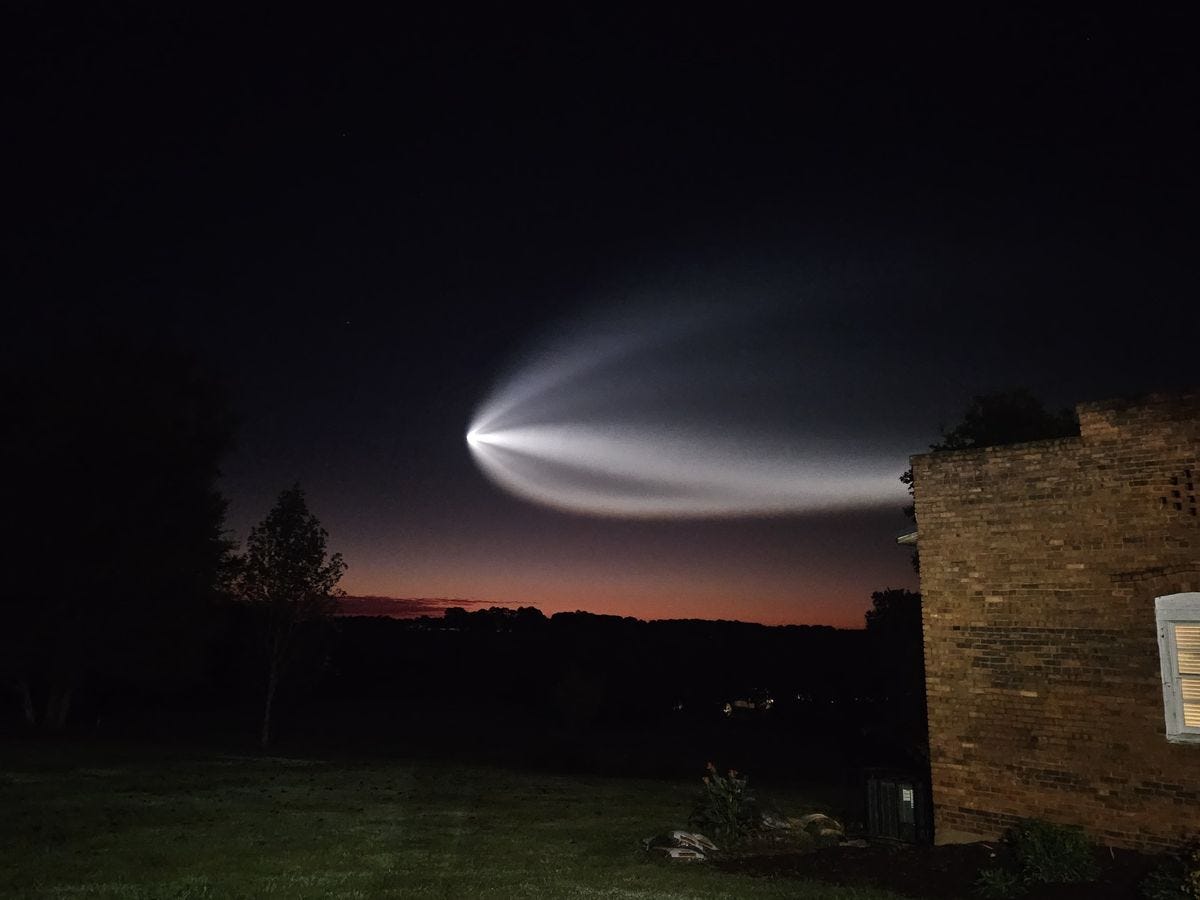
On Tuesday morning, October 13, 2026, an early launch from Florida’s Space Coast transformed the predawn skies along much of the United States East Coast into a fleeting celestial spectacle. At 6:33 a.m. Eastern Time, a SpaceX Falcon 9 rocket lifted off from Space Launch Complex 40 at Cape Canaveral Space Force Station, carrying a Cargo Dragon spacecraft on the CRS-35 mission bound for the International Space Station. The timing, roughly fifty minutes before local sunrise, combined with clear atmospheric conditions and a northeasterly trajectory that hugged the coastline, produced one of the most vivid “space jellyfish” displays in recent memory.
As the rocket climbed rapidly into the thinning upper atmosphere, its engines continued to expel a mixture of water vapor and carbon dioxide. In the near-vacuum conditions high above Earth, these exhaust gases expanded dramatically, forming a broad, diffuse plume far wider than the vehicle itself. While observers on the ground remained in darkness, the high-altitude cloud caught the first rays of the rising sun still below the horizon. The result was a luminous, morphing formation that glowed in shifting hues of blue, white, orange, and iridescent tones against the dark sky. Trailing wisps and elongated streams of illuminated vapor hung beneath the main body of the cloud, completing the resemblance to a giant jellyfish drifting through the heavens.
The phenomenon was visible across a vast stretch of the eastern seaboard. Residents from central and southern Florida reported the glowing cloud spreading overhead shortly after liftoff. Farther north, sightings came in from Georgia, the Carolinas, Virginia, Pennsylvania, and even the Washington, D.C., area. Early risers stepping outside to tend to daily routines or simply glancing upward found themselves staring at an unexpected and ethereal display that lingered for several minutes before gradually dissipating. Social media and local reports filled with accounts of the surprise, many describing the sight as both otherworldly and unforgettable.
The launch itself proceeded smoothly. The Falcon 9’s first-stage booster, flying for the eighth time, separated and returned to Landing Zone 40 near the launch pad, announcing its arrival with characteristic sonic booms that rolled across the Space Coast. The Cargo Dragon, on its fourth flight to the station, separated from the upper stage and began its roughly fifty-two-hour journey. It carried more than six thousand pounds of supplies, scientific experiments, and equipment, including roll-out solar arrays destined to boost the station’s power capacity. Autonomous docking with the space-facing port of the Harmony module was targeted for Thursday morning.
What elevated this particular mission beyond a routine resupply flight was the rare alignment of factors that produced the space jellyfish. The effect requires a precise combination of twilight lighting, high-altitude exhaust expansion, and favorable viewing geometry. When those elements converge, as they did on this October morning, the ordinary business of sending cargo to orbit briefly becomes a shared public wonder. For millions along the East Coast who happened to look up at the right moment, the expanding plume offered a vivid reminder of the beauty that can accompany humanity’s continued reach into space.