

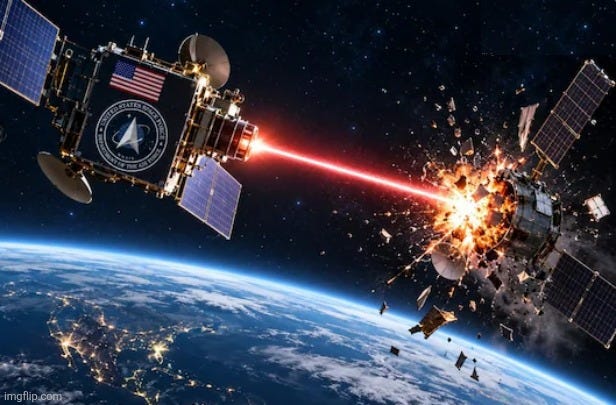
In mid-September 2026, the United States publicly acknowledged for the first time that it operates on-orbit space control weapons. Air Force Secretary Troy Meink delivered the statement during a keynote at the Air, Space and Cyber Conference, declaring that these systems are capable of defending the joint force against hostile adversary action. Space Force leadership reinforced the message the following day. Officials described the phrasing as deliberate and carefully considered, framing the disclosure as a deterrent signal aimed primarily at China and Russia. No details were provided about the number of systems, their exact capabilities, when they were deployed, or whether they are kinetic or non-kinetic. The announcement marked a clear departure from years of deliberate ambiguity in American public statements about space weapons.
This development arrives against a backdrop of intensifying competition in orbit. For more than a decade, American officials have expressed concern that potential adversaries were developing and testing counterspace capabilities, including co-orbital systems, electronic warfare tools, directed energy devices, and kinetic anti-satellite weapons. The recent disclosure shifts the United States from quiet development and restrained language toward open acknowledgment that space is now treated as a warfighting domain in which the ability to contest and control access matters.
Several important dimensions of this shift have received relatively limited attention. First, the very vagueness of the announcement may limit its deterrent value. Classic deterrence theory requires not only the existence of a capability but also credible understanding of how and under what conditions it would be employed. By confirming presence while withholding nearly all operational details, the United States has created a signal that is clear in intention yet ambiguous in practical effect. Adversaries may struggle to calibrate their responses when the precise nature of the threat remains unknown.
Second, the United States is not the first nation to develop or deploy systems with counterspace potential. Russia and China have conducted proximity operations, tested anti-satellite missiles, fielded jamming capabilities, and experimented with grappling or inspection satellites for years. What changed in September 2026 was primarily rhetorical. American officials previously preferred softer terms such as counterspace capabilities or space control. The decision to use the word weapons represents a deliberate drop of longstanding euphemisms rather than evidence of a sudden technological leap.
Third, the reactions from Beijing and Moscow highlight a pattern of mutual accusation. Both countries have long advocated for the peaceful use of outer space and proposed broad prohibitions on space weapons while simultaneously advancing their own counterspace programs. The American announcement provided them with an opportunity to criticize the militarization of space, yet it also exposed the gap between their public diplomacy and operational reality. This mirror imaging has characterized the space security discussion for years and shows little sign of resolution.
Fourth, the risk of debris and irreversible escalation remains underappreciated in much public discussion. Kinetic engagements in orbit can generate long-lived clouds of high-velocity fragments capable of damaging or destroying unrelated satellites for decades. Even limited conflict could render entire orbital regimes hazardous for military, commercial, and scientific users alike. The shared nature of the orbital environment means that actions taken by one nation can impose lasting costs on all others, including the initiator.
Fifth, commercial and economic vulnerability receives insufficient emphasis. Modern societies depend heavily on satellite services for navigation, timing, communications, weather forecasting, financial transactions, and logistics. Disruption of these systems would cascade rapidly into civilian life and the global economy. The concentration of critical infrastructure in a relatively small number of orbital regimes creates strategic targets whose loss would affect far more than military operations.
Sixth, meaningful arms control appears increasingly difficult. The 1967 Outer Space Treaty prohibits weapons of mass destruction in orbit but remains silent on conventional systems. Many dual-use technologies blur the line between peaceful and military applications. Verification of compliance would be extraordinarily challenging, and geopolitical distrust currently leaves little room for new binding agreements.
Seventh, quieter policy changes have been underway for some time. Decision-making authorities for certain reversible counterspace effects have gradually been delegated downward within the American command structure. The public announcement sits atop these less visible adjustments in how the United States prepares to respond to threats in orbit.
Eighth, the broader normalization of space as a warfighting domain may prove more consequential than any single system. Language once considered provocative is now used routinely by senior leaders. Planning for contested operations extends beyond low Earth orbit into cislunar space. The cultural and institutional shift toward treating space as a domain in which superiority must be actively contested is already reshaping doctrine, training, and acquisition priorities.
Satellites have become indispensable to modern warfare. They provide the positioning, navigation, and timing data that guide precision munitions. They enable real-time intelligence, surveillance, and reconnaissance across vast distances. They support secure and resilient communications for dispersed forces. They deliver missile warning and weather information critical to operational planning. Without reliable access to these services, the tempo, accuracy, and coordination of contemporary military operations would degrade sharply.
History shows that control of the decisive domain has repeatedly determined the outcome of major conflicts. In earlier eras, dominance on the open field through superior cavalry often decided battles. The industrial age elevated the importance of massed firepower and trench systems that locked armies into grinding attrition. The twentieth century demonstrated that control of the air could prove decisive, allowing forces that dominated the skies to strike at will while denying the same freedom to their opponents. Each shift in the character of war elevated a new domain to strategic centrality.
The conflict in Ukraine has illustrated the contemporary reality with particular clarity. Access to commercial satellite communications through Starlink has provided Ukrainian forces with resilient connectivity that has proven difficult for Russian electronic warfare to eliminate completely. This advantage has supported command and control, coordination of long-range strikes, and the effective employment of unmanned systems even under conditions of intense electronic attack. The lesson is straightforward: forces that can maintain space-enabled services hold a significant operational edge, while those denied them face severe constraints.
The trajectory is clear. As dependence on orbital systems continues to grow, the ability to protect one’s own satellites while threatening an adversary’s will become an increasingly central element of military strategy. Deterrence in space now joins deterrence on land, at sea, and in the air as a necessary component of national security. The September 2026 announcement did not create this reality. It merely made the underlying shift more difficult to ignore. The future of warfare will be shaped in significant measure by who can operate effectively in, through, and from the orbital domain.
Speaking as an American, the United States, Russia, and China are all talking out both sides of their mouths when it comes to what should/shouldn't be done in space. For me, the fortunate thing is that all 3 countries have enormous orbital assets and an implied mutually assured destruction in space could be what keeps anyone from pressing the button. On the other hand, a lesser power with no skin in the game could launch missiles and burn the whole house down in order to stake a claim in the smoldering ruins. Hopefully rational actors will prevail like they did during the Cold War.