

Sending the Machine in First
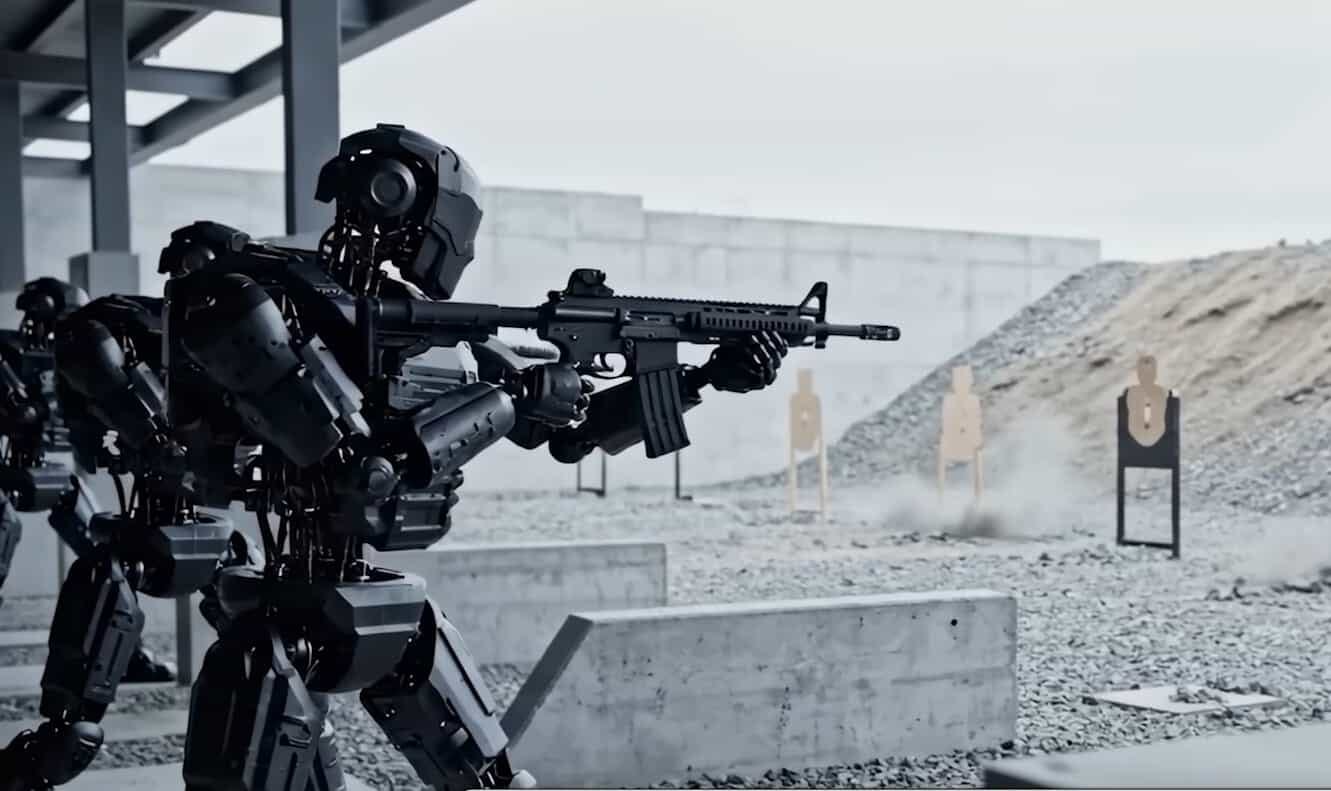
In February 2026, two Phantom MK-1 humanoid robots crossed into Ukraine and were sent toward the front line unarmed. Built by the American robotics firm Foundation and delivered with backing from the US government, the two units weren’t handed weapons or combat orders. They were assigned to reconnaissance and logistics, moving supplies and gathering information in the kind of hazardous ground no commander wants to spend a soldier’s life crossing unnecessarily. It was, by most accounts, the first time a humanoid robot had been placed in an active war zone at all, and the choice of role was not an accident. It followed a pattern Ukraine had already built its entire approach to unmanned systems around: put the machine in harm’s way first, and save the human for whatever the machine cannot yet do. A drone or a robot that gets destroyed is a line item. A soldier who gets killed is not, and Ukraine’s military has spent the last several years organizing its battlefield doctrine around that distinction as explicitly as any army in modern history.
That doctrine did not appear out of nowhere for the Phantom’s benefit. By the time the two humanoids arrived, Ukraine’s Ministry of Defense had already formalized a program called Drone Line, an integrated structure meant to detect and strike threats ten to fifteen kilometers out from Ukrainian positions using a combined web of aerial drones, sensors, and ground robots, well before an enemy soldier ever gets close enough to see a human defender at all. The country was already moving to field twenty five thousand unmanned ground vehicles in the first half of 2026 alone, more than double the total from the year before, and its drones had by then struck over a million enemy targets since the start of the year. The Phantom wasn’t introducing robots to this war. It was walking into a battlefield that had already been thoroughly automated, on both sides, for years, and asking whether a machine shaped like a person had anything left to add to an environment already saturated with machines shaped like everything else.
A War Already Hardened Around Cheap, Expendable Wings
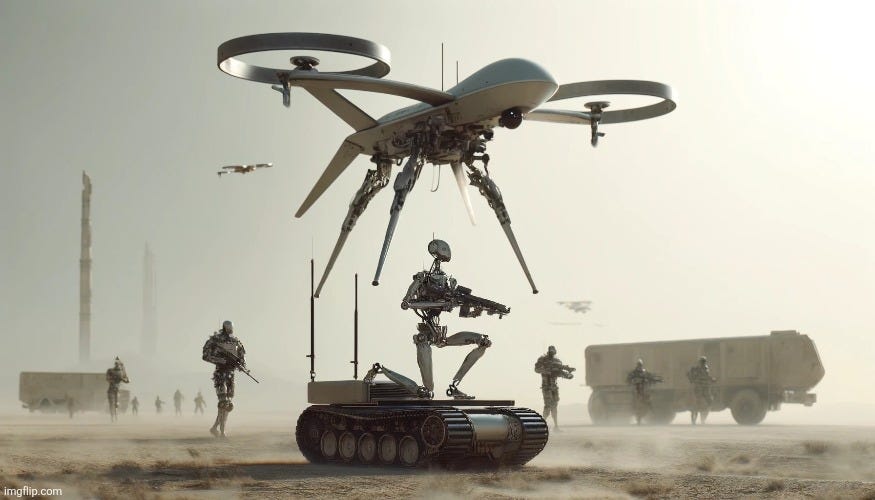
That’s the part worth sitting with before getting excited about humanoid soldiers specifically. The opponent these machines are walking into is not a slow-moving, theoretical threat. Small first-person-view attack drones costing a few hundred dollars apiece, and larger loitering munitions costing a few thousand, have already become the defining killer of this entire war, refined over years of constant combat use on both sides. These are weapons built explicitly to be thrown away, flown directly into a target, and replaced by the dozen the next morning. Against an enemy that expendable and that numerous, sending in a quarter-million-dollar humanoid robot is a genuinely different economic and tactical proposition than sending in a soldier, but it is not an automatic advantage. It only becomes one if the humanoid can actually survive, or at least usefully complicate, an environment built to kill exactly the kind of slow, exposed target a person or a simple vehicle presents.
Why Legs Might Beat Wheels
This is where the humanoid’s specific shape starts to matter, and it matters for reasons that have very little to do with looking impressive and quite a lot to do with the actual terrain this war is fought over. Ukraine’s front lines are trenches, shattered building interiors, rubble fields, forest tree lines, and irrigation ditches, none of which were built with a wheeled or tracked robot’s turning radius in mind. A wheeled ground vehicle is excellent on a road and rapidly becomes useless the moment the ground stops being flat and continuous, which describes most of the actual fighting positions along this front. A legged, bipedal machine can step over rubble, climb into a trench, pick its way through a collapsed doorway, or cross terrain a wheeled platform would simply get stuck against, which matters enormously in a war being fought street by street and field by field rather than along open highways.
That same shape offers something a wheeled robot structurally cannot: the ability to change its own silhouette. A person survives under drone observation partly by making themselves small, going prone, hugging a wall, folding into a doorway, and a humanoid robot is the only class of ground machine built with the joints to do the same thing convincingly. It can crouch behind low cover that would do nothing to hide a boxy wheeled chassis. It can drop flat and crawl the last stretch into a position rather than rolling up to it in full view. None of that is available to a machine that is, structurally, a box on wheels, no matter how well armored or cheaply built that box happens to be.
There’s a subtler advantage buried in how a humanoid moves, too. Drone-mounted targeting systems, and the humans watching their feeds, are trained to notice the mechanical, repetitive motion of wheels and treads at a glance. A walking gait, uneven, weight-shifting, occasionally stumbling over its own footing, reads differently, and in a war zone crowded with actual soldiers, a machine that moves at least somewhat like one is harder to instantly separate from the humans it’s operating alongside. That ambiguity buys time, and time is often the only thing standing between a target being identified and a target being destroyed.
None of this makes a humanoid robot immune to the threat it’s being sent to face, and it would be dishonest to pretend otherwise given what’s already been learned. The Phantom MK-1 itself has shown real, well-documented limits in its first trials: a payload capacity of only around twenty kilograms, no meaningful waterproofing, battery endurance nowhere near what sustained frontline operations would demand, and a tendency, common to every bipedal robot built so far, to simply lose its balance. Its own manufacturer has acknowledged the current version is nowhere close to the battlefield superhuman its marketing implies. Military officials reviewing the trials have flagged sharper dangers than clumsiness, too: a captured humanoid is a captured trove of sensitive data and algorithms, its control links are just as vulnerable to jamming and spoofing as any other robot’s, and an AI system making autonomous decisions under real combat stress carries a real risk of behaving in ways nobody trained it to.
A Pattern That Won’t Stay One-Sided
None of those limitations are likely to keep this idea contained to one side of one war for long. Foundation is already planning a Phantom MK-2 with roughly double the payload and, if the company’s own claims hold up, meaningfully improved durability, and it has stated ambitions to build tens of thousands of these units within the next two years, backed by tens of millions of dollars in fresh Pentagon contracts. A conflict that has spent years absorbing and refining every new unmanned technology thrown into it, on both sides, at speed, is exactly the environment in which a rival humanoid, Russian, Chinese, or otherwise, is likely to show up sooner rather than later, tested against the same saturated skies. Whatever the Phantom’s current limits, the underlying question it was sent to answer, whether a machine built in a person’s shape has something to offer a battlefield already thick with machines built in every other shape imaginable, is not going away, and neither side of this war looks likely to let the other be the only one asking it.