

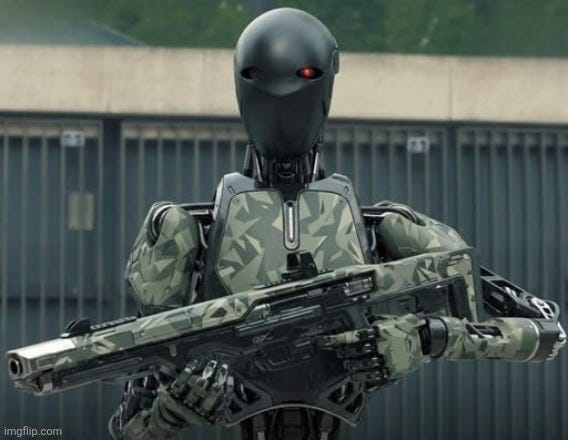
Foundation’s Phantom MK-1 has been called a humanoid soldier in nearly every headline since it was unveiled. The phrase is backwards, and the industry knows it.
The phrase “humanoid soldier” has quietly marched into the public lexicon, deployed by military press releases and companies wishing to appease their military customers. Dutifully repeated by mainstream news outlets. On the surface, the term feels natural. But beneath the grammar lies a deliberate effort to manage public perception—one that flips the linguistic reality of what these machines actually are. In truth, these entities are not soldiers who happen to be humanoid; they are humanoids built to act as soldiers. They are soldier humanoids.
To understand why this distinction matters, we must look at how the word “humanoid” has evolved. Originally an adjective meaning “resembling a human,” the word has undergone a linguistic shift known as nominalization. Much like “submersible boat” became “submersible,” “humanoid robot” has been shortened by the public and technologists alike into a standalone noun: humanoid.
Once “humanoid” functions as the core noun, standard English grammar dictates that any specialized role it performs should serve as a modifying descriptor placed in front of it. We see this everywhere else in technology and industry.
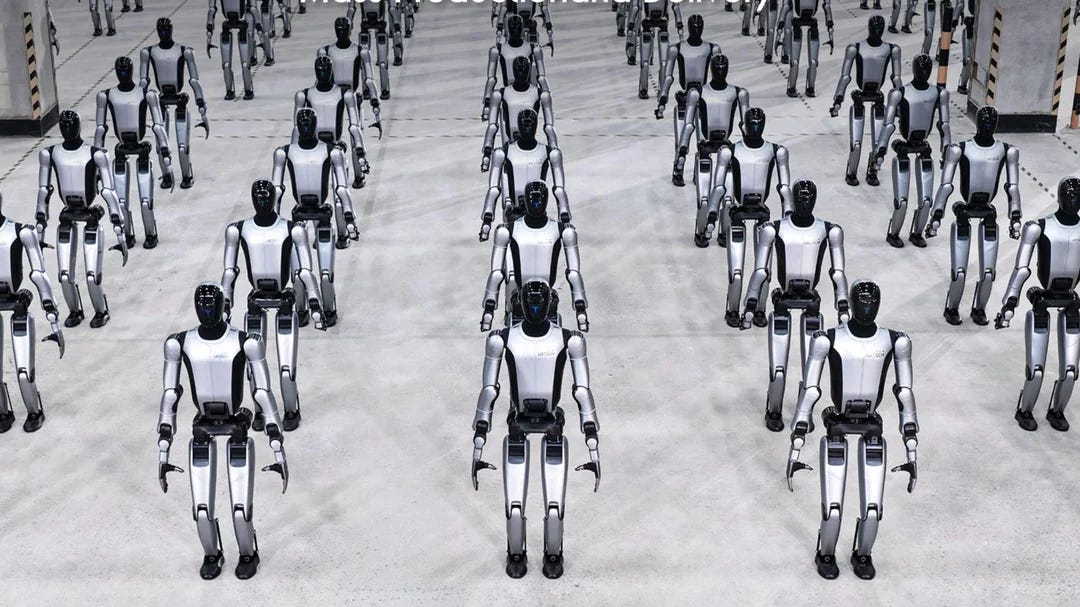
Look at how every other specialized humanoid gets named. Industrial humanoids not humanoid industrials. Service humanoids not humanoid servants. Domestic humanoids not humanoid domestics. Companion humanoids not humanoid companions. Research humanoids not humanoid researchers. In each case, humanoid is treated as the noun, the actual thing, and the job sits in front of it as a modifier. These are flexible, adaptable AI-driven robots capable of performing many different roles simply by changing the software running on broadly similar hardware. The same underlying platform can shift from an aerobics instructor to a cook to a shelf stocker with a different program rather than a different machine. Only one category consistently breaks this naming pattern, and it happens to be the one where the machine carries a weapon.
Putting soldier at the end of the phrase hands the machine a kind of borrowed legitimacy. A soldier is a person bound by duty, rules of engagement, a chain of command, three thousand years of cultural weight around courage and sacrifice. Calling a machine a humanoid soldier folds it into that tradition, whether or not the company doing the naming means it that way.
It also does something more specific: it papers over autonomy, and this is where the naming stops being merely a matter of taste. Every manufacturer insists these systems operate under human oversight, and in a demo, they probably do. Real combat doesn’t cooperate. Jammed signals, thick concrete, a tunnel with no line back to a human handler: in those conditions a machine either makes its own decisions in real time or it stops being useful. Democratic Representative Ted Lieu, who authored legislation restricting AI’s role in nuclear command, has pointed out plainly that nobody can fully explain how these large-language-model-driven systems arrive at a given decision, a genuinely uncomfortable thing to admit about a machine carrying a rifle.
That discomfort is not hypothetical or confined to one country’s domestic politics. There is no binding international law against autonomous weapons but there is real, sustained international pressure pointing directly at these machines. The United Nations has spent over a decade negotiating exactly this question through the Convention on Certain Conventional Weapons, with the Secretary-General repeatedly pushing for a binding treaty by the end of 2026. As recently as this month, those talks concluded once again without an agreement, blocked by a handful of major military powers, the United States, Russia, China, Israel, and India among them, who have resisted a preemptive ban. More than fifty states and an organized international campaign have pushed the other way, and the US Defense Department itself operates under a standing directive requiring what it calls appropriate levels of human judgment over the use of force. No law currently makes a fully autonomous soldier illegal. But a fast-moving, unresolved international norm is closing in on exactly that question, and a word like soldier, evoking a human chain of command and moral agency, is precisely the kind of language that lets a manufacturer look compliant with a standard that isn’t law yet but easily could become one.
The backwards ordering itself isn’t new. Robot soldier has used this same reversed structure, robot first, soldier last, for years, well before any company had a walking humanoid to sell. It’s worth noting this isn’t the general rule for military robot naming, though. Combat robot, military robot and war machine all put the modifier first and the mechanical body last, the same structure this article argues for. Soldier appears to be the specific word that flips the order, in both its robot and humanoid forms, which suggests the effect isn’t really about robots or humanoids at all. It’s about that one word specifically, and what borrowing it does for a machine’s public reception.
The more obvious word, android, was never really available to begin with. Google’s trademarked Android is itself named after a person, engineer Andy Rubin, nicknamed Android by his coworkers for his love of building robots, long before Google existed. By naming his mobile operating system in honour of his passion for androids he ironically destroyed any future where real androids will ever be actually called androids. Lucasfilm, separately, has owned a trademark on droid since 1977 and has defended it, once making Verizon pay to brand a phone with the name and once sending a cease-and-desist to a small ad-tech startup that had never touched Star Wars at all. Between the two of them, the plainest word for a lifelike robot became legally awkward to use for anything else, which may be as much a reason the industry landed on the clumsier phrase humanoid robot as any deliberate choice about tone.