

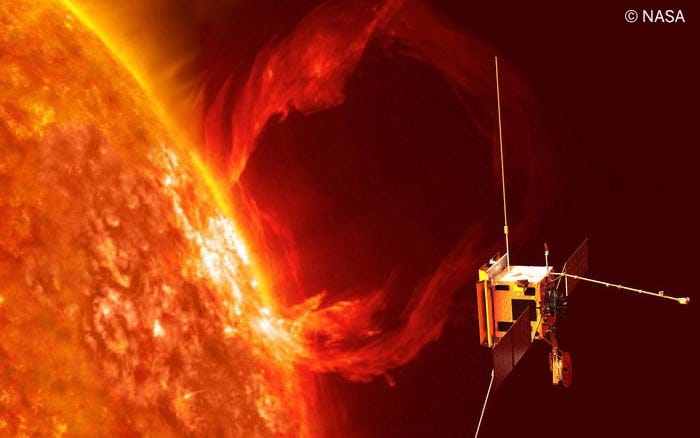
Far out in the blackness between Earth and the Sun, a spacecraft named Solar Orbiter has been doing something quietly extraordinary. It has been sailing through the endless river of particles that streams from our star, tasting the wind itself and reading the invisible magnetic rivers that shape it. In recent months it flew straight through one of the Sun’s strange magnetic kinks, known as a switchback, and brought back a chemical fingerprint that tells us where these mysterious folds are born.
The solar wind is not a gentle breeze. Every second the Sun hurls millions of tonnes of charged particles outward at hundreds of kilometres per second. This ceaseless outflow fills the entire solar system, washing over planets, shaping comet tails, and pressing against Earth’s own magnetic shield. The energy involved is almost beyond imagination. The power carried by the solar wind is greater than the total energy used by human civilisation, yet it is only a tiny fraction of the Sun’s total output. Our star burns with the force of a hundred billion nuclear bombs every second, and the wind is merely the quiet breath that escapes from that fury.
For years scientists have known that this wind is full of sudden twists. The magnetic field lines that ride along with the particles sometimes snap backward into sharp S-shaped folds before springing forward again. These switchbacks are common close to the Sun, yet their origin remained disputed. Some thought they formed far out in space as the wind became turbulent. Others believed they were born much closer to home, in the tangled magnetic fields just above the solar surface.
Solar Orbiter settled a crucial part of the argument by flying through one of the largest switchbacks yet sampled. Inside that magnetic fold it found a distinctive mix of highly charged oxygen and carbon particles. These particular ions can only be created in the intense heat of closed magnetic loops near the Sun’s surface. Their presence is like finding a unique stamp that could only have been applied in one place. The data point strongly to a process called interchange reconnection, in which open magnetic highways that stretch into space collide and reconnect with closed loops that arch back down to the Sun. The reconnection releases energy and flings an S-shaped kink outward into the wind.
This discovery matters because the solar wind is the medium through which the Sun talks to the planets. Understanding how it is launched and heated is essential if we are ever to predict space weather with real confidence. The same magnetic processes that create switchbacks also help drive the larger eruptions that can threaten satellites, power grids, and astronauts. By learning the language of the smaller, everyday features of the wind, we gain a clearer map of the bigger storms that occasionally rage across the solar system.
There is something humbling in the achievement. A machine built by human hands has travelled into the breath of a star, sampled its magnetic folds, and returned with knowledge that was previously locked inside the Sun itself. The solar wind continues to stream past us, immense and unending, carrying the faint echoes of magnetic dramas that began on the surface of a star 150 million kilometres away. Solar Orbiter has shown that we can reach into that river, read its secrets, and begin to understand the restless power that shapes our corner of the universe.