

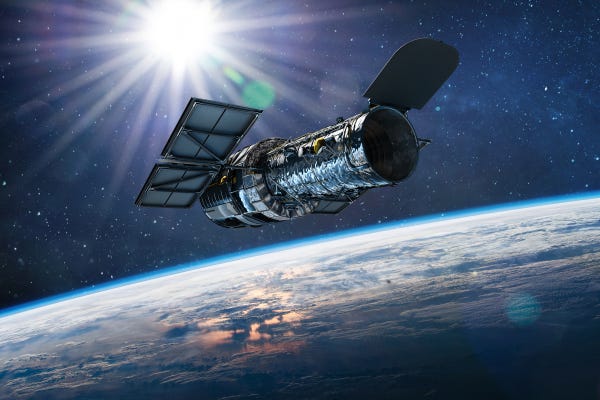
The Hubble Space Telescope has spent over three decades acting as humanity’s premier cosmic eye, transforming cold astronomical data into breathtaking art that captured the global imagination. From the pillars of creation to the deepest fields of ancient galaxies, Hubble did not just do science; it became a cultural icon.
Now, as the aging observatory slowly loses its battle with atmospheric drag, the space community faces a poignant dilemma. While standard procedure dictates letting this historic treasure burn up in a controlled reentry over the Pacific Ocean, an audacious alternative has captured the public fancy. What if SpaceX used its colossal Starship to stage the ultimate orbital salvage mission and bring Hubble home to the Smithsonian?
For Elon Musk, a mission of this magnitude offers far more than a massive public relations triumph. It represents a masterclass in operational testing. While Starship is currently slated to launch fleets of satellites and experimental orbital data centers, a retrieval mission introduces a completely different set of engineering challenges. Launching a heavy payload into orbit is a well-understood science, but capturing a delicate, school-bus-sized instrument that was never meant to be swallowed by a stainless-steel rocket is an entirely different beast.
Executing a safe rendezvous, grappling the telescope without shattering its brittle solar arrays, and securing it inside the payload bay would test Starship’s precision maneuvering and structural dynamics to their absolute absolute limits. It is exactly the kind of high-stakes, real-world stress test that a revolutionary aerospace company thrives on.
Of course, the logistics of turning Starship into a giant cosmic butterfly net are dizzying. Hubble has endured decades of extreme solar radiation and brutal thermal cycling, leaving its outer shell fragile and unpredictable. Bringing it back down through the fiery gauntlet of Earth’s atmosphere would subject the old telescope to gravitational stresses it was never designed to survive on the way down.
Engineers would need to design a bespoke, shock-absorbing cradle inside Starship just to keep the telescope from shaking itself to pieces during reentry. It is a financially irrational proposal that would cost millions of dollars for zero commercial return, but space exploration has always been driven by things far grander than a balance sheet.
Bringing Hubble back to Earth intact would be an unprecedented gift to history and inspiration. Depositing the actual telescope into the National Air and Space Museum would allow future generations to stand inches away from the machine that fundamentally rewrote our understanding of the universe. It would turn a piece of space debris into an enduring monument to human curiosity. While NASA may still opt for a quiet, watery retirement for its greatest telescope, the mere fact that we can now seriously debate a private salvage mission proves how rapidly the Starship era is expanding our horizons.