

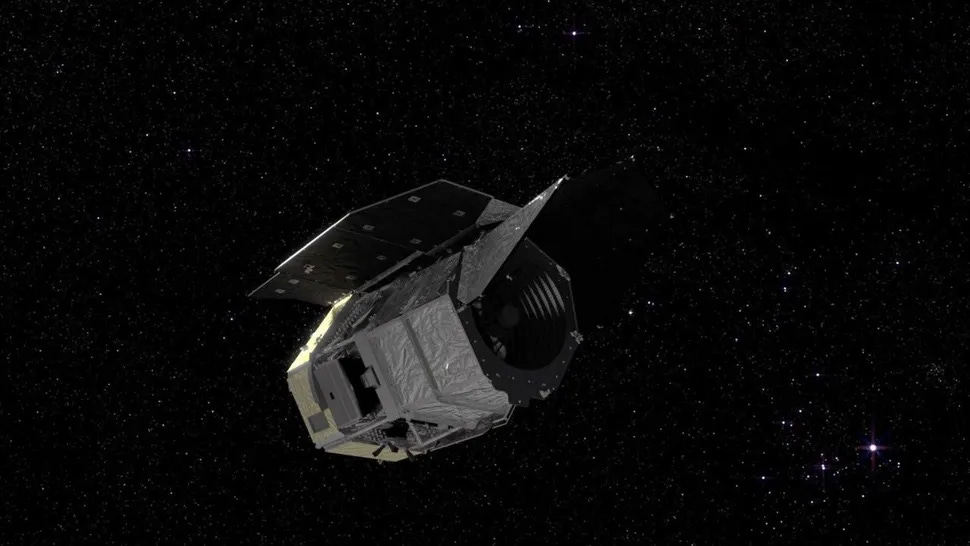
In the quiet precision of deep space, engineers have just given NASA’s Nancy Grace Roman Space Telescope a clearer view of the universe than anyone dared hope. By making an adjustment so small it borders on the invisible, they have improved the image quality of the observatory’s primary camera by nearly thirty percent beyond its already ambitious design targets.
The Roman Space Telescope, named for the astronomer who championed the idea of a space-based observatory decades ago, carries a 2.4-meter primary mirror—the same size as Hubble’s—but pairs it with a vast field of view capable of capturing areas of sky more than a hundred times larger in a single exposure. Its Wide Field Instrument, packed with eighteen detectors, is the workhorse that will map dark energy, chart the distribution of dark matter, and survey countless galaxies and exoplanets. For those surveys to deliver their full scientific power, every photon of light must be focused with extraordinary care.
After the telescope launched in late August 2026 and its instruments came online, the optical team began the delicate process of fine-tuning. The mirrors and other optical elements had already been aligned with remarkable accuracy on the ground. Only the smallest corrections were needed in space. The critical move involved the secondary mirror. Engineers shifted it by roughly one-sixteenth the diameter of a human hair—an almost imperceptible nudge in the height of the mirror above the primary. To grasp the scale, imagine the distance between the two mirrors stretched to the height of the Empire State Building. The adjustment would then equal less than the thickness of a single penny balanced on the very tip of the tower.
That microscopic change produced a dramatic result. Before the correction, the mission had set an image-quality requirement of about ninety nanometers of root-mean-square wavefront error—the measure of how far the optical system deviates from perfect focus. After the adjustment, measurements showed the Wide Field Instrument operating at just sixty-three nanometers. The improvement amounts to nearly thirty percent better performance than predicted. In practical terms, the light from distant galaxies and stars will arrive at the detectors with less distortion, yielding sharper, more precise images across the enormous surveys Roman is designed to conduct.
The same careful process also brought the Coronagraph Instrument into focus. Its initial images had been slightly soft, though less so than expected. A straightforward correction restored it to the high standard the team had planned. With both instruments now performing at or above expectations, the observatory is well positioned for the science that lies ahead.
Precision of this order does not happen by accident. Years of modeling, ground testing at NASA’s Goddard Space Flight Center, and meticulous work by contractors created an optical system so well prepared that only the tiniest in-space tweaks were required. The outcome is a telescope that will see the cosmos with greater clarity than its designers had budgeted for, turning an already powerful observatory into one capable of even finer measurements of the universe’s expansion, the hidden scaffolding of dark matter, and the faint signatures of distant worlds.
In the history of space telescopes, such moments of quiet refinement often prove decisive. Hubble’s early mirror flaw taught the cost of imperfect optics. Roman’s engineers have shown the opposite lesson: when everything is prepared with extreme care, a movement smaller than a fraction of a hair can unlock performance that exceeds every expectation. The sky that Roman will map will be sharper for it.