

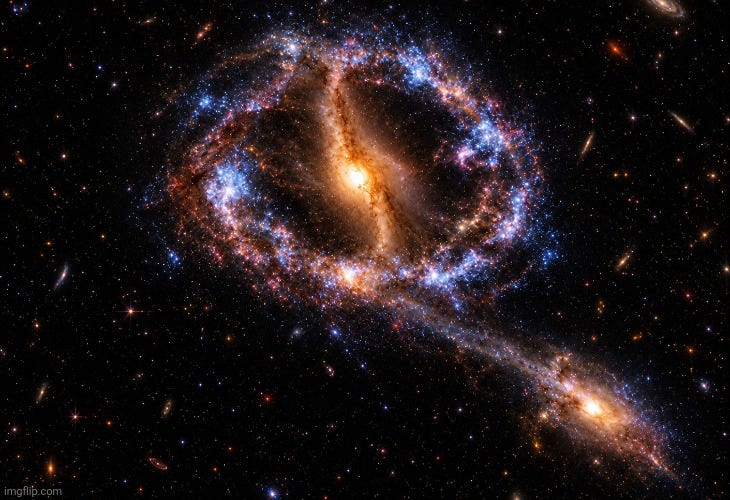
Artists rendering of the newly discovered ring galaxy GS18660
The rarest type of galaxy in the universe
An extraordinary discovery by the James Webb Space Telescope has given astronomers a rare glimpse of a galaxy shaped like a giant cosmic ring, potentially created when another galaxy punched straight through its centre.
Somewhere in the vastness of the early universe, a galaxy is glowing in a shape that seems almost too unusual to be real. Rather than displaying the familiar spiral arms or rounded appearance of most galaxies, it has a striking ring of young, newly formed stars surrounding its centre.
The galaxy, named GS18660, has recently attracted attention from astronomers using the James Webb Space Telescope (JWST). What makes the discovery particularly exciting is not just its unusual appearance, but its extraordinary age and the possible violent event responsible for creating it.
Astronomers are observing GS18660 as it appeared approximately 2.1 billion years after the Big Bang. Given that the universe is now around 13.8 billion years old, this means the light reaching us today began its journey when the universe was still relatively young.
It is also currently the most distant known ring galaxy.
A galaxy with a remarkable shape
Galaxies come in many shapes and sizes. Our own Milky Way is a spiral galaxy, with enormous arms of stars, gas and dust winding around a central region. Other galaxies are more rounded, while some have irregular shapes that make them look like enormous collections of cosmic debris.
Ring galaxies, however, are considerably more unusual.
As their name suggests, they feature a prominent circular arrangement of stars and gas, often surrounding a bright central region. From a distance, they can resemble enormous celestial bullseyes.
The newly studied GS18660 has a particularly interesting structure. Its ring contains numerous bright clumps where stars are actively forming, surrounding a brighter central region. Astronomers have also identified a smaller companion galaxy nearby, with evidence of material connecting the two systems.
It is this neighbouring galaxy that has prompted one of the most intriguing explanations for the ring’s formation.
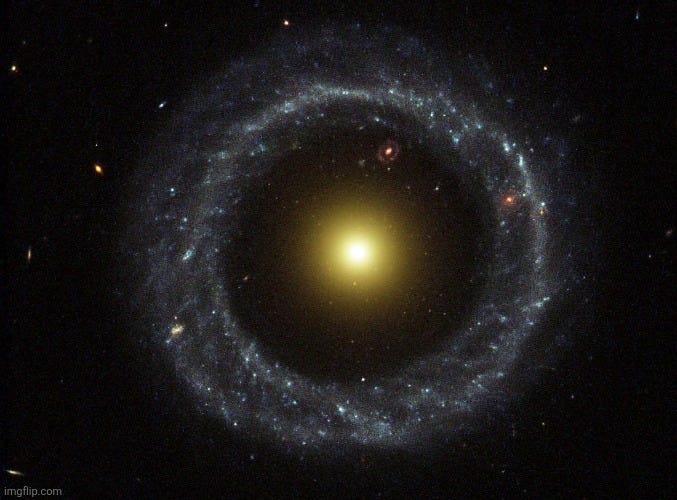
The ring galaxy Hoag’s Object is a perfect example of a well defined, symmetrical, circular island of stars
Did another galaxy punch straight through it?
One of the leading explanations for ring galaxies involves an extraordinary cosmic collision.
Imagine dropping a stone into a still pond. The impact creates ripples that spread outwards across the water.
Something broadly similar can happen when a smaller galaxy passes almost directly through a larger one.
Rather than the two galaxies simply smashing together and remaining merged, the smaller galaxy can pass through the larger galaxy’s central region. Its gravitational influence sends a powerful disturbance through the gas and stars, creating an expanding wave.
As that wave travels outwards, it compresses gas and dust, encouraging new stars to form along its path.
The result can be a spectacular ring of newly formed stars surrounding the galaxy’s centre.
In the case of GS18660, researchers have identified a smaller companion galaxy that appears to be moving away from the main galaxy. They have also detected gas structures connecting the two objects, along with unusual movements in the main galaxy’s gas.
Together, these observations support the possibility that the smaller galaxy recently passed through its larger neighbour, triggering the formation of the ring.
The researchers estimate that the possible encounter occurred around 17 to 42 million years ago. That is 17 to 42 million years before the epoch at which we are observing GS18660, not 17–42 million years before today. In astronomical terms, that is remarkably recent. We are viewing this fresh celestial object comparatively soon after its creation.
However, the collision explanation is not yet certain. The main galaxy also contains an elongated, bar-like structure, and astronomers cannot completely rule out the possibility that internal gravitational processes helped create the ring.
Further observations will be needed to settle the question.
Why ring galaxies are so rare
Although galaxies frequently interact and influence one another through gravity, producing a distinctive ring structure requires a rather particular set of circumstances.
For a classic collision-induced ring, the smaller galaxy needs to pass very close to the larger galaxy’s centre. A glancing encounter or a collision from a different angle is unlikely to produce the same spectacular result.
This helps explain why these galaxies are so uncommon.
In the nearby universe, collision-induced ring galaxies are estimated to account for approximately 0.01 per cent of galaxies. That is roughly one in every 10,000.
Some famous examples include the Cartwheel Galaxy, which displays a dramatic outer ring, and Hoag’s Object, whose almost perfectly circular ring surrounds a bright central core.
These galaxies are fascinating because they provide astronomers with an opportunity to study how gravitational encounters can dramatically reshape entire star systems.
What makes the James Webb discovery so important?
The James Webb Space Telescope has transformed our ability to study distant galaxies.
Its powerful infrared instruments allow astronomers to observe light from extremely distant objects that have travelled across the universe for billions of years.
In the case of GS18660, researchers were able to examine not only its overall shape but also the movements of gas within the galaxy, the distribution of young stars and the nearby companion.
The observations suggest that the ring is experiencing an intense period of star formation. In other words, the possible collision has not simply changed the galaxy’s appearance; it may also have triggered the birth of enormous numbers of new stars.
This is particularly interesting because astronomers are still trying to understand how galaxies developed their structures during the universe’s early history.
Finding a ring galaxy at such an early stage provides an unusual opportunity to investigate those processes.
It also raises an interesting question: were these dramatic galactic encounters more common in the early universe than we previously realised?
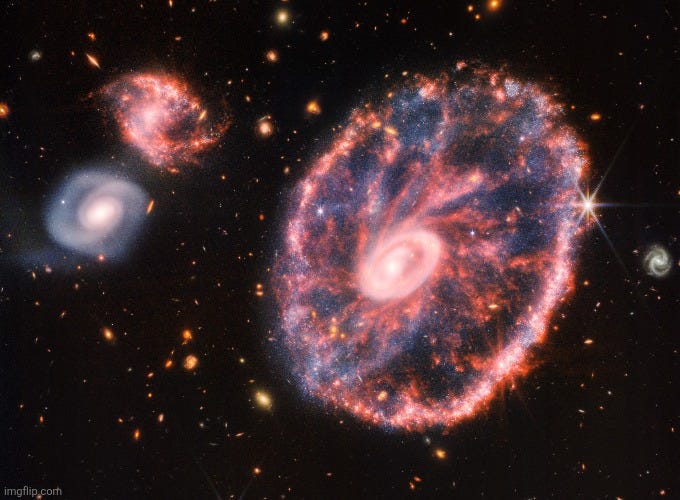
The cartwheel galaxy
A reminder of how dynamic the universe really is
When we look at photographs of galaxies, they can appear almost frozen in time. Beautiful spirals, glowing clouds and distant clusters seem like permanent fixtures in the cosmos.
But galaxies are anything but static.
They collide, merge, distort one another, trigger enormous bursts of star formation and gradually evolve over billions of years.
The discovery of GS18660 offers another glimpse into this extraordinary process. Whether its ring was created by a near-direct galactic collision or by more complicated internal gravitational forces, it represents a remarkable example of galaxy evolution in action.
And perhaps that is the most fascinating part of the discovery.
We are looking at a galaxy whose light began travelling towards Earth when the universe was only a fraction of its present age. Thanks to the James Webb Space Telescope, we can now examine the structure of that ancient galaxy in remarkable detail.
Somewhere, billions of light-years away, a cosmic bullseye is telling us a story about how galaxies are born, transformed and shaped by the immense gravitational forces of the universe.