

The water’s edge has always been a boundary of profound danger. For millions of years, across multiple geological eras, a low-slung, armored shape has patrolled this threshold, waiting for the rest of the world to get thirsty. Today, as global temperatures climb, that shape is moving. Unshackled from decades of heavy hunting, crocodiles are growing larger and expanding their territory. As the planet warms, these ancient predators are pushing further north and south, reclaiming ancestral waterways and fortifying their positions along the world’s shorelines. If humanity were to suddenly vanish from the face of the Earth, wiped out by a pandemic, nuclear war, an asteroid, or a supervolcano, the stage would be set for a quiet, prehistoric resurgence. The crocodiles would not need to conquer the land to rule it; they would simply wait at the water’s edge for the world to come to them.
The Ancient Rivals of Dinosaurs
To understand how crocodiles are poised to inherit a post-human world, one must look backward to a time when their ancestors ruled not just the swamps, but the entire planet. Long before the first true crocodile swam in a river, a grand group of reptiles called archosaurs dominated the landscape. This massive evolutionary tree eventually split into two competing factions. One branch, the bird-line archosaurs, gave rise to the dinosaurs. The other branch, known as the Pseudosuchians, belonged entirely to the crocodile lineage. During the Triassic period, more than two hundred million years ago, it was the crocodile-line archosaurs that held the crown on dry land. They were the dominant terrestrial predators and herbivores of their day, evolving into an astonishing array of shapes and sizes. There were so many fast, land-dwelling species during this golden age that paleontologists cannot even put an exact number on them. Some sprinted upright on two long legs like scaly, reptilian ostriches, acting as the primary cursorial hunters of their ecosystems, while others were armored plant-eaters that mirrored the rhinos of today.
The Shoreline Tyrants of the Cretaceous
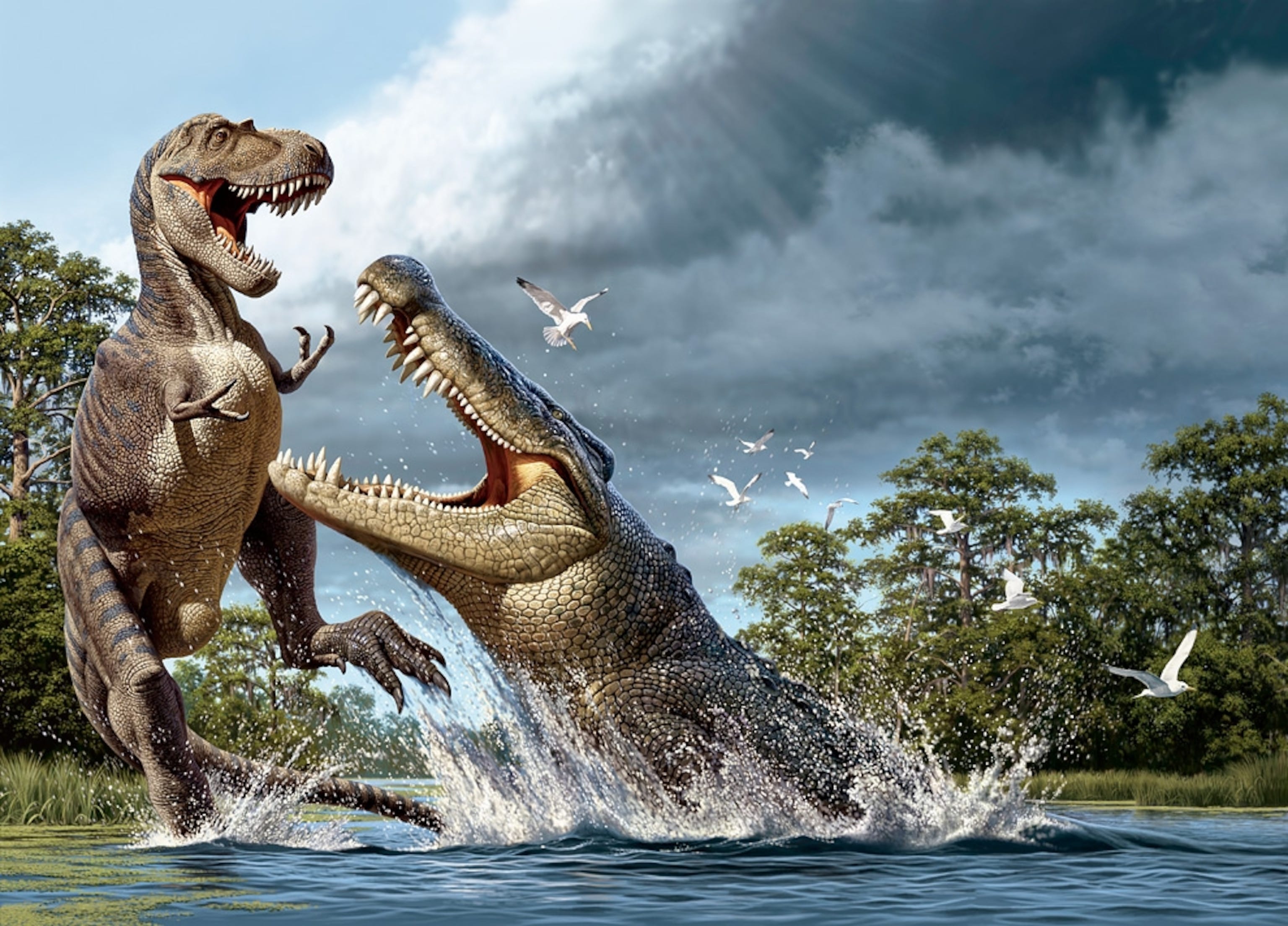
The absolute pinnacle of shoreline dominance by this lineage was demonstrated during the late Cretaceous period by a legendary giant named Deinosuchus. This prehistoric relative of modern alligators grew up to twelve metres long and weighed as much as eight tonnes, making it a true titan of the waterways. Deinosuchus ruled the coastal margins and estuaries of North America, living alongside some of the most famous dinosaurs in history. It did not need to roam the interior plains to hunt; its entire biology was geared toward ambushing giant prey at the riverbanks. Fossil evidence, including dinosaur bones marked with massive Deinosuchus tooth punctures, proves that this monster routinely hunted large, land-dwelling dinosaurs that came to the shore to drink. By commanding the water’s edge, Deinosuchus established itself as a supreme apex predator, proving that the ambush strategy could successfully subjugate even the largest terrestrial animals the world has ever seen.
When Crocodiles Grew to the Size of Buses
Deinosuchus was not an isolated anomaly; it was part of a recurring evolutionary trend where prehistoric crocodilians repeatedly ballooned to the size of modern city buses. Whenever the ancient Earth entered intense greenhouse phases, the combination of widespread tropical ecosystems and abundant food triggered gigantism in the waterways. In the Sahara of early Cretaceous Africa, an even larger crocodylomorph named Sarcosuchus—popularly known as “SuperCroc”—stretched up to twelve and a half metres long. Armed with a massive, bulbous snout and more than a hundred teeth, it patrolled wide river systems, competing directly with predatory dinosaurs. Millions of years later, during the Miocene epoch in South America, the giant caiman Purussaurus reached similar bus-sized proportions. Weighing over eight tonnes, Purussaurus required an immense daily intake of meat, which it secured by twisting and crushing giant prehistoric mammals and turtles. These eras prove that when global temperatures skyrocket, the environment naturally unlocks the genetic potential for crocodiles to grow into the most massive predators on the planet.
The Cold-Blooded Superpower
The great irony of evolutionary history is that the very trait we often view as primitive—being cold-blooded—is exactly what allowed the crocodile lineage to outlast its flashier, warm-blooded rivals. Maintaining a constant, high body temperature requires an immense amount of fuel. Warm-blooded animals must eat constantly just to stay alive. Cold-blooded creatures, or ectotherms, rely on the sun and their environment to regulate their heat. This means their metabolism runs at a fraction of the speed. When catastrophic events shook the planet, this low-energy lifestyle became a superpower. The broader evolutionary lineage of crocodiles has endured two of the most devastating mass extinctions in Earth’s history. They survived the End-Triassic extinction, which cleared the way for the rise of the dinosaurs, and they survived the legendary End-Cretaceous asteroid impact that wiped the dinosaurs out. When the sun was blocked by ash and the global food web collapsed, giant warm-blooded monsters starved to death within weeks. The crocodile ancestors simply slipped into the mud, lowered their heart rates, and waited months for the world to recover.
Anatomical Perfection and the Evolutionary Trap
The species alive today are the refined products of that brutal survival school. While their ancient ancestors were diverse land runners, the modern survivors are all heavily specialized for an aquatic lifestyle. Every inch of a modern crocodile is engineered for the water line. Their eyes and ears have muscular valves that seal hermetically when they submerge. A fleshy, waterproof valve at the back of their throat allows them to drown struggling prey without swallowing water. Even their hearts are uniquely sophisticated, capable of routing blood away from the lungs to let them stay underwater for hours. This hyper-specialization is a double-edged sword. Along with polar bears, they are among the only remaining giant predators that naturally view humans as viable prey, making them a formidable force at the water’s edge. Yet, this same anatomical perfection acts as an evolutionary trap.
Consider a continent like Australia. It is a vast, warming landmass with no other large, native land predators to compete with the massive Saltwater crocodiles that patrol its northern coastlines. If humans were to disappear tomorrow, leaving an open range filled with roaming kangaroos and feral cattle, one might imagine crocodiles gradually evolving back into the fleet-footed land runners of the Triassic. But evolution does not work that way. Because crocodiles reproduce slowly, taking well over a decade to reach maturity, their rate of genetic change is sluggish compared to fast-breeding mammals and birds. Furthermore, their bodies are locked into a physical constraint where their side-to-side walking motion compresses their lungs, making it impossible for them to breathe while running long distances. They would evolve far too slowly to reclaim the open plains before other animals filled those spaces.
Ruling the World via Checkpoints
But the brilliance of the crocodile’s design is that they do not need to take over the land. They have mastered a much better strategy: dominating the biological checkpoints of the world. No matter how fast a kangaroo can hop, how alert a deer is, or how dominant a mammalian predator becomes on the plains, every living creature must eventually drink water. By filling every major shoreline, river delta, mangrove swamp, and lake system, crocodiles effectively hold a monopoly over life itself. As global warming continues to expand the tropical and subtropical zones, these highly adaptable reptiles will push their boundaries into areas that are currently too cold, using the warming oceans as highways to colonize new continents. In a world free of human interference, the shorelines would become an inescapable trap. The planet would return to a familiar, ancient equilibrium. The land would belong to whatever animals managed to survive the next apocalypse, but the waterways would belong to the true masters of longevity. The reptiles would rule again, not by chasing down their kingdom, but by waiting patiently for it to step into the water.