

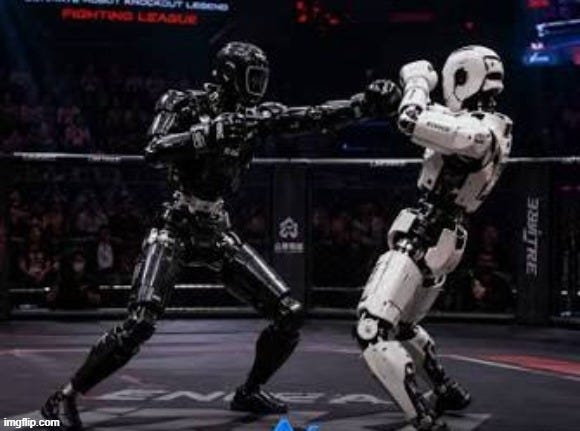
The roar of the crowd, the blinding flash of arena lights, and the unmistakable crunch of metal impacting metal have officially left the silver screen. In the iconic 2011 sci-fi film Real Steel, Hugh Jackman captured audiences as Charlie Kenton, a down-on-his-luck former prize fighter navigating a near-future world where eight-foot-tall, two-thousand-pound mechanical gladiators replaced human boxers. For over a decade, that cinematic universe stood alone—the definitive daydream of heavy-metal combat that never spawned a direct cinematic sequel or successfully launched its proposed television spin-offs. Today, however, that fiction is transforming into a high-stakes, real-world industry. In arenas across the globe, engineers and combat enthusiasts are tech-checking full-sized humanoid robots designed specifically to trade blows, proving that the era of true bipedal combat has finally arrived.
The transition from lab experiments to combat-ready gladiators has been driven by a rapid convergence of consumer robotics, advanced actuators, and motion-mimicking teleoperation. Rather than existing only on film reels, real-world fighting leagues have begun popping up internationally, turning what used to be a niche engineering hobby into a stadium-filling spectacle. Inside these newly formed organizations, teams of engineers and pilots operate real machines in real time, navigating the complex physics of bipedal balance while absorbing high-velocity impacts from opponents.
Global Combat Leagues Take Center Stage
The premier platform for this mechanical warfare is the Ultimate Robot Knock-out Legend, or URKL. Launched in Shenzhen, China, this full-contact competition features 32 teams fighting inside a professional octagon. Rather than relying on custom, home-built frames, the league standardises the violence by requiring competitors to use identical EngineAI T800 humanoid robots. With a massive 10-million-yuan prize pool on the line, the tournament relies purely on the software tuning, strategy, and reflexes of the individual engineering teams to declare a champion.
Simultaneously, prominent robotics manufacturers are creating localized platforms to demonstrate their technology under duress. The Chinese robotics maker Unitree hosted its own specialized boxing tournaments. In these events, the four-foot-tall Unitree G1 humanoid robots are outfitted with miniature boxing gloves and headgear. Operating within a miniature ring, these machines navigate autonomously or follow real-time voice commands to outmanoeuvre and out-strike their opponents.
International entertainment events are also exploring the commercial viability of remote-controlled matches. In Malaysia, the Shadow Combat League took over Pavilion Damansara Heights, hosting live events where human fighters piloted remote, motion-linked “shadow” robots to pit steel against steel in a classic tournament bracket. Meanwhile, the boundaries of human-versus-machine combat were tested in San Francisco by the startup REK. They constructed a imposing six-foot-tall, two-hundred-pound remote-controlled robot to step into a cage match against social media influencer Frankie LaPenna. The event generated massive public interest, though it quickly drew a cease-and-desist order from the California State Athletic Commission over safety regulations.
The Technology of the Teleoperated Ring
Operating a humanoid robot in a fistfight requires technology that bridges the gap between human instinct and machine execution, mirroring the “shadow function” popularized by Hugh Jackman’s character in the original film. Most top-tier combat robots utilize sophisticated teleoperation systems rather than fully autonomous artificial intelligence. Human pilots wear virtual reality headsets and motion-tracking suits, or hold specialized controllers, allowing the robot to mirror their exact physical movements. When the pilot throws a left hook, the robot executes the punch simultaneously. This setup turns the match into a true test of human strategy, fast reflexes, and mechanical endurance. The challenge for engineers is reducing latency down to milliseconds, ensuring that the robot can react to an oncoming punch before its metal structure is compromised.
Beyond the sheer entertainment value, the fighting ring serves as the ultimate proving ground for the robotics industry. In a standard laboratory setting, a humanoid robot is tested for mundane tasks like walking, lifting boxes, or navigating flat surfaces. The boxing ring, however, introduces unpredictable, violent forces. Surviving a multi-round bout requires breakthroughs in joint actuator strength, shock absorption, and real-time balance correction. When a heavy robot gets struck in the chest, its internal algorithms must instantly calculate how to shift its weight to prevent a catastrophic fall. The innovations born from these violent clashes directly accelerate the development of tougher, more agile robots for real-world industrial and rescue applications, proving that the future of combat sports is definitively made of steel.