

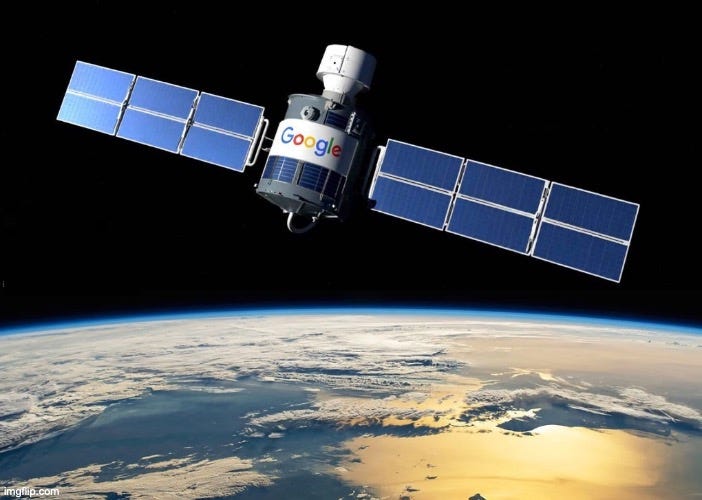
The global thirst for computing power has forced tech giants to look beyond the confines of our atmosphere, triggering an unprecedented off-world tech race. Leading this celestial charge is Google with the launch of its Project Suncatcher prototype satellite, named MVP, which marks the first major step toward establishing scalable machine learning infrastructure in low Earth orbit. Scheduled to ride aboard a SpaceX Falcon 9 rocket, the refrigerator-sized spacecraft is designed to test how cutting-edge processors withstand the unforgiving vacuum, intense vibrations, and hostile radiation of outer space. By shifting heavy workloads into orbit, engineers hope to harness uninterrupted solar energy that is up to eight times more productive than terrestrial solar arrays, effectively bypassing the energy grid locks and heavy water consumption plaguing ground-based infrastructure.
Google is far from alone in envisioning a future where data centers float among the stars. The off-world gold rush has attracted the industry’s heaviest hitters. Elon Musk has outlined plans for SpaceX to deploy up to one million orbital data centers, leveraging Nvidia chips to fuel its Starmind AI satellites. Not to be outdone, Jeff Bezos has positioned Blue Origin in the race, submitting regulatory filings for its own orbital network project, known as Project Sunrise. Other agile players like Starcloud are similarly advancing into low Earth orbit to secure their share of spatial real estate. The goal across all these platforms is uniform: to build a high-bandwidth, low-latency orbital cloud that beams pure data back to Earth rather than straining terrestrial resources.
Yet, transitioning artificial intelligence into orbit introduces monumental engineering obstacles, chief among them being radiation and thermal management. Terrestrial processors are highly susceptible to cosmic rays, which trigger destructive data errors known as bit flips or even permanent physical degradation. To counter this, companies must master rad hard compute architecture. This requires extensive testing of rad hard chips capable of filtering out cosmic interference while running complex machine learning algorithms. Achieving a reliable rad hard GPU configuration means redesigning delicate silicon pathways to ensure that high-performance hardware does not instantly fail under a deluge of solar particles. Google has actively subjected its Trillium Tensor Processing Units to rigorous simulated radiation environments on Earth to guarantee they can survive years of orbital bombardment without hard structural failure.
Beyond radiation, thermal regulation in a vacuum presents a critical bottleneck. On Earth, data centers rely on massive fans and millions of litres of water to cool power-hungry accelerators. In the vacuum of space, conventional airflow is non-existent, meaning heat cannot simply dissipate into the air. Power-intensive hardware generates vast amounts of thermal energy in highly concentrated areas, risking immediate system meltdown. To combat this, space-bound data centers must rely on a complex configuration of internal heat pipes integrated with specialized Space Radiators. These Space Radiators are critical for shedding excess heat into the void via infrared radiation, keeping the delicate components within a safe operational temperature threshold. As the first Suncatcher satellite prepares for its brief, initial trial runs, the data gathered will prove whether humanity can successfully merge rad hard compute infrastructure with advanced thermal engineering to shift the backbone of artificial intelligence into the cosmos.